

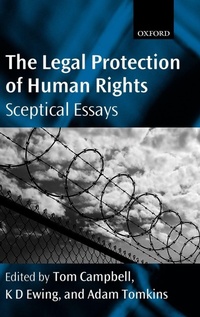
The Legal Protection of Human Rights
Sceptical Essays
1st Edition
Published on 24. February 2011
Book
Hardback
548 pages
978-0-19-960607-8 (ISBN)
Description
Reacting to the mixed record of the UK Human Rights Act 1998 and similar enactments concerned with the protection of human rights, this book explores ways of promoting human rights more effectively through political and democratic mechanisms. The book expresses ideological scepticism concerning the relative neglect of social and economic rights and institutional scepticism concerning the limitations of court-centred means for enhancing human rights goals in general. The contributors criticize the 'juridification' of human rights through transferring the prime responsibility for identifying human rights violations to courts and advocate the greater 'politicisation' of human rights responsibilities through such measures as enhanced parliamentary scrutiny of existing and proposed legislation. This group of twenty-four leading human rights scholars from around the world present a variety of perspectives on the disappointing human rights outcomes of recent institutional developments and consider the prospects of reviving the moral force and political implications of human rights values.
Thus, contributors recount the failures of the Human Rights Act with regard to counter-terrorism; chart how the 'dialogue' model reduces parliaments' capacities to hold governments to account for human rights violations; consider which institutions best protect fundamental rights; and reflect on how the idea of human rights could be 'rescued' in Britain today. In addition, the book considers the historical human rights failures of courts during the Cold War and in Northern Ireland, the diverse outcomes of human rights judicial review, and aspects of the human rights regimes in a variety of jurisdictions, including Finland, Sweden, New Zealand, Australia, Scotland, Canada, Europe, and the United States.
Thus, contributors recount the failures of the Human Rights Act with regard to counter-terrorism; chart how the 'dialogue' model reduces parliaments' capacities to hold governments to account for human rights violations; consider which institutions best protect fundamental rights; and reflect on how the idea of human rights could be 'rescued' in Britain today. In addition, the book considers the historical human rights failures of courts during the Cold War and in Northern Ireland, the diverse outcomes of human rights judicial review, and aspects of the human rights regimes in a variety of jurisdictions, including Finland, Sweden, New Zealand, Australia, Scotland, Canada, Europe, and the United States.
More details
Language
English
Place of publication
Oxford
United Kingdom
Target group
College/higher education
Public law and political science academics, law and politics students, and a broad range of those involved with or interested in human rights, constitutional issues, democracy and politics.
Dimensions
Height: 240 mm
Width: 161 mm
Thickness: 34 mm
Weight
980 gr
ISBN-13
978-0-19-960607-8 (9780199606078)
Copyright in bibliographic data and cover images is held by Nielsen Book Services Limited or by the publishers or by their respective licensors: all rights reserved.
Schweitzer Classification
Other editions
Additional editions
Book
02/2011
1st Edition
Oxford University Press
€111.42
Shipment within 15-20 days
Persons
Educated in Britain, Tom Campbell was Professor of Philosophy at the University of Stirling and Professor of Jurisprudence at the University of Glasgow before being appointed Professor of Law at the Australian National University and then Professorial Fellow in the Centre for Applied Philosophy and Public Ethics (CAPPE) at Charles Sturt University. He is the author and editor of several books, including Seven Theories of Human Society, Rights, and Justice.
Keith Ewing is Professor of Public Law at King's College London, and is one of the country's leading civil liberties lawyers. He is the author of Freedom under Thatcher: Civil Liberties in Modern Britain (with Conor Gearty) and his other books include Bonfire of the Liberties, The Right to Strike and The Struggle for Civil Liberties (also with Conor Gearty).
Adam Tomkins has held the John Millar Chair in Public Law at the University of Glasgow since 2003. Prior to that he taught at St Catherine's College, Oxford, and at King's College London. He is the author of a number of books, including the Clarendon Law Series title Public Law and also British Government and the Constitution (with Colin Turpin).
Keith Ewing is Professor of Public Law at King's College London, and is one of the country's leading civil liberties lawyers. He is the author of Freedom under Thatcher: Civil Liberties in Modern Britain (with Conor Gearty) and his other books include Bonfire of the Liberties, The Right to Strike and The Struggle for Civil Liberties (also with Conor Gearty).
Adam Tomkins has held the John Millar Chair in Public Law at the University of Glasgow since 2003. Prior to that he taught at St Catherine's College, Oxford, and at King's College London. He is the author of a number of books, including the Clarendon Law Series title Public Law and also British Government and the Constitution (with Colin Turpin).
Content
1. Introduction ; PART ONE: FAILURES OF JURIDIFICATION ; 2. Parliament, Human Rights and Counter-Terrorism ; 3. Governing Like Judges? ; 4. . Human Rights at the Interface of State and Sub-State: the Case of Scotland ; 5. Inter-Institutional "Rights Dialogue" under the New Zealand Bill of Rights Act ; 6. Statutory Bills of Rights: You Read Words In, You Read Words Out, You Take Parliament's Clear Intention and You Shake It All About ; 7. Constitutionalism, the Rule of Law and the Cold War ; 8. The Cold War, Civil Liberties and the House of Lords ; 9. Lessons from the Past? Northern Ireland, Terrorism Now and Then and the Human Rights Act ; 10. Constitutional Law Meets Comparative Politics: Socio-Economic Rights and Political Realities ; 11. Business Rights as Human Rights ; 12. Constitutionalizing Labour Rights in Europe ; 13. Freedom, Security and Justice in the European Court of Justice: The Ambiguous Nature of Judicial Review ; PART TWO: POLITICISING HUMAN RIGHTS ; 14. The Political Institutions of Rights Protection ; 15. Reclaiming the Political Protection of Rights: A Defence of Australian Party Politics ; 16. Messages from the Front Line: Parliamentarians' Perspectives on Rights Protection ; 17. Human Rights and the Global South: Transformation from Below? ; 18. Judicial Constitutional Review as a Last Resort: The Finnish Case ; 19. Preview the Swedish Way - The Law Council ; 20. Rights and the Citation of Foreign Law ; 21. Amateur Operatics: The Realization of Parliamentary Protection of Civil Liberties ; 22. Parliamentary Review with a Democratic Charter of Rights ; 23. Beyond the Human Rights Act