

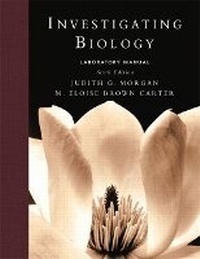
Investigating Biology Lab Manual
6th Edition
Published on 13. March 2008
Book
Spiral bound
816 pages
978-0-321-53660-0 (ISBN)
Description
With its distinctive investigative approach to learning, this best-selling laboratory manual encourages students to participate in the process of science and develop creative and critical reasoning skills. Students are invited to pose hypotheses, make predictions, conduct open-ended experiments, collect data, and apply the results to new problems. The Sixth Edition includes a new bioinformatics lab and new media references for students to explore relevant animations and exercises on the Campbell/Reece BIOLOGY textbook website. Select tables from the lab manual are provided in Excel (R) format on the website, allowing students to record data directly on their computer, process data using statistical tests, create graphs, and be prepared to communicate their results in class discussions or reports.
More details
Edition
6th edition
Language
English
Place of publication
United States
Publishing group
Pearson Education (US)
Target group
Professional and scholarly
Dimensions
Height: 229 mm
Width: 278 mm
Thickness: 30 mm
Weight
1736 gr
ISBN-13
978-0-321-53660-0 (9780321536600)
Copyright in bibliographic data and cover images is held by Nielsen Book Services Limited or by the publishers or by their respective licensors: all rights reserved.
Schweitzer Classification
Other editions
New editions
Jane B. Reece | Lisa A. Urry | Michael L. Cain
Investigating Biology Lab Manual
Book
01/2011
7th Edition
Pearson
€106.45
Article exhausted; check for reprint
Previous edition
Judith Giles Morgan | M. Eloise Brown Carter
Investigating Biology Lab Manual
Book
03/2005
5th Edition
Pearson Education (US)
€59.60
Article exhausted; check for reprint
Content
LABS
1. Scientific Investigation
2. Microscopes and Cells
3. Diffusion and Osmosis
4. Enzymes
5. Cellular Respiration and Fermentation
6. Photosynthesis
7. Mitosis and Meiosis
8. Mendelian Genetics I: Fast Plants
9. Mendelian Genetics II: Drosophila
10. Molecular Biology
11. Population Genetics I: The Hardy-Weinberg Theorem
12. Population Genetics II: Determining Genetic Variation
13. Bacteriology
14. Protists and Fungi
15. Plant Diversity I: Nonvascular Plants (Bryophytes) and Seedless Vascular Plants
16. Plant Diversity II: Seed Plants
17. Bioinformatics
18. Animal Diversity I: Porifera, Cnidaria, Platyhelminthes, Annelida, Mollusca
19. Animal Diversity II: Nematoda, Arthropoda, Echinodermata, Chordata
20. Plant Anatomy
21. Plant Growth
22. Vertebrate Anatomy I: The Skin and Digestive System
23. Vertebrate Anatomy II: The Circulatory and Respiratory Systems
24. Vertebrate Anatomy III: The Excretory, Reproductive, and Nervous Systems
25. Animal Development
26. Animal Behavior
27. Ecology I: Terrestrial Ecology
28. Ecology II: Computer Simulations of a Pond Ecosystem
1. Scientific Investigation
2. Microscopes and Cells
3. Diffusion and Osmosis
4. Enzymes
5. Cellular Respiration and Fermentation
6. Photosynthesis
7. Mitosis and Meiosis
8. Mendelian Genetics I: Fast Plants
9. Mendelian Genetics II: Drosophila
10. Molecular Biology
11. Population Genetics I: The Hardy-Weinberg Theorem
12. Population Genetics II: Determining Genetic Variation
13. Bacteriology
14. Protists and Fungi
15. Plant Diversity I: Nonvascular Plants (Bryophytes) and Seedless Vascular Plants
16. Plant Diversity II: Seed Plants
17. Bioinformatics
18. Animal Diversity I: Porifera, Cnidaria, Platyhelminthes, Annelida, Mollusca
19. Animal Diversity II: Nematoda, Arthropoda, Echinodermata, Chordata
20. Plant Anatomy
21. Plant Growth
22. Vertebrate Anatomy I: The Skin and Digestive System
23. Vertebrate Anatomy II: The Circulatory and Respiratory Systems
24. Vertebrate Anatomy III: The Excretory, Reproductive, and Nervous Systems
25. Animal Development
26. Animal Behavior
27. Ecology I: Terrestrial Ecology
28. Ecology II: Computer Simulations of a Pond Ecosystem