

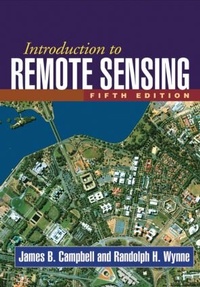
Introduction to Remote Sensing
Fifth Edition
5th Edition
Published on 17. August 2011
Book
Hardback
667 pages
978-1-60918-176-5 (ISBN)
Description
*The new edition of a leading text, fully revised to reflect a host of technological changes in the field.
*Includes cutting-edge material on the transition to digital aerial photography and change detection in multitemporal analysis.
*Modular structure allows instructors to match assignments to their own course plans with ease.
*Includes cutting-edge material on the transition to digital aerial photography and change detection in multitemporal analysis.
*Modular structure allows instructors to match assignments to their own course plans with ease.
Reviews / Votes
. - The text provides comprehensive coverage of principal topics and serves as a framework for organizing the vast amount of remote sensing information available on the web. Featuring case studies and review questions, the book's 21 chapters are carefully designed as independent units that instructors can select from as needed for their courses. --Lunar and Planetary Information Bulletin, 12/3/2011??An outstanding guide to the student as well as the experienced user of remotely sensed data. The book provides a clear overview and context for further study. The transition from analog to digital is explained extremely well without leaving out the fundamentals required to have a complete understanding. New topics including object-based image analysis are included. This book is an excellent text for an introductory remote sensing course. It is also an appropriate addition to anyone's library who is trying hard to keep up with all the changes in the remote sensing technology. This book has a valued place on my bookshelf.--Photogrammetric Engineering and Remote Sensing, 6/1/2012More details
Edition
5th edition
Language
English
Place of publication
New York
United States
Target group
College/higher education
Students in a variety of disciplines, including geography, forestry, hydrology, and planning; also of interest to professionals who utilize remotely sensed data. A core text for undergraduate- and graduate-level remote sensing courses.
Dimensions
Height: 254 mm
Width: 178 mm
Weight
1366 gr
ISBN-13
978-1-60918-176-5 (9781609181765)
Copyright in bibliographic data and cover images is held by Nielsen Book Services Limited or by the publishers or by their respective licensors: all rights reserved.
Schweitzer Classification
Persons
James B. Campbell, PhD, is Professor of Geography at Virginia Tech, where he teaches remote sensing, quantitative methods, and geomorphology. He has worked closely with students and faculty in related fields such as forestry, geology, agronomy, environmental sciences, and planning. Since 1997 he has served as Codirector of Virginia Tech's Center for Environmental Applications of Remote Sensing (CEARS). The author of numerous technical articles and several books, Dr. Campbell has received the Outstanding Service Award and the Fellow Award of the American Society for Photogrammetry and Remote Sensing. He is also a recipient of the Outstanding Service Medal awarded by the Remote Sensing Specialty Group of the Association of American Geographers. Dr. Campbell has been active in the AmericaView Program, including service as a principal investigator for the VirginiaView consortium and as a member and chair of the AmericaView Board of Directors. In 2020, he was the first recipient of the AmericaView Lifetime Achievement Award.
Randolph H. Wynne is Professor in the Forest Resources and Environmental Conservation Department at Virginia Tech. He also serves as Remote Sensing Team Leader for the Forest Productivity Cooperative, Associate Director of the Conservation Management Institute, and Codirector of CEARS. He teaches courses in forest photogrammetry and spatial data processing and remote sensing of natural resources. Dr. Wynne's research interests are in the applications of remote sensing to forestry, natural resource management, ecology, ecosystem services, and earth system science.
Randolph H. Wynne is Professor in the Forest Resources and Environmental Conservation Department at Virginia Tech. He also serves as Remote Sensing Team Leader for the Forest Productivity Cooperative, Associate Director of the Conservation Management Institute, and Codirector of CEARS. He teaches courses in forest photogrammetry and spatial data processing and remote sensing of natural resources. Dr. Wynne's research interests are in the applications of remote sensing to forestry, natural resource management, ecology, ecosystem services, and earth system science.
Content
Part I. Foundations
1. History and Scope of Remote Sensing 2. Electromagnetic Radiation Part II. Image Acquisition 3. Mapping Cameras 4. Digital Imagery 5. Image Interpretation 6. Land Observation Satellites 7. Active Microwave 8. Lidar 9. Thermal Imagery 10. Image Resolution Part III. Analysis 11. Preprocessing 12. Image Classification 13. Field Data 14. Accuracy Assessment 15. Hyperspectral Remote Sensing 16. Change Detection Part IV. Applications 17. Plant Sciences 18. Earth Sciences 19. Hydrospheric Sciences
20. Land Use and Land Cover
21. Global Remote Sensing Conclusion. The Outlook for the Field of Remote Sensing: The View from 2011
1. History and Scope of Remote Sensing 2. Electromagnetic Radiation Part II. Image Acquisition 3. Mapping Cameras 4. Digital Imagery 5. Image Interpretation 6. Land Observation Satellites 7. Active Microwave 8. Lidar 9. Thermal Imagery 10. Image Resolution Part III. Analysis 11. Preprocessing 12. Image Classification 13. Field Data 14. Accuracy Assessment 15. Hyperspectral Remote Sensing 16. Change Detection Part IV. Applications 17. Plant Sciences 18. Earth Sciences 19. Hydrospheric Sciences
20. Land Use and Land Cover
21. Global Remote Sensing Conclusion. The Outlook for the Field of Remote Sensing: The View from 2011