

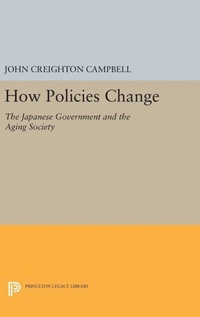
How Policies Change
The Japanese Government and the Aging Society
Will be published approx. on 19. April 2016
Book
Hardback
438 pages
978-0-691-63429-6 (ISBN)
Description
Japan is aging rapidly, and its government has been groping with the implications of this profound social change. In a pioneering study of postwar Japanese social policy, John Creighton Campbell traces the growth from small beginnings to an elaborate and expensive set of pension, health care, employment, and social service programs for older people. He argues that an understanding of policy change requires a careful disentangling of social problems and how they come to be perceived, the invention (or borrowing) of policy solutions, and conflicts and coalitions among bureaucrats, politicians, interest groups, and the general public. The key to policy change has often been the strategies adopted by policy entrepreneurs to generate or channel political energy. To make sense of all these complex processes, the author employs a new theory of four "modes" of decision-making--cognitive, political, artifactual, and inertial. Campbell refutes the claim that there is a unique "Japanese-style welfare state."
Despite the big differences in cultural values, social arrangements, economic priorities, and political control, government responsibility for the "aging-society problem" is broadly similar to that in advanced Western nations. However, Campbell's account of how Japan has taken on that responsibility raises new issues for our understanding of both Japanese politics and theories of the welfare state. Originally published in 1992. The Princeton Legacy Library uses the latest print-on-demand technology to again make available previously out-of-print books from the distinguished backlist of Princeton University Press. These editions preserve the original texts of these important books while presenting them in durable paperback and hardcover editions. The goal of the Princeton Legacy Library is to vastly increase access to the rich scholarly heritage found in the thousands of books published by Princeton University Press since its founding in 1905.
Despite the big differences in cultural values, social arrangements, economic priorities, and political control, government responsibility for the "aging-society problem" is broadly similar to that in advanced Western nations. However, Campbell's account of how Japan has taken on that responsibility raises new issues for our understanding of both Japanese politics and theories of the welfare state. Originally published in 1992. The Princeton Legacy Library uses the latest print-on-demand technology to again make available previously out-of-print books from the distinguished backlist of Princeton University Press. These editions preserve the original texts of these important books while presenting them in durable paperback and hardcover editions. The goal of the Princeton Legacy Library is to vastly increase access to the rich scholarly heritage found in the thousands of books published by Princeton University Press since its founding in 1905.
Reviews / Votes
Winner of the 1993 Ohira Memorial Prize, Masayoshi Memorial FoundationMore details
Series
Language
English
Place of publication
New Jersey
United States
Target group
College/higher education
Professional and scholarly
Product notice
Trade binding
Dimensions
Height: 240 mm
Width: 161 mm
Thickness: 28 mm
Weight
819 gr
ISBN-13
978-0-691-63429-6 (9780691634296)
Copyright in bibliographic data and cover images is held by Nielsen Book Services Limited or by the publishers or by their respective licensors: all rights reserved.
Schweitzer Classification
Other editions
Additional editions
E-Book
07/2014
1st Edition
Princeton University Press
€79.49
Available for download
Person
John Creighton Campbell
Content
*FrontMatter, pg. i*Contents, pg. vii*List of Tables and Figures, pg. ix*Preface, pg. xi*A Note on Conventions, pg. xvii*CHAPTER ONE. Introduction, pg. 3*CHAPTER TWO. A Theory of Policy Change, pg. 25*CHAPTER THREE. The Aging Problem: Establishing Pensions, pg. 52*CHAPTER FOUR. Policy in the 1960s: The Old-People Problem, pg. 105*CHAPTER FIVE. The Old-People Boom and Policy Change, pg. 139*CHAPTER SIX. Starting Small Programs, pg. 181*CHAPTER SEVEN. New Agenda: The Aging-Society Problem, pg. 210*CHAPTER EIGHT. Expanding Employment Policy, pg. 254*CHAPTER NINE. Health Care Reform, pg. 282*CHAPTER TEN. Reforming the Pension System, pg. 313*CHAPTER ELEVEN. Conclusions, pg. 352*APPENDIX. National Programs for the Aged, pg. 397*Index, pg. 405