

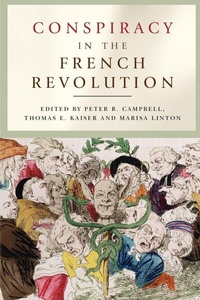
Conspiracy in the French Revolution
Published on 1. June 2010
Book
Paperback/Softback
240 pages
978-0-7190-8215-3 (ISBN)
Description
Conspiratorial views of events abound even in our modern, rational world. Often such theories serve to explain the inexplicable. Sometimes they are developed for motives of political expediency: it is simpler to see political opponents as conspirators and terrorists, putting them into one convenient basket, than to seek to understand and disentangle the complex motivations of opponents. So it is not surprising to see that just when the French Revolution was creating the modern political world, a constant obsession with conspiracies lay at the heart of the revolutionary conception of politics.
The book considers the nature and development of the conspiracy obsession from the end of the old regime to the Directory. Chapters focus on conspiracy and fears of conspiracy in the old regime; in the Constituent Assembly; by the king and Marie Antoinette; amongst the people of Paris; on attitudes towards the peasantry and conspiracy; on Jacobin politics of the Year II and the 'foreign plot'; on counter-revolutionary plots and imaginary plots; on Babeuf and the 'conspiracy of equals'; and finally on fear of conspiracy as an intellectual impasse in the revolutionary mentality. Inspired by recent debates, this book is a comprehensive survey of the nature of conspiracy in the French Revolution, with each chapter written by a leading historian on the question. Each chapter is an original contribution to the topic, written however to include the wider issues for the area concerned. There is an emphasis throughout on clarity and accessibility, making the volume suitable for a wide readership as well as undergraduates and advanced researchers -- .
The book considers the nature and development of the conspiracy obsession from the end of the old regime to the Directory. Chapters focus on conspiracy and fears of conspiracy in the old regime; in the Constituent Assembly; by the king and Marie Antoinette; amongst the people of Paris; on attitudes towards the peasantry and conspiracy; on Jacobin politics of the Year II and the 'foreign plot'; on counter-revolutionary plots and imaginary plots; on Babeuf and the 'conspiracy of equals'; and finally on fear of conspiracy as an intellectual impasse in the revolutionary mentality. Inspired by recent debates, this book is a comprehensive survey of the nature of conspiracy in the French Revolution, with each chapter written by a leading historian on the question. Each chapter is an original contribution to the topic, written however to include the wider issues for the area concerned. There is an emphasis throughout on clarity and accessibility, making the volume suitable for a wide readership as well as undergraduates and advanced researchers -- .
Reviews / Votes
This is an excellent volume - one of the most coherent and consistently engaging edited collections I have read in quite some time. A stimulating volume on a theme of immense importance to the historiography of the Revolution. Professor Darrin McMahon, The Ben Weider Professor of History, Florida State UniversityMore details
Language
English
Place of publication
Manchester
United Kingdom
Target group
College/higher education
Dimensions
Height: 234 mm
Width: 156 mm
Thickness: 14 mm
Weight
371 gr
ISBN-13
978-0-7190-8215-3 (9780719082153)
Copyright in bibliographic data and cover images is held by Nielsen Book Services Limited or by the publishers or by their respective licensors: all rights reserved.
Schweitzer Classification
Other editions
Additional editions
Peter R. Campbell | Thomas Kaiser | Marisa Linton
Conspiracy in the French Revolution
E-Book
06/2024
1st Edition
Manchester University Press
from
€44.99
Available for download
Persons
Peter R. Campbell is Senior Lecturer in History at Sussex University. Thomas E. Kaiser is Professor of History at the University of Arkansas at Little Rock. Marisa Linton is Senior Lecturer in History at Kingston Unversity -- .
Content
Introduction Conspiracy from the Old Regime to the Revolution: issues and debates. Thomas E. Kaiser, Marisa Linton, & Peter R. Campbell
1 Conspiracy at the end of the Old Regime Peter R. Campbell
2 Conspiracy thinking in the Constituent Assembly: Mirabeau and the exclusion of deputies from the ministry
Barry Shapiro
3 The real and imagined conspiracies of Louis XVI John Hardman
4 'Horrible plots and infernal treasons'; conspiracy and the urban landscape in the early Revolution David Andress
5Conspiracy in the village? French revolutionary authorities and the search for "subverters of public
opinion" in the rural south-west Jill Maciak Walshaw
6 'Do you believe that we're conspirators?' Conspiracies real and imagined in Jacobin politics,
1793-94 Marisa Linton
7 The emigres and conspiracy in the French Revolution, 1789-1799 Simon Burrows
8 Never was a plot so holy: Gracchus Babeuf and the end of the French Revolution Laura Mason
9 Conclusion. Catilina's revenge: conspiracy, revolution, and historical consciousness from the Old Regime to the Consulate Thomas E. Kaiser -- .
1 Conspiracy at the end of the Old Regime Peter R. Campbell
2 Conspiracy thinking in the Constituent Assembly: Mirabeau and the exclusion of deputies from the ministry
Barry Shapiro
3 The real and imagined conspiracies of Louis XVI John Hardman
4 'Horrible plots and infernal treasons'; conspiracy and the urban landscape in the early Revolution David Andress
5Conspiracy in the village? French revolutionary authorities and the search for "subverters of public
opinion" in the rural south-west Jill Maciak Walshaw
6 'Do you believe that we're conspirators?' Conspiracies real and imagined in Jacobin politics,
1793-94 Marisa Linton
7 The emigres and conspiracy in the French Revolution, 1789-1799 Simon Burrows
8 Never was a plot so holy: Gracchus Babeuf and the end of the French Revolution Laura Mason
9 Conclusion. Catilina's revenge: conspiracy, revolution, and historical consciousness from the Old Regime to the Consulate Thomas E. Kaiser -- .