

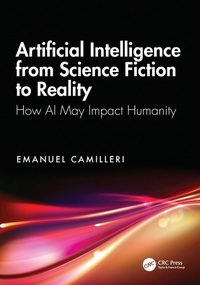
Artificial Intelligence from Science Fiction to Reality
How AI May Impact Humanity
1st Edition
Published on 2. November 2025
Book
Paperback/Softback
371 pages
978-1-041-10141-3 (ISBN)
Description
Artificial Intelligence from Science Fiction to Reality examines various aspects, starting with the evolution of human and artificial intelligence (AI). It places AI in its proper context and discusses non-technical aspects, such as philosophical and social issues. The major challenge leaders are likely to encounter is deciding what functions are to be entrusted to AI and how humanity can exercise control over them. The book also focuses on the hardware and software technology that support AI, and the essential cyber security systems that are required to address the evolving AI threat landscape. It examines centres for AI safety that are nonprofit research organisations, which focus on the mitigation of AI risks by proposing solutions against threat actors.
The book discusses the knowledge-based economy, particularly Enterprise AI, and examines the ethical and legal issues that emerge from the practical implications of AI. While most governments have endorsed voluntary ethical and moral charters, there is a reluctance to introduce binding legislative measures. This reluctance is based on the premise that specific laws might hinder AI innovation. Furthermore, detailed private and public sector case studies are presented that demonstrate how AI applications may be successfully implemented according to a practical framework.
A detailed discussion about the implications for human development is presented. The differences between key economic approaches, such as knowledge-based economy, digital economy and automated economy are examined, and how these will be impacted by AI in relation to job displacement, data privacy and security, and algorithmic bias. Finally, the book also examines the era beyond AI where organoid intelligence is emerging. It explores future human development where humans could be turned into cyborgs with hi-tech machine implants, re-growable limbs and nanotechnology that repair damaged tissue, rejuvenating human cells leading to immortality.
The book discusses the knowledge-based economy, particularly Enterprise AI, and examines the ethical and legal issues that emerge from the practical implications of AI. While most governments have endorsed voluntary ethical and moral charters, there is a reluctance to introduce binding legislative measures. This reluctance is based on the premise that specific laws might hinder AI innovation. Furthermore, detailed private and public sector case studies are presented that demonstrate how AI applications may be successfully implemented according to a practical framework.
A detailed discussion about the implications for human development is presented. The differences between key economic approaches, such as knowledge-based economy, digital economy and automated economy are examined, and how these will be impacted by AI in relation to job displacement, data privacy and security, and algorithmic bias. Finally, the book also examines the era beyond AI where organoid intelligence is emerging. It explores future human development where humans could be turned into cyborgs with hi-tech machine implants, re-growable limbs and nanotechnology that repair damaged tissue, rejuvenating human cells leading to immortality.
More details
Language
English
Place of publication
London
United Kingdom
Publishing group
Taylor & Francis Ltd
Target group
College/higher education
Professional and scholarly
Academic, General, Postgraduate, Professional Practice & Development, and Undergraduate Advanced
Illustrations
24 s/w Tabellen, 40 s/w Abbildungen, 40 s/w Zeichnungen
24 Tables, black and white; 40 Line drawings, black and white; 40 Illustrations, black and white
Dimensions
Height: 254 mm
Width: 178 mm
Thickness: 21 mm
Weight
742 gr
ISBN-13
978-1-041-10141-3 (9781041101413)
Copyright in bibliographic data and cover images is held by Nielsen Book Services Limited or by the publishers or by their respective licensors: all rights reserved.
Schweitzer Classification
Other editions
Additional editions
E-Book
11/2025
CRC Press
€69.99
Available for download
E-Book
11/2025
CRC Press
€69.99
Available for download
Book
11/2025
1st Edition
CRC Press
€206.40
Shipment within 15-20 days
Person
Emanuel Camilleri is a visiting senior lecturer at Malta University and has authored several books. His most recent publication is Key Performance Indicators: The Complete Guide to KPIs for Business Success (Routledge, 2024). He has occupied senior management posts in industrial engineering, finance and ICT sectors in Malta and Australia. Recently, he was appointed Chairman of the Planning Authority, Planning Board, Malta.
Content
Part I: The Evolution of Artificial Intelligence. Chapter 1 Artificial Intelligence: The Beginning. Chapter 2 Evolution of Human Intelligence. Chapter 3 Evolution of Artificial Intelligence (AI). Chapter 4 Contrasting Human and Artificial Intelligence. Part II: The Technology Supporting Artificial Intelligence. Chapter 5 Artificial Intelligence Hardware. Chapter 6 Artificial Intelligence Software. Chapter 7 Artificial Intelligence Security. Part III: The Practical Implications of Artificial Intelligence. Chapter 8 Knowledge-Based Economy and AI. Chapter 9 Enterprise AI. Chapter 10 Public Sector AI. Chapter 11 AI Ethical, Moral, and Legal Considerations. Part IV: The Future and Artificial Intelligence. Chapter 12 Future Developments of Artificial Intelligence. Chapter 13 AI and the Future of Humans.