

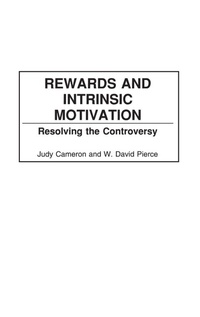
Rewards and Intrinsic Motivation
Resolving the Controversy
Published on 30. May 2002
Book
Hardback
264 pages
978-0-89789-677-1 (ISBN)
Description
Over the past 30 years, many social psychologists have been critical of the practice of using incentive systems in business, education, and other applied settings. The concern is that money, high grades, prizes, and even praise may be effective in getting people to perform an activity but performance and interest are maintained only so long as the reward keeps coming. Once the reward is withdrawn, the concern is that individuals will enjoy the activity less, perform at a lower level, and spend less time on the task. The claim is that rewards destroy people's intrinsic motivation. Widely accepted, this view has been enormously influential and has led many employers, teachers, and other practitioners to question the use of rewards and incentive systems in applied settings. Contrary to this view, the research by Cameron and Pierce indicates that rewards can be used effectively to enhance interest and performance.
The book centers around the debate on rewards and intrinsic motivation. Based on historical, narrative, and meta-analytic reviews, Cameron and Pierce show that, contrary to many claims, rewards do not have pervasive negative effects. Instead, the authors show that careful arrangement of rewards enhances motivation, performance, and interest. The overall goal of the book is to draw together over 30 years of research on rewards, motivation, and performance and to provide practitioners with techniques for designing effective incentive systems.
The book centers around the debate on rewards and intrinsic motivation. Based on historical, narrative, and meta-analytic reviews, Cameron and Pierce show that, contrary to many claims, rewards do not have pervasive negative effects. Instead, the authors show that careful arrangement of rewards enhances motivation, performance, and interest. The overall goal of the book is to draw together over 30 years of research on rewards, motivation, and performance and to provide practitioners with techniques for designing effective incentive systems.
More details
Language
English
Place of publication
United States
Publishing group
Bloomsbury Publishing Plc
Target group
College/higher education
Professional and scholarly
Dimensions
Height: 240 mm
Width: 161 mm
Thickness: 19 mm
Weight
564 gr
ISBN-13
978-0-89789-677-1 (9780897896771)
Copyright in bibliographic data and cover images is held by Nielsen Book Services Limited or by the publishers or by their respective licensors: all rights reserved.
Schweitzer Classification
Other editions
Additional editions
E-Book
05/2002
1st Edition
Praeger Publishers Inc
€82.49
Available for download
Persons
JUDY CAMERON is Associate Professor of educational psychology at the University of Alberta.
W. DAVID PIERCE is Professor in the Department of Sociology at the University of Alberta, Director of the Centre for Experimental Sociology, and retired Adjunct Professor in the Department of Neuroscience (Medicine).
W. DAVID PIERCE is Professor in the Department of Sociology at the University of Alberta, Director of the Centre for Experimental Sociology, and retired Adjunct Professor in the Department of Neuroscience (Medicine).
Content
Introduction An Introduction to the Rewards and Intrinsic Motivation Controversy Rewards and Intrinsic Motivation: A Look at the Early Studies How Rewards Got a Bad Reputation Why Rewards Don't Deserve a Bad Reputation Theoretical Disputes Over Rewards and Intrinsic Motivation Theoretical Perspectives of Rewards as Harmful Theoretical Perspectives of Rewards as Helpful The Empirical Evidence for the Impact of Rewards on Intrinsic Motivation An Overview of Rewards and Intrinsic Motivation Experiments A Critique of Meta-Analysis on the Effects of Rewards on Intrinsic Motivation A Meta-Analyses of the Effects of Rewards on Intrinsic Motivation Discussion and Implications of the Meta-Analytic Findings Rewards and Intrinsic Motivation: A Socio-Historical Perspective A Socio-Historical Analysis of the Rewards and Intrinsic Motivation Literature Practical Applications of Rewards The Effective Use of Rewards in Everyday Life Conclusion Resolving the Controversy Over Rewards and Intrinsic Motivation References Index