

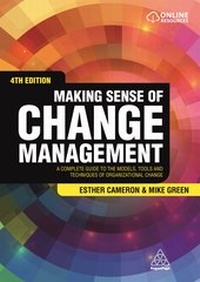
Making Sense of Change Management
A Complete Guide to the Models, Tools and Techniques of Organizational Change
4th Edition
Published on 3. March 2016
Book
Hardback
464 pages
978-0-7494-7913-8 (ISBN)
Description
The definitive, bestselling text in the field of change management, Making Sense of Change Management provides a thorough overview of the subject for both students and professionals. Along with explaining the theory of change management, it comprehensively covers the models, tools, and techniques of successful change management so organizations can adapt to tough market conditions and succeed by changing their strategies, structures, boundaries, mindsets, leadership behaviours and of course their expectations of the people who work within them.
This completely revised and updated 4th edition of Making Sense of Change Management includes more international examples and case studies, emerging new thinking and practice in the area of cultural change and a new chapter on the interrelationship with project management (PM) and change management. It also covers complexity models, agile approaches, and stakeholder management along with cultural sensitivity and what to do when cultures collide. Making Sense of Change Management remains essential reading for anyone who is currently part of, or leading, a change initiative.
Online supporting resources include lecture slides, making this an ideal textbook for MBA or graduate students focusing on leading or managing change.
This completely revised and updated 4th edition of Making Sense of Change Management includes more international examples and case studies, emerging new thinking and practice in the area of cultural change and a new chapter on the interrelationship with project management (PM) and change management. It also covers complexity models, agile approaches, and stakeholder management along with cultural sensitivity and what to do when cultures collide. Making Sense of Change Management remains essential reading for anyone who is currently part of, or leading, a change initiative.
Online supporting resources include lecture slides, making this an ideal textbook for MBA or graduate students focusing on leading or managing change.
Reviews / Votes
"Provides a clear and thorough tour of different models of change" * Richard Jolly, Adjunct Professor, London Business School * "This impressive book on change is an essential read for any professional manager who is serious about getting to grips with the important issues of making change happen." * Dr Jeff Watkins, Former MSc Course Director, University of Bristol * "There has long been a need for a readable, practical but theoretically underpinning book on change which recognizes a multiplicity of perspectives. I thoroughly recommend it." * Professor Colin Carnall, Cass Business School, City University *More details
Edition
Re-issue
Language
English
Place of publication
London
United Kingdom
Target group
College/higher education
Professional and scholarly
Edition type
Revised edition
Product notice
Cloth over boards
Dimensions
Height: 252 mm
Width: 176 mm
Thickness: 29 mm
Weight
969 gr
ISBN-13
978-0-7494-7913-8 (9780749479138)
Copyright in bibliographic data and cover images is held by Nielsen Book Services Limited or by the publishers or by their respective licensors: all rights reserved.
Schweitzer Classification
Other editions
New editions
Esther Cameron | Mike Green
Making Sense of Change Management
A Complete Guide to the Models, Tools and Techniques of Organizational Change
Book
11/2019
5th Edition
Kogan Page Ltd
€170.84
Article exhausted; check for reprint
Additional editions
Esther Cameron | Mike Green
Making Sense of Change Management
A Complete Guide to the Models, Tools and Techniques of Organizational Change
Book
03/2015
4th Edition
Kogan Page Ltd
€63.32
Article exhausted; check for reprint
Persons
Esther Cameron is a founding director of Integral Change Consulting Ltd, where she specializes in complex organizational change projects. Previously a lecturer in Change Management for the University of Bristol, she has been collecting and experimenting with approaches to change across different levels of organizational systems around the world for over 25 years.
Mike Green is director of Transitional Space Ltd, a company dedicated to individual, team and organizational development across the public, private and not-for-profit sectors. He is a Visiting Fellow at Henley Business School, where he tutors and coaches in leadership and change. Mike also delivers bespoke and accredited learning programmes in change management to senior managers and change agents around the world.
Mike Green is director of Transitional Space Ltd, a company dedicated to individual, team and organizational development across the public, private and not-for-profit sectors. He is a Visiting Fellow at Henley Business School, where he tutors and coaches in leadership and change. Mike also delivers bespoke and accredited learning programmes in change management to senior managers and change agents around the world.
Content
Chapter - 00: Introduction;
Section - ONE: The underpinning theory;
Chapter - 01: Individual change;
Chapter - 02: Team change;
Chapter - 03: Organizational change;
Chapter - 04: Leading change;
Chapter - 05: The change agent;
Section - TWO: The applications;
Chapter - 06: Restructuring;
Chapter - 07: Mergers and acquisitions;
Chapter - 08: Culture and change;
Chapter - 09: Project- and Programme-led change;
Section - THREE: Emerging inquiries;
Chapter - 10: Complex change;
Chapter - 11: Leading change in uncertain times
Section - ONE: The underpinning theory;
Chapter - 01: Individual change;
Chapter - 02: Team change;
Chapter - 03: Organizational change;
Chapter - 04: Leading change;
Chapter - 05: The change agent;
Section - TWO: The applications;
Chapter - 06: Restructuring;
Chapter - 07: Mergers and acquisitions;
Chapter - 08: Culture and change;
Chapter - 09: Project- and Programme-led change;
Section - THREE: Emerging inquiries;
Chapter - 10: Complex change;
Chapter - 11: Leading change in uncertain times