

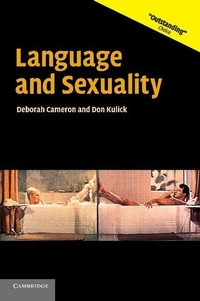
Language and Sexuality
Published on 6. March 2003
Book
Paperback/Softback
194 pages
978-0-521-00969-0 (ISBN)
Description
This lively and accessible textbook looks at how we talk about sex and why we talk about it the way we do. Drawing on a wide range of examples, from personal ads to phone sex, from sado-masochistic scenes to sexual assault trials, the book provides a clear introduction to the relationship between language and sexuality. Using a broad definition of 'sexuality', the book encompasses not only issues surrounding sexual orientation and identity but also questions about the discursive construction of sexuality and the verbal expression of erotic desire. Cameron and Kulick contextualize their findings within current research in linguistics, anthropology and psychology, and bring together relevant theoretical debates on sexuality, gender, identity, desire, meaning and power. Topical and entertaining, this much-needed textbook will be welcomed by students and researchers in sociolinguistics, linguistic anthropology and gender/sexuality studies, as well as anyone interested in the relationship between language and sex.
This lively and accessible textbook looks at how we talk about sex and why we talk about it the way we do. Drawing on a wide range of examples, from personal ads to phone sex, from sado-masochistic scenes to sexual assault trials, the book provides a clear introduction to the relationship between language and sexuality. Using a broad definition of 'sexuality', the book encompasses not only issues surrounding sexual orientation and identity but also questions about the discursive construction of sexuality and the verbal expression of erotic desire. Cameron and Kulick contextualize their findings within current research in linguistics, anthropology and psychology, and bring together relevant theoretical debates on sexuality, gender, identity, desire, meaning and power. Topical and entertaining, this much-needed textbook will be welcomed by students and researchers in sociolinguistics, linguistic anthropology and gender/sexuality studies, as well as anyone interested in the relationship between language and sex.
This lively and accessible textbook looks at how we talk about sex and why we talk about it the way we do. Drawing on a wide range of examples, from personal ads to phone sex, from sado-masochistic scenes to sexual assault trials, the book provides a clear introduction to the relationship between language and sexuality. Using a broad definition of 'sexuality', the book encompasses not only issues surrounding sexual orientation and identity but also questions about the discursive construction of sexuality and the verbal expression of erotic desire. Cameron and Kulick contextualize their findings within current research in linguistics, anthropology and psychology, and bring together relevant theoretical debates on sexuality, gender, identity, desire, meaning and power. Topical and entertaining, this much-needed textbook will be welcomed by students and researchers in sociolinguistics, linguistic anthropology and gender/sexuality studies, as well as anyone interested in the relationship between language and sex.
Reviews / Votes
'A much needed book ... the authors affirm the centrality of language to sexuality, and in doing so map out a vital field of study.' Jeffrey Weeks, author of Making Sexual History 'Using the right word at the right time is also the subject of Deborah Cameron's Language and Sexuality ... one of the questions she poses is 'how do you say no to a sadomasochist'?' Daily Telegraph 'This is a pioneering volume that integrates previous disparate studies and sets out a new and distinctive research agenda ... the result is a brave work, and its authors deserve high praise.' The Times Higher Education Supplement '... enviably lucid and erudite ... This is an important book for a wide range of readers because it addresses vital ideas with great clarity. One of the most impressive things about it, in addition to the intelligence of its arguments, is that the authors are always absolutely clear about how they are using terminology as well as about how such vocabulary has changed over time. Concrete examples and effective analogies enable the reader to follow their discussion, and the authors adroitly avoid the murkiness of language and thought that often characterizes such theoretical writing ... this is an extremely useful book for students, teachers and scholars in a range of disciplines as it allows readers to think about how language constructs categories which, without studies such as this, remain intellectual and political straightjackets.' Changing English '... this book is both valuable and unique ... The authors succeed in representing the range and diversity of research on language and should be congratulated in this respect ... the authors more than meet the objectives they set for themselves ... I found this a helpful and enjoyable read which I have no hesitation in recommending.' Feminism & Psychology 'In their brief and lively textbook Language and Sexuality, Cameron and Kulick synthesize some of this scholarship and put forth a new framework for future research in this dynamic field. ... this ambitious book takes an important first step in ushering in the next stage of language and sexuality research. ... they do not simply summarize previous work but offer fruitful research directions, most notably a greater consideration of desire. ... Both students and scholars will find this highly readable volume provocative and controversial, but never dull.' Journal of the Royal Anthropological Institute'A much needed book ... the authors affirm the centrality of language to sexuality, and in doing so map out a vital field of study.' Jeffrey Weeks, author of Making Sexual History
'Using the right word at the right time is also the subject of Deborah Cameron's Language and Sexuality ... one of the questions she poses is 'how do you say no to a sadomasochist'?' Daily Telegraph
'This is a pioneering volume that integrates previous disparate studies and sets out a new and distinctive research agenda ... the result is a brave work, and its authors deserve high praise.' The Times Higher Education Supplement
'... enviably lucid and erudite ... This is an important book for a wide range of readers because it addresses vital ideas with great clarity. One of the most impressive things about it, in addition to the intelligence of its arguments, is that the authors are always absolutely clear about how they are using terminology as well as about how such vocabulary has changed over time. Concrete examples and effective analogies enable the reader to follow their discussion, and the authors adroitly avoid the murkiness of language and thought that often characterizes such theoretical writing ... this is an extremely useful book for students, teachers and scholars in a range of disciplines as it allows readers to think about how language constructs categories which, without studies such as this, remain intellectual and political straightjackets.' Changing English
'... this book is both valuable and unique ... The authors succeed in representing the range and diversity of research on language and should be congratulated in this respect ... the authors more than meet the objectives they set for themselves ... I found this a helpful and enjoyable read which I have no hesitation in recommending.' Feminism & Psychology
'In their brief and lively textbook Language and Sexuality, Cameron and Kulick synthesize some of this scholarship and put forth a new framework for future research in this dynamic field. ... this ambitious book takes an important first step in ushering in the next stage of language and sexuality research. ... they do not simply summarize previous work but offer fruitful research directions, most notably a greater consideration of desire. ... Both students and scholars will find this highly readable volume provocative and controversial, but never dull.' Journal of the Royal Anthropological Institute
More details
Product info
Paperback
Language
English
Place of publication
Cambridge
United Kingdom
Target group
Professional and scholarly
College/higher education
Product notice
Paperback (trade)
Dimensions
Height: 229 mm
Width: 152 mm
Thickness: 11 mm
Weight
290 gr
ISBN-13
978-0-521-00969-0 (9780521009690)
Copyright in bibliographic data and cover images is held by Nielsen Book Services Limited or by the publishers or by their respective licensors: all rights reserved.
Schweitzer Classification
Other editions
Additional editions
Deborah Cameron | Don Kulick
Language and Sexuality
E-Book
02/2005
1st Edition
Cambridge University Press
€35.49
Available for download
Deborah Cameron | Don Kulick
Language and Sexuality
Book
03/2003
Cambridge University Press
€136.50
Shipment within 15-20 days
Persons
Deborah Cameron is Professor of Languages at the Institute of Education, University of London. She is the author of numerous books, including Feminism and Linguistic Theory (1992), Verbal Hygiene (1995) and Good to Talk (2000). Don Kulick is Professor of Anthropology at New York University. His published works include Language Shift and Cultural Reproduction (1992), Taboo (1995, with Margaret Willson) and Travesti (1998). He is co-editor of the journals Ethnos and GLQ.
Deborah Cameron is Professor of Languages at the Institute of Education, University of London. She is the author of numerous books, including Feminism and Linguistic Theory (1992), Verbal Hygiene (1995) and Good to Talk (2000). Don Kulick is Professor of Anthropology at New York University. His published works include Language Shift and Cultural Reproduction (1992), Taboo (1995, with Margaret Willson) and Travesti (1998). He is co-editor of the journals Ethnos and GLQ.
Deborah Cameron is Professor of Languages at the Institute of Education, University of London. She is the author of numerous books, including Feminism and Linguistic Theory (1992), Verbal Hygiene (1995) and Good to Talk (2000). Don Kulick is Professor of Anthropology at New York University. His published works include Language Shift and Cultural Reproduction (1992), Taboo (1995, with Margaret Willson) and Travesti (1998). He is co-editor of the journals Ethnos and GLQ.
Content
Preface; 1. Making connection; 2. Talking sex and thinking sex: the linguistic and discursive construction of sexuality; 3. What has gender got to do with sex? Language, heterosexuality and heteronormativity; 4. Sexuality as identity: gay and lesbian language; 5. Looking beyond identity: language and desire; 6. Language and sexuality: theory, research and politics.