

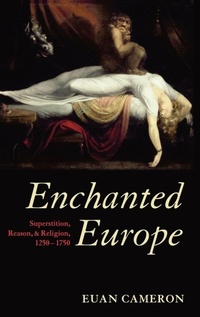
Enchanted Europe
Superstition, Reason, and Religion 1250-1750
1st Edition
Published on 18. March 2010
Book
Hardback
488 pages
978-0-19-925782-9 (ISBN)
Description
Since the dawn of history people have used charms and spells to try to control their environment, and forms of divination to try to foresee the otherwise unpredictable chances of life. Many of these techniques were called 'superstitious' by educated elites.
For centuries religious believers used 'superstition' as a term of abuse to denounce another religion that they thought inferior, or to criticize their fellow-believers for practising their faith 'wrongly'. From the Middle Ages to the Enlightenment, scholars argued over what 'superstition' was, how to identify it, and how to persuade people to avoid it. Learned believers in demons and witchcraft, in their treatises and sermons, tried to make 'rational' sense of popular superstitions by blaming them on the deceptive tricks of seductive demons.
Every major movement in Christian thought, from rival schools of medieval theology through to the Renaissance, the Reformation, and the Enlightenment, added new twists to the debates over superstition. Protestants saw Catholics as superstitious, and vice versa. Enlightened philosophers mocked traditional cults as superstitions. Eventually, the learned lost their worry about popular belief, and turned instead to chronicling and preserving 'superstitious' customs as folklore and ethnic heritage.
Enchanted Europe offers the first comprehensive, integrated account of western Europe's long, complex dialogue with its own folklore and popular beliefs. Drawing on many little-known and rarely used texts, Euan Cameron constructs a compelling narrative of the rise, diversification, and decline of popular 'superstition' in the European mind.
For centuries religious believers used 'superstition' as a term of abuse to denounce another religion that they thought inferior, or to criticize their fellow-believers for practising their faith 'wrongly'. From the Middle Ages to the Enlightenment, scholars argued over what 'superstition' was, how to identify it, and how to persuade people to avoid it. Learned believers in demons and witchcraft, in their treatises and sermons, tried to make 'rational' sense of popular superstitions by blaming them on the deceptive tricks of seductive demons.
Every major movement in Christian thought, from rival schools of medieval theology through to the Renaissance, the Reformation, and the Enlightenment, added new twists to the debates over superstition. Protestants saw Catholics as superstitious, and vice versa. Enlightened philosophers mocked traditional cults as superstitions. Eventually, the learned lost their worry about popular belief, and turned instead to chronicling and preserving 'superstitious' customs as folklore and ethnic heritage.
Enchanted Europe offers the first comprehensive, integrated account of western Europe's long, complex dialogue with its own folklore and popular beliefs. Drawing on many little-known and rarely used texts, Euan Cameron constructs a compelling narrative of the rise, diversification, and decline of popular 'superstition' in the European mind.
Reviews / Votes
Fresh and exciting...a significant contribution to the history of ideas. * Ronald Hutton, Financial Times * Enchanted Europe gives the history of superstition this strong, if necessarily teleological shape, together with some much needed rigour. It also shifts the history of Europe's intellectual disenchantment from its usual focus on the fortunes of magic and witchcraft... these are considerable achievements. * Stuart Clark, Times Literary Supplement * Thorough and enthralling * Steve Craggs, Northern Echo * Enchanted Europe is a major contribution to the religious and intellectual history of late medieval and early modern Europe...a striking intervention in a debate that has lately been in danger of stagnation. Euan Cameron has written an immensely learned book that greatly advances our understanding of the mental universe of the early modern intelligentsia and seems set to stimulate ongoing discussion of its challenging subject. * Alexandra Walsham, Journal of Ecclesiastical History *More details
Language
English
Place of publication
Oxford
United Kingdom
Target group
This book will appeal to everyone interested in the history of superstitious belief and popular religion
Dimensions
Height: 240 mm
Width: 161 mm
Thickness: 31 mm
Weight
889 gr
ISBN-13
978-0-19-925782-9 (9780199257829)
Copyright in bibliographic data and cover images is held by Nielsen Book Services Limited or by the publishers or by their respective licensors: all rights reserved.
Schweitzer Classification
Other editions
Additional editions
Book
10/2011
1st Edition
Oxford University Press
€47.30
Shipment within 15-20 days
E-Book
03/2010
1st Edition
Oxford University Press
€134.07
Available for download
E-Book
03/2010
OUP eBook
€16.99
Available for download
Person
Euan Cameron received his B.A. and D.Phil. degrees from Oxford University. He was a Fellow of All Souls College, Oxford from 1979 to 1986, and a member of the Department of History of the University of Newcastle upon Tyne from 1985 to 2002. Since 2002 he has been Henry Luce III Professor of Reformation Church History at Union Theological Seminary in New York City, where he has also served as Vice-President for Academic Affairs and Dean of the Faculty. He is a member of the departments of Religion and History at Columbia University.
Content
PART 1: DISCERNING AND CONTROLLING INVISIBLE FORCES: THE IMAGE OF 'SUPERSTITION' IN THE LITERATURE; PART 2: THE LEARNED RESPONSE TO SUPERSTITIONS IN THE MIDDLE AGES: ANGELS AND DEMONS; PART 3: SUPERSTITIONS IN CONTROVERSY: RENAISSANCE AND REFORMATIONS; PART 4: THE COSMOS CHANGES SHAPE: SUPERSTITION IS RE-DEFINED