

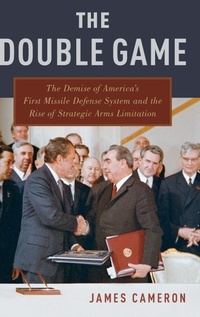
The Double Game
The Demise of America's First Missile Defense System and the Rise of Strategic Arms Limitation
Published on 7. December 2017
Book
Hardback
248 pages
978-0-19-045992-5 (ISBN)
Description
How did the United States move from position of nuclear superiority over the Soviet Union at the beginning of the 1960s to a period of arms control based on nuclear parity the doctrine of mutual assured destruction in 1972? Drawing on declassified records of conversations between three presidents and their most trusted advisors, this book provides a new and fascinating answer to this question. John F. Kennedy, Lyndon Johnson, and Richard Nixon struggled to reconcile their own personal convictions on the nuclear arms race with the very different views of the public and Congress. In doing so they engaged in a double game, hiding their true beliefs behind a facade of strategic language while grappling in private with the complex realities of the nuclear age.
The book shows how Kennedy and Johnson consistently worried about the domestic political costs of their actions, pushing ahead with an anti-ballistic missile (ABM) system for the United States for fear of the domestic political consequences of scrapping both the system and the doctrine of strategic superiority on which it was based. By contrast, the abrupt change in U.S. public and congressional opinion in 1969 forced Nixon to give up America's first ABM and the U.S. lead in offensive ballistic missiles through agreements with the Soviet Union, despite his conviction that the U.S. needed a nuclear edge over the USSR to maintain the security of the West.
By placing this dynamic at the center of the story, the book provides a completely new overarching interpretation of this pivotal period in the development of U.S. nuclear policy.
The book shows how Kennedy and Johnson consistently worried about the domestic political costs of their actions, pushing ahead with an anti-ballistic missile (ABM) system for the United States for fear of the domestic political consequences of scrapping both the system and the doctrine of strategic superiority on which it was based. By contrast, the abrupt change in U.S. public and congressional opinion in 1969 forced Nixon to give up America's first ABM and the U.S. lead in offensive ballistic missiles through agreements with the Soviet Union, despite his conviction that the U.S. needed a nuclear edge over the USSR to maintain the security of the West.
By placing this dynamic at the center of the story, the book provides a completely new overarching interpretation of this pivotal period in the development of U.S. nuclear policy.
Reviews / Votes
For some 50 years, Washington and Moscow have been involved in a bilateral process of arms limitation and reduction that appears to be coming to an end... It is natural to return to the beginning of this process to try to understand how this system of restraints emerged. As James Cameron argues in The Double Game, we've been wrong about what motivated strategic arms limitation all along. * Jeffrey Lewis, Survival * [P]rovides an extremely well-documented analysis of the evolution of US policy regarding strategic missile defense within the context of overall nuclear arms policy from the Kennedy through the Nixon administrations... Recommended * CHOICE * This book is equally balanced between an analysis of nuclear weapons buildup, BMD, and strategic calculation in relation to domestic and bureaucratic politics. Its relevance is clear today as a revisionist Russia physically reasserts itself in eastern Europe, China's influence gains momentum, and North Korea and Iran strive for nuclear weapon latency. This book is timely and important for policymakers, political scientists, historians, and analysts of policy. * Rusty Allison, H-War *More details
Language
English
Place of publication
New York
United States
Target group
Professional and scholarly
Dimensions
Height: 240 mm
Width: 161 mm
Thickness: 18 mm
Weight
543 gr
ISBN-13
978-0-19-045992-5 (9780190459925)
Copyright in bibliographic data and cover images is held by Nielsen Book Services Limited or by the publishers or by their respective licensors: all rights reserved.
Schweitzer Classification
Other editions
Additional editions
James Cameron
The Double Game
The Demise of America's First Missile Defense System and the Rise of Strategic Arms Limitation
E-Book
10/2017
OUP eBook
€47.99
Available for download
James Cameron
The Double Game
The Demise of America's First Missile Defense System and the Rise of Strategic Arms Limitation
E-Book
10/2017
OUP eBook
€37.49
Available for download
Person
James Cameron is Assistant Professor in International Relations at Fundacao Getulio Vargas (Brazil).
Content
Acknowledgments
Abbreviations
Introduction
Ch. 1. Rational Superiority, Crises, and Arms Control, 1961-1963
Ch. 2. The Great Society and the Politics of Assured Destruction, 1963-1966
Ch. 3. First Steps toward SALT, 1966-1969
Ch. 4. Collapse of the Consensus and the Struggle for Coherence, 1969-1970
Ch. 5. Reconciliation with Necessity and the Race to the Summit, 1971-1972
Conclusion: The Double Game
Notes
Sources
Index
Abbreviations
Introduction
Ch. 1. Rational Superiority, Crises, and Arms Control, 1961-1963
Ch. 2. The Great Society and the Politics of Assured Destruction, 1963-1966
Ch. 3. First Steps toward SALT, 1966-1969
Ch. 4. Collapse of the Consensus and the Struggle for Coherence, 1969-1970
Ch. 5. Reconciliation with Necessity and the Race to the Summit, 1971-1972
Conclusion: The Double Game
Notes
Sources
Index