

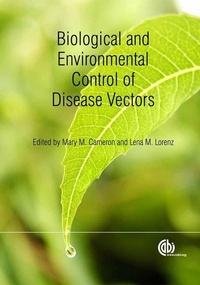
Biological and Environmental Control of Disease Vectors
Published on 13. May 2013
Book
Hardback
224 pages
978-1-84593-986-1 (ISBN)
Description
Covering the theory and practice of non-insecticidal control of insect vectors of human disease, this book provides an overview of methods including the use of botanical biocides and insect-derived semiochemicals, with an overall focus on integrated vector management strategies. While the mainstay of malaria control programmes relies on pesticides, there is a resurgence in the research and utilisation of non-insecticidal control measures due to concerns over rapid development and spread of insecticide resistance, and long-term environmental impacts. This book provides examples of successful applications in the field and recommendations for future use.
More details
Language
English
Place of publication
Wallingford
United Kingdom
Target group
College/higher education
Professional and scholarly
Product notice
sewn/stitched
Cloth over boards
Dimensions
Height: 244 mm
Width: 175 mm
Thickness: 18 mm
Weight
658 gr
ISBN-13
978-1-84593-986-1 (9781845939861)
Copyright in bibliographic data and cover images is held by Nielsen Book Services Limited or by the publishers or by their respective licensors: all rights reserved.
Schweitzer Classification
Other editions
Additional editions
Mary Cameron | Lena Lorenz
Biological and Environmental Control of Disease Vectors
E-Book
05/2013
CABI Publishing
€200.99
Available for download
Persons
Mary Cameron obtained a BSC in Zoology from Bedford College, University of London, in 1983, and a PhD in Entomology in 1987. She originally joined the Department of Entomology at LSHTM in 1984, to study oviposition behaviour in mosquitoes, but later left to take up a post-doc position at the University of Oxford in 1990. After field work on sandfly biology in Peru, and her appointment at the Liverpool School of Tropical Medicine as a Research Fellow, Mary re-joined LSHTM in 1995 to conduct laboratory and clinical trials to reduce house dust mite allergens in homes. She was appointed Lecturer in 1998, and Senior Lecturer in 2007, and her main areas of research focus on novel trapping methods for surveillance and control of a range of medically important arthropods. obtained a BSc in Zoology from the University of Bristol in 2006 and a PhD in evolutionary ecology with Prof Jacob Koella at Silwood Park Campus, Imperial College London in 2010. She incorporated evolutionary and epidemiological principles into the study of host-parasite relationships between mosquitoes and microsporidian parasites in laboratory experiments. She subsequently gained some field experience working on studies testing mosquito attractants and repellents at Ifakara Health Institute in Tanzania before starting her post-doctoral fellowship with Dr Sarah Moore at LSHTM in 2011.
Editor
London School of Hygiene and Tropical Medicine, UK
London School of Hygiene and Tropical Medicine, UK
Contributions
University of London, UK
International Centre of Insect Physiology and Ecology (ICIPE), Kenya
National Institute of Malaria Research, (Indian Council of Medical Research), Poojanahalli, Kannamangala Post, Devanahalli, Bangalore - 562110, , INDIA
Wageningen University, Netherlands
University of London, UK
Ifakara Health Institute, Tanzania
Park House, Charlton Park Estate, , Malmesbury, Wilts, SN16 9DG, UNITED KINGDOM
Content
1: Introduction 2: Control with Arthropods 3: Use of Larvivorous Fish in Biological and Environmental Control of Disease Vectors 4: The Use of Plants in Vector Control 5: Control of Disease Vectors using Fungi 6: Vector Control using Semiochemicals 7: House Screening 8: Sanitation and Vector Control 9: Water Management for Disease Vector Control 10: Integrated Vector Management 11: Evidence Required for Adoption of New Vector Control Methods in Public Health