

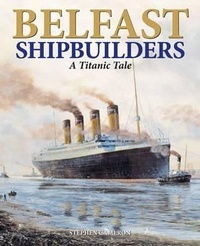
Belfast Shipbuilders
A Titanic Tale
Published on 30. April 2011
Book
Paperback/Softback
208 pages
978-1-906578-78-7 (ISBN)
Description
Today in Belfast heavy industry is the exception rather than the rule. Yet this city and its hard-working citizens have, over the years, placed Belfast at the top of the Industrial league. There were many industries but what made Belfast world famous was shipbuilding. It could proudly boast to having the largest shipyard in the world, that of the massive east Belfast shipyard of Harland and Wolff. It was here in 1912 that probably the most famous or infamous ship, the RMS Titanic, departed from the Lough and sailed into the history books.
The earliest records of this fledgling industry date to around the year 1630, when King Charles I was on the throne, Urban VIII was Pope and, in Belfast, local Presbyterian ministers commissioned the building of a ship, the Eagle Wing, that was to transport them away from these shores. Shipbuilding was formally established on the banks of the Lagan in 1791 when a Scot by the name of William Ritchie saw the potential and set up his own firm. From that date shipbuilding was to grow at such a pace that Belfast became the envy of the world.
Individuals were to make their mark but most of the growth can be attributed to a small number of families and their connections. This book traces the shipbuilding industry in Belfast via the stories of these families.
The earliest records of this fledgling industry date to around the year 1630, when King Charles I was on the throne, Urban VIII was Pope and, in Belfast, local Presbyterian ministers commissioned the building of a ship, the Eagle Wing, that was to transport them away from these shores. Shipbuilding was formally established on the banks of the Lagan in 1791 when a Scot by the name of William Ritchie saw the potential and set up his own firm. From that date shipbuilding was to grow at such a pace that Belfast became the envy of the world.
Individuals were to make their mark but most of the growth can be attributed to a small number of families and their connections. This book traces the shipbuilding industry in Belfast via the stories of these families.
More details
Language
English
Place of publication
United Kingdom
Publishing group
Colourpoint Creative Ltd
Product notice
Paperback (trade)
Unsewn / adhesive bound
Illustrations
Illustrations, ports.
Dimensions
Height: 260 mm
Width: 211 mm
Thickness: 13 mm
Weight
783 gr
ISBN-13
978-1-906578-78-7 (9781906578787)
Copyright in bibliographic data and cover images is held by Nielsen Book Services Limited or by the publishers or by their respective licensors: all rights reserved.
Schweitzer Classification
Other editions
Additional editions
E-Book
02/2023
Blackstaff Press Ltd
€9.49
Available for download
Person
Stephen Cameron is a co-founder and past Chairman of the Belfast Titanic Society, which was formerly called The Ulster Titanic Society. An acknowledge expert on the subject, he has been researching the Titanic since 1992. He was a Station Commander with the Northern Ireland Fire Brigade. He lives in Bangor, Co. Down with his wife. He continues to research and write and has lectured widely.
Content
CONTENTS Acknowledgements Foreword by Una Reilly Introduction Chapter 1 Early Shipbuilding in Belfast Chapter 2 The Next Steps Forward Chapter 3 The Emergence of Iron Men Chapter 4 Edward J. Harland Chapter 5 Partners Chapter 6 Pupils, Apprentices and Working Conditions Chapter 7 Building the Ship Chapter 8 Yards, Yards and Yards Chapter 9 Expansion at Queen's Island Chapter 10 A New Beginning Chapter 11 Approaching the End of an Era Chapter 12 Arising from the Ashes Chapter 13 The New Century Chapter 14 The Olympic Class Liners Chapter 15 The League of Gentlemen Chapter 16 William Pirrie Chapter 17 The End of an Era Appendices Did you know...? Belfast Shipbuilding Chronology White Star Line vessels built by Harland and Wolff * Other Selected Ships Built by Belfast Shipyards Shipyard Trades Notes to Chapters Bibliography Picture Credits Index