

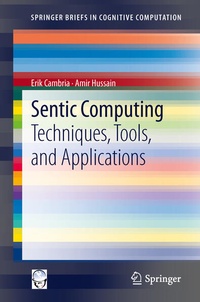
Sentic Computing
Techniques, Tools, and Applications
1st Edition
Published on 28. July 2012
Book
Paperback/Softback
XVIII, 153 pages
978-94-007-5069-2 (ISBN)
Description
In this book common sense computing techniques are further developed and applied to bridge the semantic gap between word-level natural language data and the concept-level opinions conveyed by these. In particular, the ensemble application of graph mining and multi-dimensionality reduction techniques is exploited on two common sense knowledge bases to develop a novel intelligent engine for open-domain opinion mining and sentiment analysis. The proposed approach, termed sentic computing, performs a clause-level semantic analysis of text, which allows the inference of both the conceptual and emotional information associated with natural language opinions and, hence, a more efficient passage from (unstructured) textual information to (structured) machine-processable data.
More details
Series
Language
English
Place of publication
Dordrecht
Netherlands
Target group
Professional and scholarly
Research
Illustrations
35 farbige Abbildungen, 4 s/w Abbildungen
XVIII, 153 p. 39 illus., 35 illus. in color.
Dimensions
Height: 235 mm
Width: 155 mm
Thickness: 10 mm
Weight
271 gr
ISBN-13
978-94-007-5069-2 (9789400750692)
DOI
10.1007/978-94-007-5070-8
Schweitzer Classification
Other editions
Additional editions
E-Book
07/2012
1st Edition
Springer
€53.49
Available for download
Persons
Erik Cambria is the Founder of SenticNet, a Singapore-based company offering B2B sentiment analysis services, and an Associate Professor at NTU, where he also holds the appointment of Provost Chair in Computer Science and Engineering. Prior to joining NTU, he worked at Microsoft Research Asia and HP Labs India and earned his PhD through a joint programme between the University of Stirling and MIT Media Lab. Erik is recipient of many awards, e.g., the 2018 AI's 10 to Watch and the 2019 IEEE Outstanding Early Career award, and is often featured in the news, e.g., Forbes. He is Associate Editor of several journals, e.g., NEUCOM, INFFUS, KBS, IEEE CIM and IEEE Intelligent Systems (where he manages the Department of Affective Computing and Sentiment Analysis), and is involved in many international conferences as PC member, program chair, and speaker.
Content
1. Introduction. - 2. Background. - 3. Techniques. - 4. Tools. - 5. Applications. - 6. Concluding Remarks.