

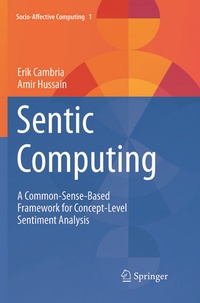
Sentic Computing
A Common-Sense-Based Framework for Concept-Level Sentiment Analysis
Published on 21. March 2019
Book
Paperback/Softback
XXII, 176 pages
978-3-319-79516-4 (ISBN)
Description
This volume presents a knowledge-based approach to concept-level sentiment analysis at the crossroads between affective computing, information extraction, and common-sense computing, which exploits both computer and social sciences to better interpret and process information on the Web.
Concept-level sentiment analysis goes beyond a mere word-level analysis of text in order to enable a more efficient passage from (unstructured) textual information to (structured) machine-processable data, in potentially any domain.
Readers will discover the following key novelties, that make this approach so unique and avant-garde, being reviewed and discussed:
Sentic Computing's multi-disciplinary approach to sentiment analysis-evidenced by the concomitant use of AI, linguistics and psychology for knowledge representation and inference
Sentic Computing's shift from syntax to semantics-enabled by the adoption of the bag-of-concepts model instead of simply counting word co-occurrence frequencies in text
Sentic Computing's shift from statistics to linguistics-implemented by allowing sentiments to flow from concept to concept based on the dependency relation between clauses
This volume is the first in the Series Socio-Affective Computing edited by Dr Amir Hussain and Dr Erik Cambria and will be of interest to researchers in the fields of socially intelligent, affective and multimodal human-machine interaction andsystems.
Concept-level sentiment analysis goes beyond a mere word-level analysis of text in order to enable a more efficient passage from (unstructured) textual information to (structured) machine-processable data, in potentially any domain.
Readers will discover the following key novelties, that make this approach so unique and avant-garde, being reviewed and discussed:
Sentic Computing's multi-disciplinary approach to sentiment analysis-evidenced by the concomitant use of AI, linguistics and psychology for knowledge representation and inference
Sentic Computing's shift from syntax to semantics-enabled by the adoption of the bag-of-concepts model instead of simply counting word co-occurrence frequencies in text
Sentic Computing's shift from statistics to linguistics-implemented by allowing sentiments to flow from concept to concept based on the dependency relation between clauses
This volume is the first in the Series Socio-Affective Computing edited by Dr Amir Hussain and Dr Erik Cambria and will be of interest to researchers in the fields of socially intelligent, affective and multimodal human-machine interaction andsystems.
More details
Series
Edition
Softcover Reprint of the Original 1st 2015 ed.
Language
English
Place of publication
Cham
Switzerland
Publishing group
Springer International Publishing
Target group
Professional and scholarly
Illustrations
40 farbige Abbildungen, 14 s/w Abbildungen
XXII, 176 p. 54 illus., 40 illus. in color.
Dimensions
Height: 235 mm
Width: 155 mm
Thickness: 11 mm
Weight
348 gr
ISBN-13
978-3-319-79516-4 (9783319795164)
DOI
10.1007/978-3-319-23654-4
Schweitzer Classification
Other editions
Additional editions
Erik Cambria | Amir Hussain
Sentic Computing
A Common-Sense-Based Framework for Concept-Level Sentiment Analysis
Book
12/2015
Springer
€106.99
Shipment within 10-15 days
Persons
Erik Cambria is the Founder of SenticNet, a Singapore-based company offering B2B sentiment analysis services, and an Associate Professor at NTU, where he also holds the appointment of Provost Chair in Computer Science and Engineering. Prior to joining NTU, he worked at Microsoft Research Asia and HP Labs India and earned his PhD through a joint programme between the University of Stirling and MIT Media Lab. Erik is recipient of many awards, e.g., the 2018 AI's 10 to Watch and the 2019 IEEE Outstanding Early Career award, and is often featured in the news, e.g., Forbes. He is Associate Editor of several journals, e.g., NEUCOM, INFFUS, KBS, IEEE CIM and IEEE Intelligent Systems (where he manages the Department of Affective Computing and Sentiment Analysis), and is involved in many international conferences as PC member, program chair, and speaker.
Content
Introduction.- SenticNet.- Sentic Patterns.- Sentic Applications.- Conclusion.- Index.