

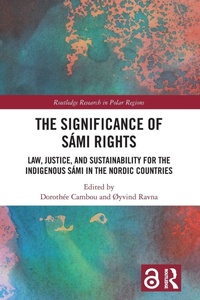
The Significance of Sami Rights
Law, Justice, and Sustainability for the Indigenous Sami in the Nordic Countries
1st Edition
Published on 14. April 2025
Book
Paperback/Softback
208 pages
978-1-032-11600-6 (ISBN)
Description
This book examines the significance of the rights of the Sami people and analyses the issues raised by the recognition and implementation of these rights in the Nordic countries.
Written together by Sami and non-Sami experts, the book adopts a human rights approach to examine the adequacy of law and policies that seek to protect the culture and livelihood of Sami communities in their traditional lands and territories. The book discusses contemporary legal and jurisprudential developments in the field of Sami rights. It examines the processes and challenges in the recognition and implementation of these rights, particularly in relation to the governance of their traditional land and resources.
The book will be of particular interest to legal scholars, political scientists, experts in the field of Indigenous peoples' rights, governmental authorities, and members of Indigenous communities.
The Open Access version of this book, available at www.taylorfrancis.com, has been made available under a Creative Commons (CC-BY) 4.0 license.
Written together by Sami and non-Sami experts, the book adopts a human rights approach to examine the adequacy of law and policies that seek to protect the culture and livelihood of Sami communities in their traditional lands and territories. The book discusses contemporary legal and jurisprudential developments in the field of Sami rights. It examines the processes and challenges in the recognition and implementation of these rights, particularly in relation to the governance of their traditional land and resources.
The book will be of particular interest to legal scholars, political scientists, experts in the field of Indigenous peoples' rights, governmental authorities, and members of Indigenous communities.
The Open Access version of this book, available at www.taylorfrancis.com, has been made available under a Creative Commons (CC-BY) 4.0 license.
More details
Series
Language
English
Place of publication
London
United Kingdom
Publishing group
Taylor & Francis Ltd
Target group
College/higher education
Postgraduate and Undergraduate
Illustrations
1 s/w Abbildung, 1 s/w Zeichnung
1 Line drawings, black and white; 1 Illustrations, black and white
Dimensions
Height: 234 mm
Width: 156 mm
Thickness: 12 mm
Weight
345 gr
ISBN-13
978-1-032-11600-6 (9781032116006)
Copyright in bibliographic data and cover images is held by Nielsen Book Services Limited or by the publishers or by their respective licensors: all rights reserved.
Schweitzer Classification
Other editions
Additional editions
Dorothee Cambou | Oyvind Ravna
The Significance of Sami Rights
Law, Justice, and Sustainability for the Indigenous Sami in the Nordic Countries
E-Book
11/2023
1st Edition
Taylor & Francis
€0.00
Available for download
Dorothee Cambou | Oyvind Ravna
The Significance of Sami Rights
Law, Justice, and Sustainability for the Indigenous Sami in the Nordic Countries
E-Book
11/2023
1st Edition
Taylor & Francis
€0.00
Available for download
Dorothee Cambou | Oyvind Ravna
The Significance of Sami Rights
Law, Justice, and Sustainability for the Indigenous Sami in the Nordic Countries
Book
11/2023
1st Edition
Routledge
€209.70
Shipment within 10-20 days
Persons
Dorothee Cambou is Assistant Professor of sustainability science at the Faculty of Law and HELSUS at the University of Helsinki. Her research examines international law and human rights, including the rights of Indigenous peoples, environmental and social justice issues linked with the governance of lands in the Arctic and the Global South. She is the current chair of the Nordic Network for Sami and Indigenous Peoples Law (NORSIL). Currently, she also leads several research initiatives, including a project concerning the responsibilities of business to respect the rights of Indigenous peoples in the green transition and a network project on 'the implementation of the rights of the Indigenous Sami people as a means to achieve inclusive and sustainable development in the Nordic countries', financed by the Nordic Research Council. The present volume is an outcome of the latter project.
Oyvind Ravna is Professor of Law (Dr. Juris eq. to PhD, 2008). He is also the head of the research group of Sami and Indigenous law at UIT the Arctic University of Norway, Tromso; the head of the GoSapmi research project; the editor of Arctic Review on Law and Politics; and Adjunct Professor at the Sami University of Applied Sciences, Kautokeino, Norway. His research fields include property law, legal history, human rights and indigenous people's law.
Oyvind Ravna is Professor of Law (Dr. Juris eq. to PhD, 2008). He is also the head of the research group of Sami and Indigenous law at UIT the Arctic University of Norway, Tromso; the head of the GoSapmi research project; the editor of Arctic Review on Law and Politics; and Adjunct Professor at the Sami University of Applied Sciences, Kautokeino, Norway. His research fields include property law, legal history, human rights and indigenous people's law.
Content
1 The significance of Sami rights in the Nordic countries - An introduction
Dorothee Cambou & Ovind Ravna
2 The relevance of the UN Declaration on the Rights of Indigenous Peoples to vibrant, viable and sustainable Sami communities
Mattias Ahren
3 The survey of property rights in Sami areas of Norway - With focus on the survey of the Karasjok case
Oyvind Ravna
4 Indigenous peoples' right to fish: Recent recognition of Sami rights in Finland through civil disobedience and criminal trial
Martin Scheinin
5 The significance of the Fosen decision for protecting the cultural rights of the Sami Indigenous people in the green transition
Dorothee Cambou
6 The interplay of politics and jurisprudence in the Girjas court case
Eivind Torp
7 The prohibition to weaken the Sami culture in international law and Finnish environmental legislation
Leena Heinaemaeki
8 The implementation of Sami land rights in the Swedish Forestry Act
Malin Braennstroem
9 Navigating conservation currents: conditions for Sami agency in collaborative governance and management models
Elsa Reimersona & Linn Floden
10 A human rights-based approach to Sami statistics in Norway
Peter Dawson
11 Rendering the invisible visible: Sami rights and data governance
Tamara Krawchenko & Chris McDonald
12 Sami rights and sustainability in early childhood education and care: Sustainability in everyday practices in Norwegian kindergartens
Ingvild Amot & Monica Bjerklund
13 Sami rights in the sustainable transition - Concluding remarks
Christina Allard
Dorothee Cambou & Ovind Ravna
2 The relevance of the UN Declaration on the Rights of Indigenous Peoples to vibrant, viable and sustainable Sami communities
Mattias Ahren
3 The survey of property rights in Sami areas of Norway - With focus on the survey of the Karasjok case
Oyvind Ravna
4 Indigenous peoples' right to fish: Recent recognition of Sami rights in Finland through civil disobedience and criminal trial
Martin Scheinin
5 The significance of the Fosen decision for protecting the cultural rights of the Sami Indigenous people in the green transition
Dorothee Cambou
6 The interplay of politics and jurisprudence in the Girjas court case
Eivind Torp
7 The prohibition to weaken the Sami culture in international law and Finnish environmental legislation
Leena Heinaemaeki
8 The implementation of Sami land rights in the Swedish Forestry Act
Malin Braennstroem
9 Navigating conservation currents: conditions for Sami agency in collaborative governance and management models
Elsa Reimersona & Linn Floden
10 A human rights-based approach to Sami statistics in Norway
Peter Dawson
11 Rendering the invisible visible: Sami rights and data governance
Tamara Krawchenko & Chris McDonald
12 Sami rights and sustainability in early childhood education and care: Sustainability in everyday practices in Norwegian kindergartens
Ingvild Amot & Monica Bjerklund
13 Sami rights in the sustainable transition - Concluding remarks
Christina Allard