

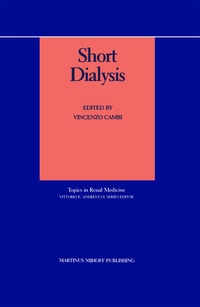
Short Dialysis
Published on 1. November 2011
Book
Paperback/Softback
XVI, 370 pages
978-1-4612-9216-6 (ISBN)
Description
Vittorio E. Andreucci of keeping alive patients in terminal chronic Initially created with the purpose renal failure, dialysis has undergone improvements in methodology, and its final goal has become complete health rehabilitation and optimization of the quality of life of chronic dialysis patients. To achieve this, many investigators have attempted to increase dialysis efficiency and at the same time shorten dialysis time. Their main concern was, obviously, patient safety: the Latin proverb 'primum non nocere' is still valid all over the world. Thus, when clinical observations of the first patients on regular dialysis therapy suggested an inverse relationship between duration of dialysis sessions and severity of peripheral neuropathy, long and frequent dialysis sessions were considered the only way to prevent the catastrophic consequences of nerve damage and underdialysis syndrome. It was then, in 1971, when dialysis duration was 8- 12 hours per session, that Vincenzo Cambi started a 'short dialysis' trial, i. e. , 4 hours 3 times weekly or 3 hours every second day. For the first time, dialysis was shortened from 24-36 hours weekly to 10. 5-12 hours weekly [1, 2]. In 1971 I was still at the Parma University Hospital. We had both just returned from the United States, and Dr. Cambi was responsible for the dia lysis unit.
More details
Series
Edition
Softcover reprint of the original 1st ed. 1987
Language
English
Place of publication
New York
United States
Target group
Professional and scholarly
Research
Illustrations
XVI, 370 p.
Dimensions
Height: 235 mm
Width: 155 mm
Thickness: 22 mm
Weight
593 gr
ISBN-13
978-1-4612-9216-6 (9781461292166)
DOI
10.1007/978-1-4613-2045-6
Schweitzer Classification
Other editions
Additional editions
Content
1. Short dialysis 1971-1986: the first experience.- 2. Short dialysis: a single center study.- 3. Hemodialysis strategies in European countries.- 4. Middle molecule hypothesis and short dialysis.- 5. Features of uremic peripheral polyneuropathy in the light of experience with the short hemodialysis schedule (SHS).- 6. Nutritional status and nitrogen metabolism in patients treated with short dialysis.- 7. Nutrition in dialysis patients.- 8. Acid-base metabolism in short dialysis.- 9. Modeling dialysis therapy.- 10. Aluminum intoxication.- 11. Water treatment for the preparation of the dialysate.- 12. 'On-site' preparation of sterile apyrogenic electrolyte solutions for hemofiltration and hemodiafiltration.- 13. Present clinical experience and future aspects of hemodiafiltration.- 14. Cardiovascular stability in hemodialysis and hemofiltration.