

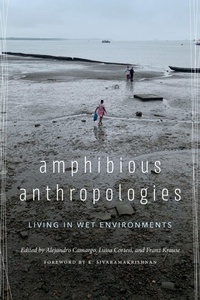
Amphibious Anthropologies
Living in Wet Environments
Published on 29. July 2025
Book
Paperback/Softback
312 pages
978-0-295-75389-8 (ISBN)
Description
Muddying the divide between land and water
This interdisciplinary collection delves into the experiences and meanings of life in environments where water levels and availability are in constant flux. Amphibious Anthropologies brings together a global set of case studies, from Italy's historic marshes to the tidal pools of the Bahamas, to show how living with unpredictable wetness has become crucial in the age of climate crisis. The book introduces "amphibious anthropologies" as a framework to challenge the dichotomy of water and land and interrogate spaces marked by rapid and profound environmental change. It brings to light the everyday creativity and uncertainty in wet environments like California's Salton Sea and India's North Bihar floodplain. Engaging with disciplines like anthropology, geography, and STS, this work offers a timely discourse on environmental change and resilience.
This interdisciplinary collection delves into the experiences and meanings of life in environments where water levels and availability are in constant flux. Amphibious Anthropologies brings together a global set of case studies, from Italy's historic marshes to the tidal pools of the Bahamas, to show how living with unpredictable wetness has become crucial in the age of climate crisis. The book introduces "amphibious anthropologies" as a framework to challenge the dichotomy of water and land and interrogate spaces marked by rapid and profound environmental change. It brings to light the everyday creativity and uncertainty in wet environments like California's Salton Sea and India's North Bihar floodplain. Engaging with disciplines like anthropology, geography, and STS, this work offers a timely discourse on environmental change and resilience.
Reviews / Votes
"The book presents insightful observations, conversations and case studies, showing the variety of forms that wet environments, and the life there, can take. It encourages readers to reject extreme binaries and imagine new ways of understanding the vibrant life in amphibious worlds." * Nature * "[A] compelling collection . . . . Through the foregrounding of ethnographic accounts of living with wetness, the collection shifts focus between theoretical abstractions and the everyday negotiations through which people inhabit such worlds. This expands the conceptual repertoire for thinking with such environments, offering a grounded anthropology of the amphibious that is all at once ecological and political." * Asian Journal of Social Science *More details
Series
Language
English
Place of publication
Seattle
United States
Target group
Professional and scholarly
US School Grade: College Graduate Student
Product notice
Paperback (trade)
Illustrations
3 Maps; 3 Maps; 3 Maps; 3 Maps; 3 Maps; 3 Maps; 3 Maps; 3 Maps; 3 Maps; 3 Maps; 3 Maps; 3 Maps; 3 Maps; 3 Maps; 3 Maps; 3 Maps; 3 Maps; 3 Maps; 7 Illustrations, black and white; 7 Illustrations, black and white; 7 Illustrations, black and white; 7 Illustrations, black and white; 7 Illustrations, black and white; 7 Illustrations, black and white; 7 Illustrations, black and white; 7 Illustrations, black and white; 7 Illustrations, black and white; 7 Illustrations, black and white; 7 Illustrations, black and white; 7 Illustrations, black and white; 7 Illustrations, black and white; 7 Illustrations, black and white; 7 Illustrations, black and white; 7 Illustrations, black and white; 7 Illustrations, black and white; 7 Illustrations, black and white
Dimensions
Height: 227 mm
Width: 150 mm
Thickness: 21 mm
Weight
436 gr
ISBN-13
978-0-295-75389-8 (9780295753898)
Copyright in bibliographic data and cover images is held by Nielsen Book Services Limited or by the publishers or by their respective licensors: all rights reserved.
Schweitzer Classification
Persons
Alejandro Camargo is assistant professor of environmental and Caribbean studies at the Universidad del Norte in Colombia. He is coeditor of Water Urbanization in Colombia. Luisa Cortesi is assistant professor of water, disasters, and environmental justice at the International Institute of Social Studies at Erasmus University. She is coeditor of Split Waters: The Idea of Water Conflicts. Franz Krause is professor of environmental anthropology and codirector of Multidisciplinary Environmental Studies in the Humanities at the University of Cologne. He is coeditor of Delta Worlds: Life Between Land and Water.
Content
Foreword by K. Sivaramakrishnan
Acknowledgments
Introduction, by Franz Krause, Luisa Cortesi, Alejandro Camargo
Part I. On the Brink
1. Postnatural Environmental Management in an Amphibious Delta: Hybridity, Performativity, and Indeterminacy at the Salton Sea, by Alida Cantor
2. Between Hydro and Geo: Amphibious Spaces of Social Exception, by Simone Popperl
3. The Shape of Waterland: A Geomorphoanthropological Commentary on Fluvial Infrastructures and Amphibious Environmental Knowledge, by Luisa Cortesi
Part II. In the Damp
4. Keeping the Land Wet: "Wet Lands" and the Rise of "Wetland Literacy" by Paolo Gruppuso
5. Situating Wetness in Soomaa, Estonia, by Franz Krause
6. The Hyporheic Imaginary in Multispecies Watershed Governance, How Beaver Collaborations Remix Patterns of Wet and Dry in Northern California Streams, by Cleo Woelfle-Hazard and Daniel Sarna-Wojcicki
Part III. Through the Muck
7. Restoring Wetlands in Alpine Ski Resorts: The Biopolitics of Water, Land, and Snow by Celine Granjou and Stephanie Gaucherand
8. Muddy Waters: Governing the Littoral in Andros Island, The Bahamas, by Sarah Wise
9. The Contours of the Amphibious: Wetlands, Knowledge, and Politics in Colombia by Alejandro Camargo
Amphibious Epilogue, by Stuart McLean
List of Contributors
Index
Acknowledgments
Introduction, by Franz Krause, Luisa Cortesi, Alejandro Camargo
Part I. On the Brink
1. Postnatural Environmental Management in an Amphibious Delta: Hybridity, Performativity, and Indeterminacy at the Salton Sea, by Alida Cantor
2. Between Hydro and Geo: Amphibious Spaces of Social Exception, by Simone Popperl
3. The Shape of Waterland: A Geomorphoanthropological Commentary on Fluvial Infrastructures and Amphibious Environmental Knowledge, by Luisa Cortesi
Part II. In the Damp
4. Keeping the Land Wet: "Wet Lands" and the Rise of "Wetland Literacy" by Paolo Gruppuso
5. Situating Wetness in Soomaa, Estonia, by Franz Krause
6. The Hyporheic Imaginary in Multispecies Watershed Governance, How Beaver Collaborations Remix Patterns of Wet and Dry in Northern California Streams, by Cleo Woelfle-Hazard and Daniel Sarna-Wojcicki
Part III. Through the Muck
7. Restoring Wetlands in Alpine Ski Resorts: The Biopolitics of Water, Land, and Snow by Celine Granjou and Stephanie Gaucherand
8. Muddy Waters: Governing the Littoral in Andros Island, The Bahamas, by Sarah Wise
9. The Contours of the Amphibious: Wetlands, Knowledge, and Politics in Colombia by Alejandro Camargo
Amphibious Epilogue, by Stuart McLean
List of Contributors
Index