

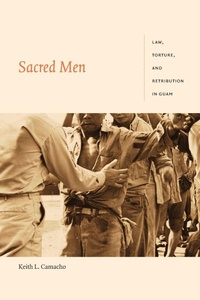
Sacred Men
Law, Torture, and Retribution in Guam
Published on 22. November 2019
Book
Paperback/Softback
312 pages
978-1-4780-0634-3 (ISBN)
Description
Between 1944 and 1949 the United States Navy held a war crimes tribunal that tried Japanese nationals and members of Guam's indigenous Chamorro population who had worked for Japan's military government. In Sacred Men Keith L. Camacho traces the tribunal's legacy and its role in shaping contemporary domestic and international laws regarding combatants, jurisdiction, and property. Drawing on Giorgio Agamben's notions of bare life and Chamorro concepts of retribution, Camacho demonstrates how the U.S. tribunal used and justified the imprisonment, torture, murder, and exiling of accused Japanese and Chamorro war criminals in order to institute a new American political order. This U.S. disciplinary logic in Guam, Camacho argues, continues to directly inform the ideology used to justify the GuantAnamo Bay detention center, the torture and enhanced interrogation of enemy combatants, and the American carceral state.
Reviews / Votes
"Sacred Men is a truly singular work of immense importance. It is original, compelling, and fiercely thought-provoking. Through a theoretical engagement with the Chamorro, Rotanese, and Saipanese indigenous epistemologies, Keith L. Camacho has brought the discussion of U.S. empire, law, sovereignty, militarism, and the working of carceral power to an entirely new horizon in ways no other scholar has done. A pathbreaking, field-shifting intervention." - Lisa Yoneyama, author of (Cold War Ruins: Transpacific Critique of American Justice and Japanese War Crimes) "Exceedingly engaging, theoretically accomplished, and incisively researched, Sacred Men unravels the 1944 U.S. military tribunal in Guam, which included the prosecution and torture of Chamorro indigenes. Employing Agamben's homo sacer, Keith L. Camacho provides a razor-sharp analysis of the tribunal as a very real 'bare life' event but also as a metaphor for the murder, torture, and foreclosure of political life that has occurred throughout the colonies as 'states of exception.'" - Brendan Hokowhitu, coeditor of (The Fourth Eye: Maori Media in Aotearoa New Zealand) "Provocative and engaging, Camacho's work not only breaks new ground in postcolonial and transpacific studies, but also calls attention to the role that Chamorro, Rotanese, and Saipanese indigenous epistemologies may play in the decolonization and deimperialization of US-occupied Guam." - Y. Shu (Choice) "Author Keith Camacho is especially interested in developing an analysis of law, justice, incarceration, and punishment in colonial situations...and in weaving this theoretical apparatus into the longer and larger history of US colonial rule in both North America and abroad.... [P]ath-breaking work..." - Glenn Petersen (Pacific Affairs) "Camacho's intricately researched and powerfully theorized book Sacred Men is the first to examine, at close range, the U.S. Navy trials of Japanese and native people in Guam before and after 1945.... [It] should be required reading for all graduate students and scholars of war, justice, and the American empire in the Pacific." - Franziska Seraphim (Journal of Military History) "Sacred Men makes crucial theoretical, methodological, and historiographical interventions into carceral studies, Indigenous studies, and studies of U.S. empire and militarism.... Sacred Men is an essential resource for scholars of Indigenous peoples, especially those separated by political regimes and imperial boundaries."- Kristin Oberiano (Amerasia Journal) "Through uncovering these once buried stories, Camacho illustrates a wide range of human responses to the pressures of war and colonial domination. . . . Sacred Men will prove to be a welcome addition to the cannon of Marianas history." - Michael R. Clement Jr. (Small States & Territories)
More details
Series
Language
English
Place of publication
North Carolina
United States
Target group
Professional and scholarly
Product notice
Paperback (trade)
Illustrations
20 illustrations
Dimensions
Height: 229 mm
Width: 152 mm
Thickness: 18 mm
Weight
509 gr
ISBN-13
978-1-4780-0634-3 (9781478006343)
Copyright in bibliographic data and cover images is held by Nielsen Book Services Limited or by the publishers or by their respective licensors: all rights reserved.
Schweitzer Classification
Other editions
Additional editions
E-Book
11/2019
1st Edition
Duke University Press Books
€208.99
Available for download
Person
Keith L. Camacho is Associate Professor of Asian American Studies at the University of California, Los Angeles, author of Cultures of Commemoration: The Politics of War, Memory, and History in the Mariana Islands, and coeditor of Militarized Currents: Toward a Decolonized Future in Asia and the Pacific.
Content
Acknowledgments vii
Introduction 1
Part I. The State of Exception
1. War Bodies 29
2. War Crimes 60
Part II. The Bird and the Lizard
3. Native Assailants 89
4. Native Murderers 116
Part III. The Military Colony
5. Japanese Traitors 149
6. Japanese Militarists 181
Conclusion 215
Notes 225
Bibliography 269
Index 283
Introduction 1
Part I. The State of Exception
1. War Bodies 29
2. War Crimes 60
Part II. The Bird and the Lizard
3. Native Assailants 89
4. Native Murderers 116
Part III. The Military Colony
5. Japanese Traitors 149
6. Japanese Militarists 181
Conclusion 215
Notes 225
Bibliography 269
Index 283