

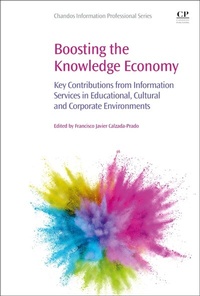
Boosting the Knowledge Economy
Key Contributions from Information Services in Educational, Cultural and Corporate Environments
Published on 20. May 2022
Book
Paperback/Softback
232 pages
978-1-84334-772-9 (ISBN)
Description
This book presents a comprehensive, international and up-to-date review of the key contributions of information services to the Knowledge Economy. Chapters contributed by experts in different areas of LIS focus on the crucial roles libraries, archives and museums are playing in their home institutions -private, public, non-profit-, as much as their impact on the economy and society as a whole. Boosting the Knowledge Economy: Key Contributions from Information Services in Educational, Cultural, and Corporate Environments has a particular interest in learning services, exploring principles and strategies for their implementation - from marketing strategy to analytics -, and covers implications for the LIS profession.
Reviews / Votes
"The book is organised into three sections- key contributions from libraries, key contributions from archives and cultural heritage institutions, and implications for the library and information services professions. It covers a wide range of topics such as educational services and programs for the LIS sector, relevant metrics, the role of artificial intelligence in the provision of information services, quality management processes and issues, management of television audio-visual archives, provision of a generalised data model, and the importance of organisational archives. . . . The book is scholarly yet remains quite readable despite the complexity of some of the topics discussed. The chapter on transparency and social responsibility for libraries and archives is particularly interesting and covers the identification and measurement of transparency indicators in a very topical and relevant way. . . .It is also refreshing to have a work like this that is non-American in its approach and content so we might benefit from different perspectives." --JALIA - Journal of the Australian Library and Information Association"A knowledge economy is one in which the acquisition, creation, dissemination, and utilization of knowledge contributes to economic growth, and a key point noted for this book is that it Provides new insights into the value of information services in the context of the knowledge economy...The content is international in scope and each chapter stands on its own quite nicely as a solid resource for that area of study. Given the scholarly nature of the various topics covered, this book would be suitable for libraries that have a library science program, a focus on international librarianship, or a focus on knowledge economy and knowledge organizations." --Journal of Electronic Resources Librarianship
More details
Series
Language
English
Place of publication
Witney
United Kingdom
Publishing group
Woodhead Publishing Ltd
Target group
College/higher education
Librarians and teachers involved in academic pedagogy; students in various disciplines, including (but not limited to) library and information sciences, Internet studies, and communication studies.
Dimensions
Height: 229 mm
Width: 152 mm
Weight
220 gr
ISBN-13
978-1-84334-772-9 (9781843347729)
Copyright in bibliographic data and cover images is held by Nielsen Book Services Limited or by the publishers or by their respective licensors: all rights reserved.
Schweitzer Classification
Other editions
Additional editions
Francisco Javier Calzada-Prado
Boosting the Knowledge Economy
Key Contributions from Information Services in Educational, Cultural and Corporate Environments
E-Book
05/2022
Chandos Publishing
€56.95
Available for download
Person
Francisco Calzada-Prado is Assistant Professor at the Library and Information Science Department, Carlos III University of Madrid. His research focuses on exploring innovative services aimed at facilitating learning and research in different environments. He is author of a book on the contribution of academic libraries to the production and exploitation of learning content in Higher Education. He has also authored and co-authored several peer-reviewed book chapters, conference papers and journal articles on related topics. He has been visiting research fellow at the Information School, Syracuse University (USA), the Center for Digital Library Research, Strathclyde University (UK), the London Knowledge Lab, Institute of Education, University of London (UK) and the School of Information, University of Washington (USA), among others.
Content
Part 1 Rights: Copyright basics
1. Digital rights management and the Digital Millennium Copyright Act
2. Types of digital content
3. Best practices regarding copyrights and digital content
4. Challenges to fair use
Part 2 Formats: Three components of eBooks
5. Creating eBooks
6. Touchscreen devices and apps
Part 3 Vibrancy: Publishing support
7. Academic support with digital content
8. Conclusion
1. Digital rights management and the Digital Millennium Copyright Act
2. Types of digital content
3. Best practices regarding copyrights and digital content
4. Challenges to fair use
Part 2 Formats: Three components of eBooks
5. Creating eBooks
6. Touchscreen devices and apps
Part 3 Vibrancy: Publishing support
7. Academic support with digital content
8. Conclusion