

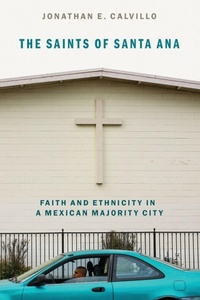
The Saints of Santa Ana
Faith and Ethnicity in a Mexican Majority City
Published on 5. January 2021
Book
Paperback/Softback
288 pages
978-0-19-009780-6 (ISBN)
Description
Catholicism has long been the dominant religion among ethnic Mexicans in the U.S. Recent shifts, however, have challenged the traditional association between Mexican ethnicity and Catholicism. Evangelical Protestantism has emerged as a notable alternative of ethnic identity expression for ethnic Mexicans.
This book takes readers into the thriving Mexican-majority neighborhoods of Santa Ana, California, a city once dubbed the hardest place to live in the U.S. There, Jonathan E. Calvillo explores how religious practices permeate the fabric of everyday social interactions for Mexican immigrants. How does faith shape these immigrants' sense of ethnic identity?
To answer this question, The Saints of Santa Ana compares the experiences of Catholic and Evangelical Mexican immigrants-the two largest religious groupings in the city. Drawing on five years of participant observation and in-depth interviews, this book argues that religious affiliations set Catholics and Evangelicals along diverging trajectories with regard to ethnic identity. In particular, Calvillo argues, Catholics and Evangelicals have differing perspectives on collective memory and ethnic community. The Saints of Santa Ana offers a rich portrait of a fascinating American community.
This book takes readers into the thriving Mexican-majority neighborhoods of Santa Ana, California, a city once dubbed the hardest place to live in the U.S. There, Jonathan E. Calvillo explores how religious practices permeate the fabric of everyday social interactions for Mexican immigrants. How does faith shape these immigrants' sense of ethnic identity?
To answer this question, The Saints of Santa Ana compares the experiences of Catholic and Evangelical Mexican immigrants-the two largest religious groupings in the city. Drawing on five years of participant observation and in-depth interviews, this book argues that religious affiliations set Catholics and Evangelicals along diverging trajectories with regard to ethnic identity. In particular, Calvillo argues, Catholics and Evangelicals have differing perspectives on collective memory and ethnic community. The Saints of Santa Ana offers a rich portrait of a fascinating American community.
Reviews / Votes
I highly recommend The Saints of Santa Ana. Calvillo does a superb job in weaving together these multifaceted elements that could each individually be a topic for a book. The vivid ethnographic descriptions, along with a robust theoretical framework, ground Calvillo's analyses of participants'understandings of faith, place, and ethnicity. * Rodrigo Serrao, American Journal of Sociology * This is an engaging, well-researched book that links immigration, religion, and identity. * I. Coronado, CHOICE * Calvillo's mastery of his subject matter allows him to converse with a wide variety of ongoing religious studies conversations including those that touch on lived religion, religion and space, religion and ethnic identity formation and maintenance, religion and emotions, and the experience of divine communication. As a result, this book demonstrates decisively the burgeoning importance of research on Latinx religions within the larger field of North American religions. The Saints of Santa Ana is a welcome addition to this growing literature and will be an asset in both undergraduate and graduate classrooms. * Brett Hendrickson, Reading Religion * Drawing on years of ethnographic inquiry, Jonathan Calvillo provides a fascinating picture of the routine and sacred ways that Catholicism and Evangelicalism structure daily life and understandings of group boundaries among Latinx immigrants. Breaking new ground with its analytical rigor and impressive empirical scope, The Saints of Santa Ana is beautifully written and is essential reading for race, religion, and immigration scholars alike. * G. Cristina Mora, Associate Professor of Sociology, University of California, Berkeley * Jonathan Calvillo's The Saints of Santa Ana is a deeply moving, richly detailed account of life in the most Mexican community in the United States. Calvillo's historical and ethnographic account of the sacred nature of space, belonging, and identity deepens our best understandings of religion and Latinidad. A must-read for any serious scholar of religion, immigration, or Latina/o/x studies. * Edward Orozco Flores, author of Jesus Saved an Ex-Con: Political Activism and Redemption after Incarceration *More details
Language
English
Place of publication
New York
United States
Target group
Professional and scholarly
Dimensions
Height: 210 mm
Width: 140 mm
Thickness: 16 mm
Weight
356 gr
ISBN-13
978-0-19-009780-6 (9780190097806)
Copyright in bibliographic data and cover images is held by Nielsen Book Services Limited or by the publishers or by their respective licensors: all rights reserved.
Schweitzer Classification
Other editions
Additional editions
Book
12/2020
Oxford University Press Inc
€126.90
Shipment within 15-20 days

E-Book
10/2020
OUP eBook
€16.49
Available for download

E-Book
10/2020
OUP eBook
€16.49
Available for download
Person
Jonathan E. Calvillo is Assistant Professor of Sociology of Religion at Boston University School of Theology. A son of Mexican immigrants, born and raised in Southern California, he holds a Ph.D. in Sociology from the University of California at Irvine. His scholarship centers on the sociology of religion, race and ethnicity, and immigration, especially within Latinx communities.
Content
Introduction
1 A City of Saints
2 A Century of Saints
3 The Authentic Ethnic Self
4 Altar Encounters
5 Defining Commitments Through Spiritual Dialogue
6 Notions of Neighborhood
Conclusion
Appendix A
Appendix B
Appendix C
Bibliography
1 A City of Saints
2 A Century of Saints
3 The Authentic Ethnic Self
4 Altar Encounters
5 Defining Commitments Through Spiritual Dialogue
6 Notions of Neighborhood
Conclusion
Appendix A
Appendix B
Appendix C
Bibliography