

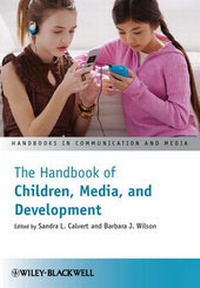
The Handbook of Children, Media and Development
Published on 3. December 2010
Book
Paperback/Softback
634 pages
978-1-4443-3694-8 (ISBN)
Description
The Handbook of Children, Media and Development brings together an interdisciplinary group of experts in the fields of developmental psychology, developmental science, communication, and medicine to provide an authoritative, comprehensive look at the empirical research on media and media policies within the field.
* 25 newly-commissioned essays bring new research to the forefront, especially on digital media, developmental research, and public policy debates
* Includes helpful introductions to each section, a theoretical overview of the field, and a final chapter that offers a vision of future research
* Contributors include key, international authorities in the field
Reviews / Votes
"This handbook is a meticulously researched 'tour-de-force' of the role media play in shaping child and family development. Through a multi-disciplinary analysis of the varied impacts the media are having on children's learning, social interactions, and healthy development, the handbook offers an authoritative, balanced perspective, while identifying pressing issues to be addressed by policymakers. It is a must-read for those who wish to understand the rich and subtle ways media influence children's lives every day." --Michael Levine, PhD, Joan Ganz Cooney Center at Sesame Workshop "The Handbook of Children, Media and Development assembles the most accomplished researchers in the field and presents in-depth and theoretically driven analyses of the most important research advances, including novel theorizing on recent technological innovations in the media. Essential as a text or reference for students, scholars, and policymakers. Understandable to undergraduates, but with depth and accuracy that scholars will appreciate." --Joanne Cantor, Director, Center for Communication Research, University of Wisconsin-Madison "Calvert and Wilson have gathered together a collection of up-to-the-moment research on how children use and are influenced by various mass media, but also on the business models underlying the industry and an array of possible policies and interventions designed to protect children. Students, scholars, policymakers, and parents will all find this book an invaluable resource." --Donald F. Roberts, Thomas More Storke Professor Emeritus, Stanford UniversityMore details
Series
Edition
1. Auflage
Language
English
Place of publication
Hoboken
United Kingdom
Publishing group
John Wiley and Sons Ltd
Target group
Professional and scholarly
Product notice
Paperback (trade)
Unsewn / adhesive bound
Dimensions
Height: 244 mm
Width: 170 mm
Thickness: 34 mm
Weight
1087 gr
ISBN-13
978-1-4443-3694-8 (9781444336948)
Schweitzer Classification
Other editions
Additional editions
Sandra L. Calvert | Barbara J. Wilson
The Handbook of Children, Media and Development
E-Book
01/2009
Wiley-Blackwell
€40.99
Available for download
Sandra L. Calvert | Barbara J. Wilson
The Blackwell Handbook of Children, Media and Development
Book
06/2008
Wiley
€236.50
Shipment within 3-4 weeks
Persons
Sandra L. Calvert, the Director of the Children's Digital Media Center, is a Professor of Psychology at Georgetown University. A fellow of the American Psychological Association, she has consulted for Nickelodeon Online, Sesame Workplace, Blue's Clues, and Sega of America, to influence the development of children's television programs, Internet software, and video games. She is author of Children's Journeys through the Information Age (1999), and co-editor of Children in the Digital Age: Influences of Electronic Media on Development (2002).
Barbara J. Wilson is a Professor and Head of the Department of Speech Communication at the University of Illinois at Urbana-Champaign. She is co-author of Children, Adolescents, and the Media (2002) and three book volumes of the National Television Violence Study (1997-1998).
Content
Preface- Aletha C. Huston
Part 1: Historical, Conceptual and Financial Underpinnings
Part 2: Media Access and Differential Use Patterns
Part 3: Cognitive Effects of Media: How & What Children Learn
Part 4: Social Effects of Media
Part 5: Health Effects of Media
Part 6: Media Policy & Interventions
About the Editors and Contributors