

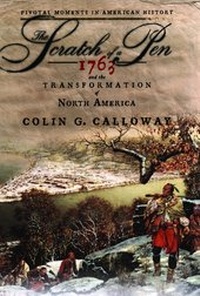
The Scratch of a Pen
1763 and the Transformation of North America
Published on 1. May 2006
Book
Hardback
244 pages
978-0-19-530071-0 (ISBN)
Description
In February 1763, Britain, Spain, and France signed the Treaty of Paris, ending the French and Indian War. In this one document, more American territory changed hands than in any treaty before or since. As the great historian Francis Parkman wrote, "half a continent...changed hands at the scratch of a pen." As Colin Calloway reveals in this superb history, the Treaty set in motion a cascade of unexpected consequences. Indians and Europeans, settlers and frontiersmen, all struggled to adapt to new boundaries, new alignments, and new relationships. Britain now possessed a vast American empire stretching from Canada to the Florida Keys, yet the crushing costs of maintaining it would push its colonies toward rebellion. White settlers, free to pour into the West, clashed as never before with Indian tribes struggling to defend their way of life. In the Northwest, Pontiac's War brought racial conflict to its bitterest level so far. Whole ethnic groups migrated, sometimes across the continent: it was 1763 that saw many exiled settlers from Acadia in French Canada move again to Louisiana, where they would become Cajuns.
Calloway unfurls this panoramic canvas with vibrant narrative skill, peopling his tale with memorable characters such as William Johnson, the Irish baronet who moved between Indian campfires and British barracks; Pontiac, the charismatic Ottawa chieftain whose warriors, for a time, chased the Europeans from Indian country; and James Murray, Britain's first governor in Quebec, who fought to protect the religious rights of his French Catholic subjects. Most Americans know the significance of the Declaration of Independence or the Emancipation Proclamation, but not the Treaty of Paris. Yet 1763 was a year that shaped our history just as decisively as 1776 or 1862. This captivating book shows why.
Calloway unfurls this panoramic canvas with vibrant narrative skill, peopling his tale with memorable characters such as William Johnson, the Irish baronet who moved between Indian campfires and British barracks; Pontiac, the charismatic Ottawa chieftain whose warriors, for a time, chased the Europeans from Indian country; and James Murray, Britain's first governor in Quebec, who fought to protect the religious rights of his French Catholic subjects. Most Americans know the significance of the Declaration of Independence or the Emancipation Proclamation, but not the Treaty of Paris. Yet 1763 was a year that shaped our history just as decisively as 1776 or 1862. This captivating book shows why.
Reviews / Votes
The Scratch of a Pen must now be included on the list of required readings for any who wish to understand the origins of the American Revolution. The Journal of American HistoryMore details
Language
English
Place of publication
New York
United States
Target group
College/higher education
Professional and scholarly
Illustrations
13 Fotos bzw. Rasterbilder, 6 Karten
13 halftones, 6 maps
Dimensions
Height: 234 mm
Width: 156 mm
Weight
497 gr
ISBN-13
978-0-19-530071-0 (9780195300710)
Copyright in bibliographic data and cover images is held by Nielsen Book Services Limited or by the publishers or by their respective licensors: all rights reserved.
Schweitzer Classification
Other editions
Additional editions
E-Book
05/2006
1st Edition
OUP eBook
€14.49
Available for download
E-Book
05/2006
1st Edition
OUP eBook
€14.49
Available for download
Person
Colin G. Calloway is Professor of History and Samson Occom Professor of Native American Studies at Dartmouth College. His many books on early American history include New Worlds for All: Indians, Europeans, and the Remaking of Early America and The American Revolution in Indian Country. His most recent work, One Vast Winter Count: The Native American West Before Lewis and Clark (2003), received the Ray Allen Billington
Prize, the Merle Curti Award, and many other prizes and was named one of Publishers Weekly's Best Books of the Year.
Prize, the Merle Curti Award, and many other prizes and was named one of Publishers Weekly's Best Books of the Year.