

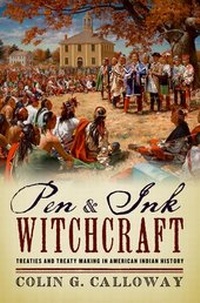
Pen and Ink Witchcraft
Treaties and Treaty Making in American Indian History
Published on 30. May 2013
Book
Hardback
400 pages
978-0-19-991730-3 (ISBN)
Description
Treaties were the primary instruments by which Native American tribal homelands passed into non-Indian hands. Indian people were coerced, manipulated, and misled into signing treaties and Euro-Americans used treaty documents to justify their acquisition and perpetuate their occupation of Indian lands. Indians called treaties "pen and ink witchcraft."
But each treaty had its own story and cast of characters and involved particular maneuverings and competing ambitions, and Indians frequently matched their colonizing counterparts in diplomatic savvy. Treaties were cultural encounters, human dramas, and power struggles where people representing different ways of life faced each other in a public contest of words rather than weapons. Treaty making changed over time and serves as a barometer of Indian-white relations in North America. Early treaty negotiations usually followed Indian protocol and forms, and sometimes were conducted on Indian terms, and early treaties were often agreements between equals. As power dynamics shifted the United States adapted and applied processes and procedures developed in the colonial era to effect the acquisition of Native lands by a rapidly expanding nation state.
Pen and Ink Witchcraft begins with the protocols, practices, and precedents of Indian diplomacy in colonial America but then focuses the century between 1768 and 1871 when Congress ended treaty making. It traces the stories and the individuals behind three treaties that represent distinct phases in treaty relations. The Treaty of Fort Stanwix in 1768 culminated colonial efforts to establish a boundary between Indian lands and white settlers; the Treaty of New Echota in 1835 implemented national efforts to remove Indians, and the Treaty of Medicine Lodge in 1867 intended to confine and transform Indians as the United States pushed across the Great Plains.
Although treaty making officially ended in 1871, nearly four hundred Indian treaties remain the law of the land. They continue to define the status of tribes as sovereign entities, determine their rights to hunting, fishing, and other resources, shape their dealings with state and federal governments, and provide the basis for much litigation and lobbying.
But each treaty had its own story and cast of characters and involved particular maneuverings and competing ambitions, and Indians frequently matched their colonizing counterparts in diplomatic savvy. Treaties were cultural encounters, human dramas, and power struggles where people representing different ways of life faced each other in a public contest of words rather than weapons. Treaty making changed over time and serves as a barometer of Indian-white relations in North America. Early treaty negotiations usually followed Indian protocol and forms, and sometimes were conducted on Indian terms, and early treaties were often agreements between equals. As power dynamics shifted the United States adapted and applied processes and procedures developed in the colonial era to effect the acquisition of Native lands by a rapidly expanding nation state.
Pen and Ink Witchcraft begins with the protocols, practices, and precedents of Indian diplomacy in colonial America but then focuses the century between 1768 and 1871 when Congress ended treaty making. It traces the stories and the individuals behind three treaties that represent distinct phases in treaty relations. The Treaty of Fort Stanwix in 1768 culminated colonial efforts to establish a boundary between Indian lands and white settlers; the Treaty of New Echota in 1835 implemented national efforts to remove Indians, and the Treaty of Medicine Lodge in 1867 intended to confine and transform Indians as the United States pushed across the Great Plains.
Although treaty making officially ended in 1871, nearly four hundred Indian treaties remain the law of the land. They continue to define the status of tribes as sovereign entities, determine their rights to hunting, fishing, and other resources, shape their dealings with state and federal governments, and provide the basis for much litigation and lobbying.
Reviews / Votes
the book is especially well-written. Its narrative flows easily through the tortuous paths (both literal and figurative) of treaty making, while always giving proper attention to Native agency and hitherto forgotten historical players ... Suited both for the student and for the historian of American expansionism ... Pen and Ink Witchcraft will be a valuable addition to libraries and classrooms. * Phillip H. Round, American Hisorical Review *More details
Language
English
Place of publication
New York
United States
Target group
College/higher education
Illustrations
21 hts
Dimensions
Height: 236 mm
Width: 163 mm
Thickness: 32 mm
Weight
660 gr
ISBN-13
978-0-19-991730-3 (9780199917303)
Copyright in bibliographic data and cover images is held by Nielsen Book Services Limited or by the publishers or by their respective licensors: all rights reserved.
Schweitzer Classification
Other editions
Additional editions
E-Book
04/2013
1st Edition
OUP eBook
€24.99
Available for download
E-Book
04/2013
1st Edition
OUP eBook
€24.99
Available for download
Person
John Kimball Jr. 1943 Professor of History and Professor of Native American Studies. Author of numerous books on Native American History, including One Vast Winter Count: The American West before Lewis and Clark.
Content
Acknowledgments ; Ch. 1: Treaty Making in Colonial America: The Many Languages of Indian Diplomacy ; Ch. 2: Fort Stanwix, 1768: Shifting Boundaries ; Ch. 3: Treaty Making, American-Style ; Ch. 4: New Echota, 1835: Implementing Removal ; Ch. 5: Treaties in the West ; Ch. 6: Medicine Lodge, 1867: Containment on the Plains ; Ch. 7: The Death and Rebirth of Indian Treaties ; Appendix: The Treaties ; Notes ; Bibliography ; Index