

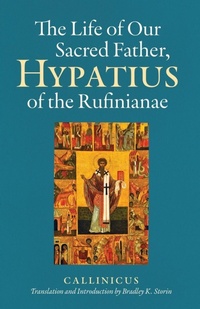
The Life of Our Sacred Father, Hypatius of the Rufinianae
Published on 19. December 2024
Book
Paperback/Softback
186 pages
978-0-87907-356-5 (ISBN)
Description
The life of Hypatius offers a precious witness to the timeless perspectives, values, and virtues of the former fifth-century abbot and saint.
Better known by its short title, the Life of Hypatius was written in the mid-fifth century by Callinicus, the second abbot of the monastery that Hypatius (ca. 366-446) founded across the Bosporus Strait from Constantinople. Saint Hypatius was known for his ascetic regimen, unflagging rigor, and spiritual wisdom, and he challenged his disciples to resist careless Christianity and eliminate the influence of paganism. In this monastic hagiography, readers encounter a stark vision where monks are spiritual enforcers working with zeal and vigilance to promote Christian orthodoxy, worship, and moral conduct. The Life of Our Sacred Father, Hypatius of the Rufinianae offers:
a precious witness to the perspectives, values, and attitudes of the early generation of monks in and around Constantinople.
enthusiasm for imperial Christianity juxtaposed with a distrust for the worldliness of clergy members and an aggravated hostility toward traditional, local, and non-Christian worship practices.
a look at Hypatius's long paraenetic discourse that focuses on the timeless and indisputable virtues that monks strove to cultivate, including: humility, possessionlessness, care for the poor, self-control, and zealous commitment.
Better known by its short title, the Life of Hypatius was written in the mid-fifth century by Callinicus, the second abbot of the monastery that Hypatius (ca. 366-446) founded across the Bosporus Strait from Constantinople. Saint Hypatius was known for his ascetic regimen, unflagging rigor, and spiritual wisdom, and he challenged his disciples to resist careless Christianity and eliminate the influence of paganism. In this monastic hagiography, readers encounter a stark vision where monks are spiritual enforcers working with zeal and vigilance to promote Christian orthodoxy, worship, and moral conduct. The Life of Our Sacred Father, Hypatius of the Rufinianae offers:
a precious witness to the perspectives, values, and attitudes of the early generation of monks in and around Constantinople.
enthusiasm for imperial Christianity juxtaposed with a distrust for the worldliness of clergy members and an aggravated hostility toward traditional, local, and non-Christian worship practices.
a look at Hypatius's long paraenetic discourse that focuses on the timeless and indisputable virtues that monks strove to cultivate, including: humility, possessionlessness, care for the poor, self-control, and zealous commitment.
Reviews / Votes
"Scholars and students have long needed an accessible version of the Life of Hypatius, and Storin's skillful translation brings the life of this late ancient saint into elegant, striking English. The scenes in Hypatius's life illustrate major themes in the study of early Christianity, from the importance of bodily holiness to the prevalence of religious violence, from the basic tenets of spiritual direction to the organization of a successful monastery. Accompanying the text is a comprehensive introduction to Hypatius's life and to the late ancient genre of saint's lives in general-teachers and students will benefit from Storin's sensible, erudite treatment of hagiography and its uses."Ellen Muehlberger, Professor of History, University of Michigan "In his translation of this understudied text, Storin shares the foundational narratives of a monastery in a suburb of fifth-century Constantinople. While very much hagiography with all its tropes, the text also reveals the workings of a significant monastery involved in the ecclesiastical disputes of its days, as well as its role in a late antique neighborhood with all its peculiar characters, squabbles, and worries. It is a delightful text that offers valuable glimpses into how the relationship between a local monastery and its community were imagined."
Rebecca Stephens Falcasantos, Assistant Professor of Religion, Amherst College "This is a useful book for those who are interested in monastic hagiography, but it also gives an insight into the Church and some of the theological controversies of the time. It is, in many ways, extraordinary that the Rufinianae has disappeared into such obscurity and Dr. Storin is to be commended for bringing it back to our attention."
The Downside Review
More details
Series
Language
English
Place of publication
Collegeville, MN
United States
Target group
College/higher education
Professional and scholarly
Product notice
Paperback (trade)
Dimensions
Height: 216 mm
Width: 140 mm
Thickness: 10 mm
Weight
240 gr
ISBN-13
978-0-87907-356-5 (9780879073565)
Copyright in bibliographic data and cover images is held by Nielsen Book Services Limited or by the publishers or by their respective licensors: all rights reserved.
Schweitzer Classification
Other editions
Additional editions
E-Book
12/2024
1st Edition
LITURGICAL PRESS
from
€44.99
Available for download
Persons
Bradley K. Storin is the associate professor of the history of Christianity in the department of philosophy and religious studies at Louisiana State University. He is the author of Self-Portrait in Three Colors: The Epistolary Autobiography of Gregory of Nazianzus (University of California Press, 2019). He published the first English translation of Gregory's entire letter collection (Gregory of Nazianzus's Letter Collection: The Complete Translation [University of California Press, 2019]), and he has published translations of many Greek, Latin, and Syriac texts in The Cambridge Edition of Early Christian Writings.
Content
Contents
Acknowledgments vii
Map of Constantinople and the Surrounding Area viii
Introduction 1
Note on Translation 39
The Life of Our Sacred Father, Hypatius of the Rufinianae 41
Bibliography 165
Index of Scriptural References and Citations 173
Acknowledgments vii
Map of Constantinople and the Surrounding Area viii
Introduction 1
Note on Translation 39
The Life of Our Sacred Father, Hypatius of the Rufinianae 41
Bibliography 165
Index of Scriptural References and Citations 173