

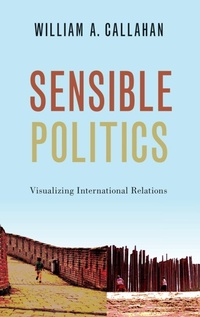
Sensible Politics
Visualizing International Relations
Published on 5. March 2020
Book
Hardback
364 pages
978-0-19-007173-8 (ISBN)
Description
Visual images are everywhere in international politics. But how are we to understand them? In Sensible Politics, William A. Callahan uses his expertise in theory and filmmaking to explore not only what visuals mean, but also how visuals can viscerally move and connect us in "affective communities of sense." The book's rich analysis of visual images (photographs, film, art) and visual artifacts (maps, veils, walls, gardens, cyberspace) shows how critical scholarship needs to push beyond issues of identity and security to appreciate the creative politics of social-ordering and world-ordering. Here "sensible politics" isn't just sensory, but looks beyond icons and ideology to the affective politics of everyday life. It challenges our Eurocentric understanding of international politics by exploring the meaning and impact of visuals from Asia and the Middle East. Sensible Politics offers a unique approach to politics that allows us to not only think visually, but also feel visually-and creatively act visually for a multisensory appreciation of politics.
Reviews / Votes
Together with recent contributions to visual IR, Callahan's book proves how insightful a broader perspective on visual artefacts is. * Gabi Schlag, University of Tuebingen, Germany, International Affairs * Sensible Politics is a provocative, intellectually and visually stimulating book that convincingly situates the visual at the heart of global politics. Callahan brings his deep knowledge of Chinese culture and history to show how visual politics is a global phenomenon that cannot be understood without taking a multisensory, interdisciplinary approach. Engaging with Callahan's work is a sensory experience in itself: the interplay of text, image, and touch of the page draws the reader in, with each chapter stepping the reader through the argument as one might hop across sunken stones in a memorial garden lake, challenging, exciting, and enticing the reader to see what is on the other side of each chapter. This book is an excellent example of what critical inquiry can accomplish outside of the confines of conventional academic practice. * Constance Duncombe, H - Diplo * Sensible Politics is an excellent read for anyonetrying to understand changing internationalrelations in a post-pandemic scenario. * Gazal Arora, Jawaharlal Nehru University, Insight Turkey * Sensible Politics is the one book I've read on visual politics that applies critical thinking on what the visual can do - rupture, appeal to the senses, disorient - to the written word. The written word exists in 'dynamic dyad' with the images in the book, while the structure and the chapters interline to create a multisensory experience in reading it: Callahan is not just telling us about such dyadic interactions, he is showing us. * Professor Sophie Harman, LSE Review of Books * William A. Callahan offers an impressive and genuinely interdisciplinary tour-de-force of visual global politics. Reaching beyond the Western cannon and beyond a conventional focus on images and icons, he compellingly shows how the visual can-and should-be seen as a much broader phenomena that fundamentally shapes how we view and conduct global politics." -Roland Bleiker, Professor of International Relations, University of QueenslandMore details
Language
English
Place of publication
New York
United States
Target group
Professional and scholarly
Dimensions
Height: 240 mm
Width: 161 mm
Thickness: 24 mm
Weight
708 gr
ISBN-13
978-0-19-007173-8 (9780190071738)
Copyright in bibliographic data and cover images is held by Nielsen Book Services Limited or by the publishers or by their respective licensors: all rights reserved.
Schweitzer Classification
Other editions
Additional editions
Book
03/2020
Oxford University Press Inc
€45.50
Shipment within 15-20 days
E-Book
01/2020
OUP eBook
€20.99
Available for download
E-Book
01/2020
OUP eBook
€15.49
Available for download
Person
William A. Callahan is Professor of International Relations at the London School of Economics and Political Science. His recent books include China Dreams: 20 Visions of the Future (OUP, 2015) and China: The Pessoptimist Nation (OUP: 2010). Callahan also makes documentary films: "China Dreams" was broadcast on KCET (Los Angeles) in 2015, "Toilet Adventures" (2015) was shortlisted for a major award by the Arts and Humanities Research Council, and "Great Walls" (2019) juxtaposes Trump's wall with the Great Wall of China.
Content
Preface
Introduction: Visualizing International Relations
Part I: Visibility/Visuality: A Framework for Analysis
1. Visibility: The Social Construction of the Visual
2. Visuality: The Visual Performance of the International
3. Dynamic Dyads: Visibility/Visuality and East/West
Part II: Visual Images
4. Methods, Ethics, and Filmmaking
5. Visualizing Security, Order, and War
6. Visual Art, Ethical Witnessing, and Resistance
Part III: Visual Artifacts and Sensory Spaces
7. Maps, Space, and Power
8. The Sartorial Engineering of Race, Gender, and Faith
9. Walls as Barriers, Gateways, and the Sublime
10. Gardens in Diplomacy, War, and Peace
11. Visibility, Visuality, and Mass (Self)Surveillance
Conclusion: Sensible Politics
Introduction: Visualizing International Relations
Part I: Visibility/Visuality: A Framework for Analysis
1. Visibility: The Social Construction of the Visual
2. Visuality: The Visual Performance of the International
3. Dynamic Dyads: Visibility/Visuality and East/West
Part II: Visual Images
4. Methods, Ethics, and Filmmaking
5. Visualizing Security, Order, and War
6. Visual Art, Ethical Witnessing, and Resistance
Part III: Visual Artifacts and Sensory Spaces
7. Maps, Space, and Power
8. The Sartorial Engineering of Race, Gender, and Faith
9. Walls as Barriers, Gateways, and the Sublime
10. Gardens in Diplomacy, War, and Peace
11. Visibility, Visuality, and Mass (Self)Surveillance
Conclusion: Sensible Politics