

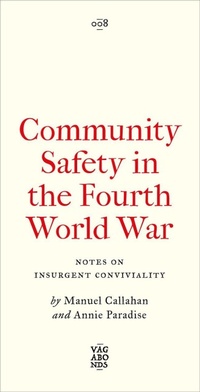
Community Safety in the Fourth World War
Notes on Insurgent Conviviality
Will be published approx. on 20. July 2026
Book
Paperback/Softback
176 pages
978-0-7453-5151-3 (ISBN)
Description
We are living through what the Zapatistas call the 'Fourth World War'-a war waged by the forces of colonialism and racial capitalism-that insists we forget our victories, relinquish our practices of care, and abandon our struggle. For communities targeted and ravaged by policing and militarization, safety is a paramount concern. But where do we turn? To the state, with its warped ideas of security and all its attendant violences?
Drawing on more than a decade of 'convivial research' and 'insurgent learning', alongside struggles across the San Francisco Bay Area, and in dialogue with struggles across the Global South, the authors argue for self-organized, locally rooted insurgent conviviality. This, they claim, can be observed through a community safety with five critical elements: community self-defense; fierce care; assembly; knowledge production and self-representation; and autonomous justice.
Advancing conviviality as a praxis, as a counterforce to racial patriarchal capital, this book aims to re-enchant the world through a focus on life; to share and generate tools, strategies, and theorizations that build from below in order to cross-pollinate struggles everywhere.
Drawing on more than a decade of 'convivial research' and 'insurgent learning', alongside struggles across the San Francisco Bay Area, and in dialogue with struggles across the Global South, the authors argue for self-organized, locally rooted insurgent conviviality. This, they claim, can be observed through a community safety with five critical elements: community self-defense; fierce care; assembly; knowledge production and self-representation; and autonomous justice.
Advancing conviviality as a praxis, as a counterforce to racial patriarchal capital, this book aims to re-enchant the world through a focus on life; to share and generate tools, strategies, and theorizations that build from below in order to cross-pollinate struggles everywhere.
Reviews / Votes
'Unraveling the codes of violence unfolding across multiple geographies and diverse sociocultural fabrics-yet always inscribed upon the same wretched of the earth-the authors propose a combative and dissident impulse-concept aimed at disarming societal violence while weaving new fabrics of life: fierce care.' -- Ana Esther Cecena, Institute for Economic Research, National Autonomous University of Mexico 'A collective ethnography, a workbook and a toolkit for convivial research that makes us want to study assembly and create the councils of care.' -- Gerald Raunig, Professor of Philosophy, Zurich University of the Arts 'The indispensable handbook for living in the dark times. Study it, engage with it and most of all, live by it' -- Nicholas Mirzoeff, author of <i>To See In the Dark: Palestine and Visual Activism Since October 7</i>More details
Series
Language
English
Place of publication
London
United Kingdom
Product notice
Paperback (UK-trade)
Dimensions
Height: 215 mm
Width: 110 mm
Thickness: 12 mm
Weight
454 gr
ISBN-13
978-0-7453-5151-3 (9780745351513)
Copyright in bibliographic data and cover images is held by Nielsen Book Services Limited or by the publishers or by their respective licensors: all rights reserved.
Schweitzer Classification
Persons
Manuel Callahan is the co-founder of the Center for Convivial Research and Autonomy (CCRA), a transterritorial research collective based in the San Francisco Bay Area with connections to struggles across Southern Mexico. Since 2003, he has facilitated the Universidad de la Tierra, Califas. For over three decades, he has been a primary activator of Accion Zapatista, including work with the Zapatista Autonomy Project. He is both a researcher and co-convener of the Counter Counterinsurgency Lab.
Annie Paradise is a member of the Center for Convivial Research and Autonomy (CCRA), a transterritorial research collective, and a collaborator with the Universidad de la Tierra, Califas, an autonomous learning initiative, both based in the San Francisco Bay Area. She is a researcher and co-convener of the Counter Counterinsurgency Lab, and together with Manuel Callahan and others, facilitates Methodologies Against Forgetting and Oblivion (MAFO).
Annie Paradise is a member of the Center for Convivial Research and Autonomy (CCRA), a transterritorial research collective, and a collaborator with the Universidad de la Tierra, Califas, an autonomous learning initiative, both based in the San Francisco Bay Area. She is a researcher and co-convener of the Counter Counterinsurgency Lab, and together with Manuel Callahan and others, facilitates Methodologies Against Forgetting and Oblivion (MAFO).
Content
Foreword by Stefano Harney and Fred Moten
Introduction
1. Fierce Care
2. Community Self-Defense
3. Insurgent Knowledge Production
4. Assembly
5. Autonomous Justice
Notes
Introduction
1. Fierce Care
2. Community Self-Defense
3. Insurgent Knowledge Production
4. Assembly
5. Autonomous Justice
Notes