

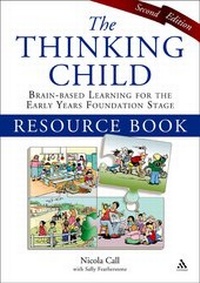
The Thinking Child Resource Book
Brain-based learning for the early years foundation stage
2nd Edition
Published on 17. June 2010
Book
Paperback/Softback
192 pages
978-1-85539-741-5 (ISBN)
Description
This fully-updated edition offers hundreds of practical hints and tips for implementing brain-based learning in early years settings for practitioners, students and parents. In this new edition of a popular resource, the authors combine their knowledge and experience to provide a wealth of practical suggestions on how to implement brain-based learning techniques in early years settings. This practical resource includes ways to promote self-esteem and emotional intelligence; ideas for teaching through play, music and movement; activities for circle time; and, advice on managing behaviour positively and fostering relationships with parents and carers. Case studies from a range of settings provide insights into using brain-based techniques to enrich the learning experience of young children. This resource book can be used independently or as a companion to the more theoretical "The Thinking Child". Handy margin references direct practitioners to the appropriate pages of the sister book should the reader wish to learn more about the theory and research behind the practical suggestions.
An indispensable resource for early years practitioners of all settings, this book will also appeal to trainee teachers and parents.
An indispensable resource for early years practitioners of all settings, this book will also appeal to trainee teachers and parents.
Reviews / Votes
An extremely practical, accessible guide to putting brain-based research into action in foundation stage settings. Children taught like this will be at a huge advantage in the acquisition of literacy skills... indeed, in all their learning. -- Sue Palmer, Literacy Specialist Many of the ideas and suggestions in the book can be used to support approaches and ways of working that are used in a wide variety of different early years settings. -- Early Years Update "These are by no means tick lists, but thought-provoking ideas that will move practitioners on in terms of fun, creativity and innovation... It is an indispensable resource that no practitioner, or those in training, should be without." -- Martine Horvath, Early Years EducatorMore details
Edition
2nd edition
Language
English
Place of publication
London
United Kingdom
Publishing group
Bloomsbury Publishing PLC
Target group
Professional and scholarly
Illustrations
70
Dimensions
Height: 297 mm
Width: 210 mm
ISBN-13
978-1-85539-741-5 (9781855397415)
Copyright in bibliographic data and cover images is held by Nielsen Book Services Limited or by the publishers or by their respective licensors: all rights reserved.
Schweitzer Classification
Other editions
Additional editions
Nicola Call
The Thinking Child Resource Book
Brain-Based Learning for the Early Years Foundation Stage
E-Book
06/2010
2nd Edition
Continuum Publishing Corporation
€29.99
Available for download
Person
Nicola Call started her teaching career in Inner London, rising rapidly to become Deputy Head of three primary schools. Nicola now lives in California where she combines writing with research into Accelerated Learning work in schools. Sally Featherstone is co-founder of a publishing company, Featherstone Education, with her husband. Sally won 'Education Publisher of the Year' at the Independent Publishing Awards 2007.
Content
Introduction: Understanding the child's brain; Step 1: About brain-based learning; Step 2: Meeting the children in their settings; Part One: Preparing the climate and context for learning; Step 1: Addressing the children's physical needs; Step 2: Developing emotional intelligence; Step 3: Providing children with the tools for learning; Step 4: Managing behaviour positively; Step 5: Fostering partnerships with parents and carers; Step 6: Inclusion; Part Two: Supporting independent learning; Step 1: Making maximum use of the environment; Step 2: Helping children to develop good attention skills; Step 3: Helping children to stay on task; Step 4: Talking the language of learning; Part Three: Developing brain-based techniques; Step 1: Teaching children to mind map; Step 2: Adventures in play; Step 3: Maximizing learning through music; Step 4: Teaching and learning through movement; Step 5: The place for technology; Part Four: Teaching for intelligence; Step 1: Creative teaching for better learning; Step 2: Fostering the beginnings of group work; Step 3: Teaching through VAK; Step 4: Engaging the multiple intelligences; Step 5: Over-scheduled children and the importance of 'downtime'; References; Appendices; Some principles for planning; Key vocabulary; Recommended reading; Useful websites; Photocopiable material; Index.