

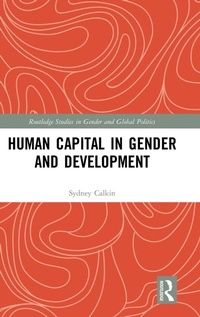
Human Capital in Gender and Development
Feminist Political Economy and Empowerment
1st Edition
Published on 3. May 2018
Book
Hardback
200 pages
978-1-138-69734-8 (ISBN)
Description
Human Capital in Gender and Development addresses timely feminist debates about the relationship between feminism, neoliberalism, and international development. The book engages with human capital theory, a labour economics theory associated with the Chicago School that now animates a wide range of political and economic governance. The book argues that human capital theory has been instrumental in constructing an economistic vision of gender equality as a tool for economic growth, and girls and women of the global South as the quintessential entrepreneurs of the post-global financial crisis era.
The book's critique of human capital theory and its role in Gender and Development gives insights into the kinds of development interventions that typify the 'Gender Equality as Smart Economics' agenda of the World Bank and other international development institutions. From the World Bank, to NGOs, and private businesses, discourses about the economic benefits of gender equality and women's empowerment underpin a range of development interventions that aim to unlock the 'untapped' potential of the world's women. Its implications are both conceptual and material, producing more interventionist forms of development governance, increased power by private sector actors in development, and de-politicization of gender equality issues.
Human Capital in Gender and Development will be of particular interest to feminist scholars in Politics, International Relations, Development Studies, and Human Geography. It will also be a useful resource for teaching key debates about feminism, neoliberalism, and international development.
The book's critique of human capital theory and its role in Gender and Development gives insights into the kinds of development interventions that typify the 'Gender Equality as Smart Economics' agenda of the World Bank and other international development institutions. From the World Bank, to NGOs, and private businesses, discourses about the economic benefits of gender equality and women's empowerment underpin a range of development interventions that aim to unlock the 'untapped' potential of the world's women. Its implications are both conceptual and material, producing more interventionist forms of development governance, increased power by private sector actors in development, and de-politicization of gender equality issues.
Human Capital in Gender and Development will be of particular interest to feminist scholars in Politics, International Relations, Development Studies, and Human Geography. It will also be a useful resource for teaching key debates about feminism, neoliberalism, and international development.
More details
Series
Language
English
Place of publication
London
United Kingdom
Publishing group
Taylor & Francis Ltd
Target group
College/higher education
Illustrations
2 s/w Abbildungen, 2 s/w Zeichnungen, 2 s/w Tabellen
2 Tables, black and white; 2 Line drawings, black and white; 2 Illustrations, black and white
Dimensions
Height: 240 mm
Width: 161 mm
Thickness: 16 mm
Weight
473 gr
ISBN-13
978-1-138-69734-8 (9781138697348)
Copyright in bibliographic data and cover images is held by Nielsen Book Services Limited or by the publishers or by their respective licensors: all rights reserved.
Schweitzer Classification
Other editions
Additional editions
Sydney Calkin
Human Capital in Gender and Development
Book
11/2019
1st Edition
Routledge
€52.07
Shipment within 15-20 days
E-Book
05/2018
1st Edition
Routledge
€59.49
Available for download
E-Book
05/2018
Routledge
€59.49
Available for download
Person
Sydney Calkin is Assistant Professor (Research) and Leverhulme Early Career Fellow in Human Geography at Durham University. Her research addresses questions at the intersection of political economy, reproductive justice, and international relations.
Content
Introduction 1. Feminism, Neoliberalism and Development 2. A Feminist Critique of Human Capital Theory 3. Gender, Development and Smart Economics at the World Bank 4. Unlocking Female Resources 5. Girl Effects 6. Human Capital, Private Profit Conclusion