

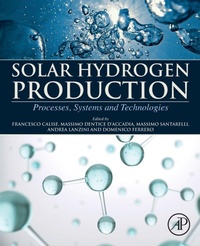
Solar Hydrogen Production
Processes, Systems and Technologies
Published on 16. August 2019
Book
Paperback/Softback
560 pages
978-0-12-814853-2 (ISBN)
Description
Solar Hydrogen Production: Processes, Systems and Technologies presents the most recent developments in solar-driven hydrogen generation methods. The book covers different hydrogen production routes, from renewable sources, to solar harvesting technologies. Sections focus on solar energy, presenting the main thermal and electrical technologies suitable for possible integration into solar-based hydrogen production systems and present a thorough examination of solar hydrogen technologies, ranging from solar-driven water electrolysis and solar thermal methods, to photo-catalytic and biological processes. All hydrogen-based technologies are covered, including data regarding the state-of-the art of each process in terms of costs, efficiency, measured parameters, experimental analyses, and demonstration projects.
In the last part of the book, the role of hydrogen in the integration of renewable sources in electric grids, transportation sector, and end-user applications is assessed, considering their current status and future perspectives. The book includes performance data, tables, models and references to available standards. It is thus a key-resource for engineering researchers and scientists, in both academic and industrial contexts, involved in designing, planning and developing solar hydrogen systems.
In the last part of the book, the role of hydrogen in the integration of renewable sources in electric grids, transportation sector, and end-user applications is assessed, considering their current status and future perspectives. The book includes performance data, tables, models and references to available standards. It is thus a key-resource for engineering researchers and scientists, in both academic and industrial contexts, involved in designing, planning and developing solar hydrogen systems.
More details
Language
English
Place of publication
San Diego
United States
Publishing group
Elsevier Science Publishing Co Inc
Target group
Professional and scholarly
Energy engineering researchers in academia and industry. Master and PhD students in this field. Energy engineering professionals, including electrical and mechanical engineers.
Product notice
Paperback (trade)
Dimensions
Height: 231 mm
Width: 193 mm
Thickness: 35 mm
Weight
1143 gr
ISBN-13
978-0-12-814853-2 (9780128148532)
Copyright in bibliographic data and cover images is held by Nielsen Book Services Limited or by the publishers or by their respective licensors: all rights reserved.
Schweitzer Classification
Other editions
Additional editions
Francesco Calise | Massimo Dentice D'Accadia | Massimo Santarelli
Solar Hydrogen Production
Processes, Systems and Technologies
E-Book
08/2019
Academic Press
€175.00
Available for download
Persons
Francesco Calise is currently a Professor in the Department of Industrial Engineering at the University of Naples Federico II, Italy. He teaches several courses of energy management and applied thermodynamics, and has been invited to lecture for courses in the UK and Finland. Prof. Calise has been involved in several research projects funded by EU and Italian Government and has served as chair and/or member of scientific committee in a number of international conferences. His research interests include fuel cells, solar energy, polygeneration systems, cogeneration, and efficiency in energy systems. Massimo Dentice d'Accadia is a mechanical engineer and holds a Ph. D. degree in Applied Thermodynamics. Presently, he is Full Professor of Energetics and Applied Thermodynamics at the University of Naples Federico II. He is also member of the advisory board of the Department of Industrial Engineering and Energy Manager in the same university. His fields of interest include thermodynamic and thermoeconomic analysis of advanced energy systems, energy saving, and renewable energy sources. On these topics, Professor d'Accadia has published numerous scientific papers, mostly in International journals and proceedings of international conferences. Currently, he is coordinator of government-funded research programs such as SAHARA (Solar-Assisted Heating And Refrigeration Appliances) and RISE (Research and Innovation in the Energy Sector - section: Concentrated Solar Power). In addition, he is a reviewer for a number of international journals and for many scientific organizations, such as ASME (American Society of Mechanical Enegineers). He is evaluator/monitoring/reviewer expert for the European Commission (FP7 research and innovation programmes) and for Italian public institutions, such as the Ministry of the economic Development (MiSE), the Ministry of University and Research (MIUR), the Italian Energy Authority and the Tuscan Region. Massimo Gian Luca Santarelli is a mechanical engineer, Ph.D. in Thermodynamics and Heat Transfer and Full Professor at the Department of Energy, Politecnico di Torino, Italy. He is Affiliated Professor in KTH, Stockholm, Sweden, and has published a great number of articles in international journals and conference proceedings. Professor Santarelli is also Coordinator of EU Project SOFCOM (FCH JU Call 2010), and DEMOSOFC (FCH2 JU Call 2014), as well as partner in EU projects such as GRINHY, ENEFIELD, ENFICA-FC, SELECT-CD, Explore Energy, Virtual Hub, and MARS-EV, in addition to other national projects. He has been chair for Italy of ISO/TC 197 'Hydrogen Technologies. At Politecnico Torino, he is Coordinator of the SOFC/SOEC section in the High-Quality Laboratory (LAQ) IN.TE.S.E. (Technology Innovation for Energy Sustainability), focusing on SOFC and SOEC single cells and short stacks, high pressure PEM electrolysis, and power-to-chemical (synthetic CH4). Andrea Lanzini received his B.S. and M.S. in Energy and Nuclear Engineering in 2007 and his Ph.D. in Energetics in 2011. He is post-doc research associate at the Energy Department of Politecnico di Torino, Italy, and member of the STEPS (Synergies of Thermochemical and Electrochemical Systems) Group. He has published various articles in international peer-reviewed journals, gathering a fast-growing citation count. He was awarded with a Fulbright scholarship in 2010/2011, spent as visiting scientist in the Energy Systems Analysis Group (ESAG) at Princeton University, United States. Post-doctoral Researcher, Department of Energy, Politecnico di Torino, Italy
Editor
Professor, Department of Industrial Engineering, University of Naples Federico II, Italy
Professor of Energetics and Applied Thermodynamics, University of Naples Federico II, Italy
Full Professor in Thermodynamics and Heat Transfer, Department of Energy, Politecnico di Torino, Italy
Post-doctoral Research Associate, Department of Energy, Politecnico di Torino, Italy
Post-doctoral Researcher, Department of Energy, Politecnico di Torino, Italy
Content
Part I. Introduction to Hydrogen Production Routes: Processes and technologies
1. Hydrogen properties
2. Hydrogen utilization, market and R&D Projects
3. Hydrogen production
4. Hydrogen storage
Part II. Solar harvesting
5. Solar energy availability
6. Solar thermal collectors
7. Solar thermal power plants
8. Solar photovoltaic (PV)
Part III. Processes for solar-driven Hydrogen production
9. Electrochemical hydrogen generation
10. Hydrogen from solar thermal energy
11. Hydrogen from photo-catalytic water splitting
12. Photo-biologic hydrogen
13. Hybrid and novel systems
14. Comparative analysis of the solar-based hydrogen production techniques
Part IV. Hydrogen for bulk energy storage of renewable power sources
15. Power-to-gas and power-to-power technologies
1. Hydrogen properties
2. Hydrogen utilization, market and R&D Projects
3. Hydrogen production
4. Hydrogen storage
Part II. Solar harvesting
5. Solar energy availability
6. Solar thermal collectors
7. Solar thermal power plants
8. Solar photovoltaic (PV)
Part III. Processes for solar-driven Hydrogen production
9. Electrochemical hydrogen generation
10. Hydrogen from solar thermal energy
11. Hydrogen from photo-catalytic water splitting
12. Photo-biologic hydrogen
13. Hybrid and novel systems
14. Comparative analysis of the solar-based hydrogen production techniques
Part IV. Hydrogen for bulk energy storage of renewable power sources
15. Power-to-gas and power-to-power technologies