

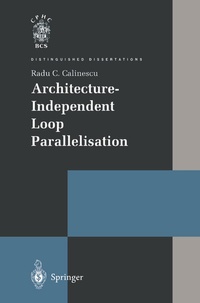
Architecture-Independent Loop Parallelisation
Published on 16. September 2011
Book
Paperback/Softback
XVIII, 172 pages
978-1-4471-1197-9 (ISBN)
Description
Architecture-independent programming and automatic parallelisation have long been regarded as two different means of alleviating the prohibitive costs of parallel software development. Building on recent advances in both areas,
Architecture-Independent Loop Parallelisation
proposes a unified approach to the parallelisation of scientific computing code. This novel approach is based on the bulk-synchronous parallel model of computation, and succeeds in automatically generating parallel code that is architecture-independent, scalable, and of analytically predictable performance.
More details
Series
Edition
Softcover reprint of the original 1st ed. 2000
Language
English
Place of publication
London
United Kingdom
Target group
Professional and scholarly
Research
Illustrations
XVIII, 172 p.
Dimensions
Height: 235 mm
Width: 155 mm
Thickness: 11 mm
Weight
306 gr
ISBN-13
978-1-4471-1197-9 (9781447111979)
DOI
10.1007/978-1-4471-0763-7
Schweitzer Classification
Other editions
Additional editions
Radu C. Calinescu
Architecture-Independent Loop Parallelisation
Book
06/2000
Springer
€123.04
Article exhausted; check different version
Content
1 Introduction.- 1.1 Motivation.- 1.2 Parallelisation Approach Proposed in the Book.- 1.3 Organisation of the Book.- 2 The Bulk-Synchronous Parallel Model.- 2.1 Introduction.- 2.2 Bulk-Synchronous Parallel Computers.- 2.3 The BSP Programming Model.- 2.4 The BSP Cost Model.- 2.5 Assessing the Efficiency of BSP Code.- 2.6 The Development of BSP Applications.- 2.7 BSP Pseudocode.- 3 Data Dependence Analysis and Code Transformation.- 3.1 Introduction.- 3.2 Data Dependence.- 3.3 Code Transformation Techniques.- 4 Communication Overheads in Loop Nest Scheduling.- 4.1 Introduction.- 4.2 Related Work.- 4.3 Communication Overheads Due to Input Data.- 4.4 Inter-Tile Communication Overheads.- 4.5 Summary.- 5 Template-Matching Parallelisation.- 5.1 Introduction.- 5.2 Related Work.- 5.3 Communication-Free Scheduling.- 5.4 Wavefront Block Scheduling.- 5.5 Iterative Scheduling.- 5.6 Reduction Scheduling.- 5.7 Recurrence Scheduling.- 5.8 Scheduling Broadcast Loop Nests.- 5.9 Summary.- 6 Generic Loop Nest Parallelisation.- 6.1 Introduction.- 6.2 Related Work.- 6.3 Data Dependence Analysis.- 6.4 Potential Parallelism Identification.- 6.5 Data and Computation Partitioning.- 6.6 Communication and Synchronisation Generation.- 6.7 Performance Analysis.- 6.8 Summary.- 7 A Strategy and a Tool for Architecture-Independent Loop Parallelisation.- 7.1 Introduction.- 7.2 Related Work.- 7.3 A Two-Phase Strategy for Loop Nest Parallelisation.- 7.4 BSPscheduler: an Architecture-Independent Loop Paralleliser.- 7.5 Summary.- 8 The Effectiveness of Architecture-Independent Loop Parallelisation.- 8.1 Introduction.- 8.2 Matrix-Vector and Matrix-Matrix Multiplication.- 8.3 LU Decomposition.- 8.4 Algebraic Path Problem.- 8.5 Finite Difference Iteration on a Cartesian Grid.- 8.6 Merging.- 8.7 Summary.- 9 Conclusions.- 9.1 Summary of Contributions and Concluding Remarks.- 9.2 Future work directions.