

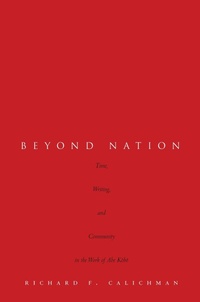
Beyond Nation
Time, Writing, and Community in the Work of AbeKobo
Published on 2. March 2016
Book
Hardback
288 pages
978-0-8047-9701-6 (ISBN)
Description
In the work of writer Abe Kobo (1924-1993), characters are alienated both from themselves and from one another. Through close readings of Abe's work, Richard Calichman reveals how time and writing have the ability to unground identity. Over time, attempts to create unity of self cause alienation, despite government attempts to convince people to form communities (and nations) to recapture a sense of wholeness. Art, then, must resist the nation-state and expose its false ideologies.
Calichman argues that Abe's attack on the concept of national affiliation has been neglected through his inscription as a writer of Japanese literature. At the same time, the institution of Japan Studies works to tighten the bond between nation-state and individual subject. Through Abe's essays and short stories, he shows how the formation of community is constantly displaced by the notions of time and writing. Beyond Nation thus analyzes the elements of Orientalism, culturalism, and racism that often underlie the appeal to collective Japanese identity.
Calichman argues that Abe's attack on the concept of national affiliation has been neglected through his inscription as a writer of Japanese literature. At the same time, the institution of Japan Studies works to tighten the bond between nation-state and individual subject. Through Abe's essays and short stories, he shows how the formation of community is constantly displaced by the notions of time and writing. Beyond Nation thus analyzes the elements of Orientalism, culturalism, and racism that often underlie the appeal to collective Japanese identity.
Reviews / Votes
"Beyond Nationmarks a rare and fortunate encounter of theoretical passion with the work of Abe Kobo. It is also a public protestation against the conservative climate of academia in the United States and Japan. Calichman makes a dimensional leap from the previous studies of Abe Kobo's work and modern Japanese literature."-Naoki Sakai, Goldwin Smith Professor of Asian Studies, Cornell University "At a time when Abe Kobo's work once again reverberates powerfully within contemporary life, Richard Calichman offers a timely intervention into this author's complex and under-thought oeuvre.But beyond the searching insight that he brings to bear, Calichman offers a series of original and critical interventions that resonate just as poignantly with the present."-Akira Mizuta Lippit, Chair, Bryan Singer Divisionof Critical Studies, USC "A remarkable writer and philosopher, Abe Kobo raised questions about human existence and the boundaries of identity which have powerful resonance for the present day. Richard Calichman's work offers a profound and illuminating perspective on Abe's vision of the human condition."-Tessa Morris-Suzuki, Australian National University Calichman reads Abe Kobo's work with extraordinary precision, gathering a focus that unfolds in a layered dialectical cascade of regressions."-Steven C. Ridgely, Journal of Japanese Studies
More details
Edition
New edition
Language
English
Place of publication
Palo Alto
United States
Target group
Professional and scholarly
Edition type
New edition
Product notice
Cloth
Dimensions
Height: 231 mm
Width: 152 mm
Thickness: 20 mm
Weight
522 gr
ISBN-13
978-0-8047-9701-6 (9780804797016)
Copyright in bibliographic data and cover images is held by Nielsen Book Services Limited or by the publishers or by their respective licensors: all rights reserved.
Schweitzer Classification
Person
Richard Calichman is Professor of Japanese Studies at The City College of New York and translator of The Frontier Within: Selected Writings of Abe Kobo (2013).
Content
Introduction
1. Markings in the Sand: On Suna no onna
2. The Time of Disturbance: On "Uchinaru henkyo"
3. The Lure of Community in Tanin no kao
4. Interventions: Of Abe Kobo
Epilogue
1. Markings in the Sand: On Suna no onna
2. The Time of Disturbance: On "Uchinaru henkyo"
3. The Lure of Community in Tanin no kao
4. Interventions: Of Abe Kobo
Epilogue