

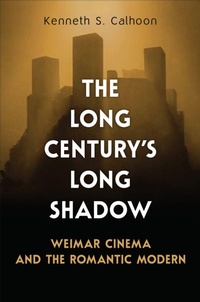
The Long Century's Long Shadow
Weimar Cinema and the Romantic Modern
Published on 25. June 2021
Book
Hardback
288 pages
978-1-4875-2695-5 (ISBN)
Description
The Long Century's Long Shadow approaches German Romanticism and Weimar cinema as continuous developments, enlisting both in a narrative of reciprocal illumination. The author investigates different moments and media as connected phenomena, situated at alternate ends of the "long nineteenth century" but joined by their mutual rejection of the neo-classical aesthetic standard of placid and weightless poise in numerous media, including film, painting, sculpture, prose, poetry, and dance.
Connecting Weimar filmmaking to Romantic thought and practice, Kenneth S. Calhoon offers a non-technological, aesthetic genealogy of cinema. He focuses on well-known literary and artistic works, including films such as Nosferatu, Metropolis, Frankenstein, and Fantasia; the writings of Conrad, Kafka, Goethe, and Novalis; and the paintings of Caspar David Friedrich, one of the leading artists of German Romanticism. With an eye to the modernism of which Weimar filmmaking was a part, The Long Century's Long Shadow employs the Romantic landscape in poetry and painting as a mirror in which to regard cinema.
Connecting Weimar filmmaking to Romantic thought and practice, Kenneth S. Calhoon offers a non-technological, aesthetic genealogy of cinema. He focuses on well-known literary and artistic works, including films such as Nosferatu, Metropolis, Frankenstein, and Fantasia; the writings of Conrad, Kafka, Goethe, and Novalis; and the paintings of Caspar David Friedrich, one of the leading artists of German Romanticism. With an eye to the modernism of which Weimar filmmaking was a part, The Long Century's Long Shadow employs the Romantic landscape in poetry and painting as a mirror in which to regard cinema.
Reviews / Votes
"The study would be of interest to advanced scholars of Weimar cinema well-read in the German and European aesthetic traditions of the nineteenth century. Its richness demands a patient reader, but one who will no doubt be left inspired by what comparative media studies affords to cinema studies."- Ervin Malakaj, University of British Columbia (EuropeNow) "Drawing on various Romantic texts including paintings, poetry, and prose, as well as expressionist Weimar cinema, Calhoun grounds his interpretations of the marriage between German Romanticism and works of expressionist cinema ... This volume is recommended for both advanced students and scholars working in the field of Weimar cinema and Germanic studies."
- Barbara Hales, University of Houston-Clear Lake (German Quarterly) "This volume is recommended for both advanced students and scholars working in the field of Weimar cinema and Germanic studies." - Barbara Hales, University of Houston-Clear Lake (German Quarterly)
More details
Series
Language
English
Place of publication
Toronto
Canada
Target group
College/higher education
Professional and scholarly
Product notice
sewn/stitched
Cloth over boards
With dust jacket
Illustrations
54 b&w illustrations
Dimensions
Height: 231 mm
Width: 150 mm
Thickness: 20 mm
Weight
544 gr
ISBN-13
978-1-4875-2695-5 (9781487526955)
Copyright in bibliographic data and cover images is held by Nielsen Book Services Limited or by the publishers or by their respective licensors: all rights reserved.
Schweitzer Classification
Person
Kenneth S. Calhoon is a professor of German and Comparative Literature at the University of Oregon.
Content
Introduction
1. Empathy Begets Abstraction
2. Under the Sign of Insomnia
3. Nightwatching
4. A Pause in the Action
5. Facing the Image
6. Necessary Advances
Epilogue: Music of the Third Kind
1. Empathy Begets Abstraction
2. Under the Sign of Insomnia
3. Nightwatching
4. A Pause in the Action
5. Facing the Image
6. Necessary Advances
Epilogue: Music of the Third Kind