

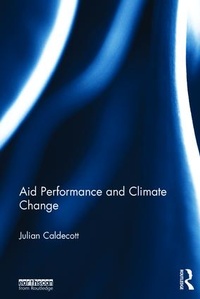
Aid Performance and Climate Change
1st Edition
Published on 19. April 2017
Book
Hardback
260 pages
978-1-138-29446-2 (ISBN)
Description
The richer countries spend about US$165 billion yearly on overseas aid, mainly to keep human development going. These efforts are undermined by climate change, water-catchment damage, biodiversity loss, and desertification, and their interactions with social systems at all scales, which few aid designs or evaluations fully address. This must change if aid performance is to be improved.
Constraints to be overcome include limited understanding of the very complex systems that aid investments affect, and of the ecology behind climate change adaptation and mitigation. Aid Performance and Climate Change targets these problems and others, by explaining how to use multiple points of view to describe each aid investment as a complex system in its own unique context. With examples throughout, it reviews cases, ideas, and options for mitigation using technology and ecology, and for adaptation by preserving resilience and diversity, while exploring related priorities, treaties, and opportunities.
Combining an empirical, eye-witness approach with methodological conclusions, this book is an essential resource for those looking to improve aid design and evaluation, and will be a necessary tool in training the next generation of aid professionals to respond to the causes and consequences of climate change.
Constraints to be overcome include limited understanding of the very complex systems that aid investments affect, and of the ecology behind climate change adaptation and mitigation. Aid Performance and Climate Change targets these problems and others, by explaining how to use multiple points of view to describe each aid investment as a complex system in its own unique context. With examples throughout, it reviews cases, ideas, and options for mitigation using technology and ecology, and for adaptation by preserving resilience and diversity, while exploring related priorities, treaties, and opportunities.
Combining an empirical, eye-witness approach with methodological conclusions, this book is an essential resource for those looking to improve aid design and evaluation, and will be a necessary tool in training the next generation of aid professionals to respond to the causes and consequences of climate change.
Reviews / Votes
"In over 30 years of working in climate, environment and international development this is the most extensive analysis of the lessons from climate and environment interventions based on solid evaluations that I have come across. A must-have for sustainability practitioners and evaluators, and a book I wish I had been able to read many years ago." - John Carstensen, Head of Profession, Climate and Environment, Department for International Development (DFID), UK"This book uniquely captures the skills of a good evaluator as it intelligently combines what needs to be assessed and how to present evidence from a variety of diverse projects and programmes. It offers an essential guide to anyone interested in project/programme design as well as learning how to evaluate. It is the go-to guide that every consultant, donor, and evaluation manager must read. For those starting or learning about project/programme management, look no further than this book - it's pure bottled experience." - Karen Lawrence, Impact Measurement Manager, Zoological Society of London (ZSL), UK
"This book is a hugely valuable contribution to the professionalisation of aid evaluation; a challenge to the prevalent 'conspiracy of optimism' in designing and delivering aid investments; a fascinating source of knowledge on the various kinds of investment aimed at climate change mitigation and adaptation; and a smart guide for navigating the contextual challenges associated with evaluation practice." - Letisha Lunin, Monitoring and Evaluation Coordinator, Climate and Development Knowledge Network (CDKN), PricewaterhouseCoopers LLP, UK
"The evaluation methods described in this book have several strengths. Scoring requires both evidence and analysis, and the process has to be documented in a transparent and systematic manner. As a result, the scores encourage a comparative approach and can promote dialogue. The methods are thus powerful tools, and will be very useful if evaluators are well trained, and if those evaluated are not too defensive to let them be used." - Carmenza Robledo, ECOEXISTENCE - Robledo Abad Althaus, Switzerland.
More details
Language
English
Place of publication
London
United Kingdom
Publishing group
Taylor & Francis Ltd
Target group
College/higher education
Professional and scholarly
Postgraduate, Professional, and Professional Practice & Development
Illustrations
8 s/w Abbildungen, 8 s/w Tabellen
8 Tables, black and white; 8 Illustrations, black and white
Dimensions
Height: 234 mm
Width: 156 mm
Weight
760 gr
ISBN-13
978-1-138-29446-2 (9781138294462)
Copyright in bibliographic data and cover images is held by Nielsen Book Services Limited or by the publishers or by their respective licensors: all rights reserved.
Schweitzer Classification
Other editions
Additional editions
Julian Caldecott
Aid Performance and Climate Change
E-Book
04/2017
Routledge
€55.49
Available for download
Julian Caldecott
Aid Performance and Climate Change
E-Book
04/2017
Routledge
€55.49
Available for download
Julian Caldecott
Aid Performance and Climate Change
Book
04/2017
1st Edition
Routledge
€63.50
Shipment within 10-20 days
Person
Julian Caldecott has a background in wildlife management and rainforest conservation. Since 2000 he has evaluated major aid investment programmes for the EC, UK, Norway, Finland, and Switzerland, five donors that together contribute more than a quarter of all official aid. His work focuses on design and performance issues concerning climate change, biodiversity, ecosystem management, and related matters of sustainability and institutional and community development.
Content
Introduction
Core evaluation criteria
Keeping human development going
Technological mitigation
Ecological mitigation
Adaptation by preserving resilience and diversity
Evaluating partnerships
Evaluating transformations
Conclusions
Core evaluation criteria
Keeping human development going
Technological mitigation
Ecological mitigation
Adaptation by preserving resilience and diversity
Evaluating partnerships
Evaluating transformations
Conclusions