

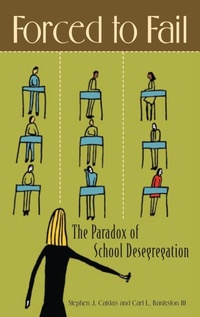
Forced to Fail
The Paradox of School Desegregation
Published on 30. August 2005
Book
Hardback
268 pages
978-0-275-98693-3 (ISBN)
Description
Caldas and Bankston provide a critical, dispassionate analysis of why desegregation in the United States has failed to achieve the goal of providing equal educational opportunities for all students. They offer case histories through dozens of examples of failed desegregation plans from all over the country. The book takes a very broad perspective on race and education, situated in the larger context of the development of individual rights in Western civiliztion.
The book traces the long legal history of first racial segregation, and then racial desegregation in America. The authors explain how rapidly changing demographics and family structure in the United States have greatly complicated the project of top-down government efforts to achieve an ideal racial balance in schools. It describes how social capital-a positive outcome of social interaction between and among parents, children, and teachers-creates strong bonds that lead to high academic achievement.
The authors show how coercive desegregation weakens bonds and hurts not only students and schools, but also entire communities. Examples from all parts of the United States show how parents undermined desegregation plans by seeking better educational alternatives for their children rather than supporting the public schools to which their children were assigned. Most important, this book offers an alternative, more realistic viewpoint on class, race, and education in America.
The book traces the long legal history of first racial segregation, and then racial desegregation in America. The authors explain how rapidly changing demographics and family structure in the United States have greatly complicated the project of top-down government efforts to achieve an ideal racial balance in schools. It describes how social capital-a positive outcome of social interaction between and among parents, children, and teachers-creates strong bonds that lead to high academic achievement.
The authors show how coercive desegregation weakens bonds and hurts not only students and schools, but also entire communities. Examples from all parts of the United States show how parents undermined desegregation plans by seeking better educational alternatives for their children rather than supporting the public schools to which their children were assigned. Most important, this book offers an alternative, more realistic viewpoint on class, race, and education in America.
Reviews / Votes
According to Caldas and Bankston, efforts to enhance racial mixing in schools have been self-defeating. They contend that the premise of desegregation was that schools could redesign American society; however, they believe this clashed with the goals of parents who were concerned only with benefiting their own children....In their new book, the authors look at a wide range of secondary sources to conclude that school people in the US face a paradox. While minority youth might profit from attending middle-class schools, middle-class parents abandon schools that must desegregate. Since the authors believe that racial desegregation exacerbates the problems schools and communities face, they favor strengthening neighborhood schools....Recommended. General readers, upper-division undergraduates through faculty. * Choice *More details
Language
English
Place of publication
United States
Publishing group
Bloomsbury Publishing Plc
Target group
Professional and scholarly
Interest Age: From 7 to 17 years
Dimensions
Height: 240 mm
Width: 161 mm
Thickness: 19 mm
Weight
567 gr
ISBN-13
978-0-275-98693-3 (9780275986933)
Copyright in bibliographic data and cover images is held by Nielsen Book Services Limited or by the publishers or by their respective licensors: all rights reserved.
Schweitzer Classification
Other editions
Additional editions
E-Book
08/2005
1st Edition
Praeger Publishers Inc
€55.99
Available for download
Persons
Stephen J. Caldas is Professor of Educational Foundations and Leadership at the University of Louisiana, Lafayette. He has authored or co-authored more than 45 publications, including the book entitled A Troubled Dream: The Promise and Failure of School Desegregation in Louisiana, which was awarded the Louisiana Library Assn. Literary Award for 2002.
Carl L. Bankston III is Professor of Sociology at Tulane University. He has been author or co-author of several previous books, including Growing Up American: How Vietnamese Children Adapt to Life in the United States (winner of the 1999 Thomas and Znaniecki Award and the Mid South Sociological Association's 2000 Distinguished Book Award), A Troubled Dream: The Promise and Failure of School Desegregation in Louisiana (winner of the 2002 Louisiana Library Association Literary Award), and Blue Collar Bayou: Louisiana Cajuns in the New Economy of Ethnicity. He has also edited six books and authored over 85 journal articles and book chapters.
Carl L. Bankston III is Professor of Sociology at Tulane University. He has been author or co-author of several previous books, including Growing Up American: How Vietnamese Children Adapt to Life in the United States (winner of the 1999 Thomas and Znaniecki Award and the Mid South Sociological Association's 2000 Distinguished Book Award), A Troubled Dream: The Promise and Failure of School Desegregation in Louisiana (winner of the 2002 Louisiana Library Association Literary Award), and Blue Collar Bayou: Louisiana Cajuns in the New Economy of Ethnicity. He has also edited six books and authored over 85 journal articles and book chapters.
Content
School Desegregation: A Policy in Crisis
How Did We Get Here?
The Demographic Transformation of America
It Takes "A Certain Kind" of Village to Raise a Child
The Political Economy of Education and Equality of Educational Opportunity
Rational Self-Interest vs. Irrational Government Policy
School Desegregation and the Racial Achievement Gap
A New Perspective of Race and Schooling: Attaining the Dream
How Did We Get Here?
The Demographic Transformation of America
It Takes "A Certain Kind" of Village to Raise a Child
The Political Economy of Education and Equality of Educational Opportunity
Rational Self-Interest vs. Irrational Government Policy
School Desegregation and the Racial Achievement Gap
A New Perspective of Race and Schooling: Attaining the Dream