

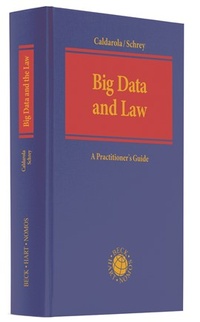
Big Data and Law
Description
“Big Data” refers to large amounts of data originating from various sources which are stored, processed and analysed with specific applications to obtain all kind of (inter-) dependency analyses, environmental and trend research, and for system and production control purposes. As in data mining, knowledge discovery is a priority for Big Data applications.
Big Data is now seen as a new source and a “reserve” of additional revenue. When dealing with Big Data, it is not enough to have the necessary technical expertise and infrastructure. Rather, the legal scope must also be observed. As a result of the applicability of the EU General Data Protection Regulation since 25 May 2018 and the as-sociated potentially substantial fines for data protection infringements, data protection supervisory authorities in particular will intensify their supervisory measures and also focus their attention on Big Data applications.
With numerous guidelines and graphics, this book is a practical legal guide to gathering, storing and analysing personal and other types of data in Big Data applications. It provides comprehensive, practice-oriented assistance and reliability for planning everyday business in a Big Data environment.
Advantages at a glance
- offers a presentation specially tai-lored to the legal problems with Big Data
- gives concrete recommendations for best practice
- is written by authors who are proven in legal challenges with Big Data

More details
Other editions
Additional editions
Persons
Maria C. Caldarola is lawyer and an experienced IP/IT in-house law-yer with worldwide responsibilities in a multinational. She offers a broad spectrum of skills related to licensing, patents, trademarks, domains, software, data protection, cloud, big data, industry 4.0 and new digital business models. She is assistant lecturer of the Master Pro-gram Business Innovation at the University St. Gallen.
Joachim Schrey is a lawyer and certified expert lawyer for IT-law, partner in Noerr LLP and advises on complex IT projects, in particular IT system integration, IT as well as business process outsourcing contracts and digitalization projects. His areas of expertise also include data protection law, Internet of Things and IT compliance. He is an honorary professor at the Universi-ty of Frankfurt/Main and was a member of the advisory board of DC Data Centre Group GmbH.
Content
Content
- Affected data types (personal and factual data)
- Objectives of protection according to different applicable laws (data protection, copyright, civil law…)
- Right holders (data subject, copyright owner, owner or possessor of a thing)
- Lawful grounds for data processing (collection, acquisition, combination, transmission, evaluation and commercialisation)
- Prohibition rights
- Sanctions in case of violation (administrative fines, material and non-material damages, penalties…)
- Verification steps for Big Data applications
- Rights and duties of controller, processors, data protection officers
- Data life cycle, storage and erasure obligations
- Third country transfer and applicable law
- Anonymization/ pseudonymization of data stored in a Big Data database
- Rights of data subjects (information, access, rectification, erasure, portability etc.)
- Records of processing activities, risk assessment /data impact assessment, implementation of technical and organizational measures
- Big Data applications as service