

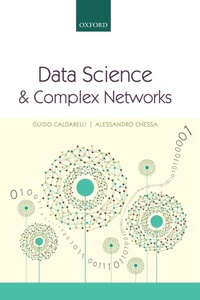
Data Science and Complex Networks
Real Case Studies with Python
Published on 15. September 2016
Book
Hardback
140 pages
978-0-19-963960-1 (ISBN)
Description
This book provides a comprehensive yet short description of the basic concepts of Complex Network theory. In contrast to other books the authors present these concepts through real case studies. The application topics span from Foodwebs, to the Internet, the World Wide Web and the Social Networks, passing through the International Trade Web and Financial time series. The final part is devoted to definition and implementation of the most important network models.
The text provides information on the structure of the data and on the quality of available datasets. Furthermore it provides a series of codes to allow immediate implementation of what is theoretically described in the book. Readers already used to the concepts introduced in this book can learn the art of coding in Python by using the online material. To this purpose the authors have set up a dedicated web site where readers can download and test the codes. The whole project is aimed as a learning tool for scientists and practitioners, enabling them to begin working instantly in the field of Complex Networks.
The text provides information on the structure of the data and on the quality of available datasets. Furthermore it provides a series of codes to allow immediate implementation of what is theoretically described in the book. Readers already used to the concepts introduced in this book can learn the art of coding in Python by using the online material. To this purpose the authors have set up a dedicated web site where readers can download and test the codes. The whole project is aimed as a learning tool for scientists and practitioners, enabling them to begin working instantly in the field of Complex Networks.
Reviews / Votes
Data science and network science are two of the most dynamically developing areas in modern science. It is fantastic to see these two topics, whose synergy is evident to the practitioner, under one roof, presented with clarity and through numerous practical examples by Caldarelli and Chessa. * Albert-Laszlo Barabasi, Northeastern University * The authors nicely integrate ideas from data science and complex networks to create a toolkit for tackling big data challenges. An essential read in the information age. * Geoff F. Rodgers, Brunel University London *More details
Language
English
Place of publication
Oxford
United Kingdom
Target group
College/higher education
Professional and scholarly
Illustrations
26 b/w illustrations
Dimensions
Height: 260 mm
Width: 183 mm
Thickness: 12 mm
Weight
472 gr
ISBN-13
978-0-19-963960-1 (9780199639601)
Copyright in bibliographic data and cover images is held by Nielsen Book Services Limited or by the publishers or by their respective licensors: all rights reserved.
Schweitzer Classification
Other editions
Additional editions
E-Book
11/2016
1st Edition
OUP eBook
€56.49
Available for download
Persons
Guido Caldarelli received his Ph.D. from SISSA (Italy), after which he was a postdoc in the University of Manchester (UK). He then worked at the TCM Group, University of Cambridge (UK), He returned to Italy as a lecturer at National Institute for Condensed Matter (INFM) and later as Primo Ricercatore in the Institute of Complex Systems of the National Research Council (CNR) of Italy. He also spent some terms at University of Fribourg (Switzerland) and he has been visiting professor at ENS in Paris, University of Barcelona and ETH Zurich. He is expert of Statistical Physics and Complex Networks and author of more than 150 publications and two books on the topic. He is currently oordinating the EC FET IP project Multiplex on Multi-level complex systems.
Alessandro Chessa graduated in Physics and received a PhD in theoretical Physics at the University of Cagliari (Italy). From April 1999 to July 2000 he has been Research Associate in the Physics Department of Boston University, studying Econophysics. In the meantime he has also been Scientific Consultant at the International Center for Theoretical Physics (ICTP, Trieste) for a project about Parallel Computation. In the year 2012 he has been adjunct researcher in the Institute for Complex Systems (CNR) , 'La Sapienza' Rome, doing research in the field of Complex Network Theory. At present he is Assistant Professor in Statistical Physics in IMT, Institute of Advanced Studies, Lucca (Italy). Expert of Complex Networks and Data Science, has worked in the area of Community Detection for spatial networks. As entrepreneur is the founder of the SME Linkalab.
Alessandro Chessa graduated in Physics and received a PhD in theoretical Physics at the University of Cagliari (Italy). From April 1999 to July 2000 he has been Research Associate in the Physics Department of Boston University, studying Econophysics. In the meantime he has also been Scientific Consultant at the International Center for Theoretical Physics (ICTP, Trieste) for a project about Parallel Computation. In the year 2012 he has been adjunct researcher in the Institute for Complex Systems (CNR) , 'La Sapienza' Rome, doing research in the field of Complex Network Theory. At present he is Assistant Professor in Statistical Physics in IMT, Institute of Advanced Studies, Lucca (Italy). Expert of Complex Networks and Data Science, has worked in the area of Community Detection for spatial networks. As entrepreneur is the founder of the SME Linkalab.
Content
1: Food Webs
2: International Trade Networks and World Trade Web
3: The Internet Network
4: World Wide Web, Wikipedia and Social Networks
5: Financial Networks
6: Modelling
2: International Trade Networks and World Trade Web
3: The Internet Network
4: World Wide Web, Wikipedia and Social Networks
5: Financial Networks
6: Modelling