

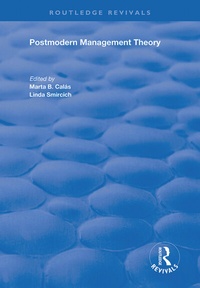
Postmodern Management Theory
1st Edition
Published on 5. June 2019
Book
Hardback
542 pages
978-1-138-36328-1 (ISBN)
Description
First published in 1997, this volume asks: when was 'The Postmodern' in the History of Management Thought? Marta B. Calas and Linda Smircich have chosen this subtitle as entry point to the collection for several reasons. The first, and most evident, is that it prompts us to reflect on the inclusion of a volume on postmodern organization studies within a series of books on the history of management thought. What does such inclusion signal? Are we saying that we are past the postmodern in organization studies? That we have transcended modernity and, beyond, postmodernity?
Similar to other social sciences, organization and management studies in the Anglo-American and European academy became impressed by the styles of 'postmodernism' and their epistemological companions, 'poststructuralisms', during the 1980s.
For this collection we have selected twenty two journal articles, published between 1985 and 1996, that we consider emblematic of postmodern endeavours in management thought, as they further our understanding of how 'truth' (of any paradigmatic persuasion), is fashioned through particular discourses and other signifying practices.
Taken together, these articles address the following questions: What has the field accomplished through attempts at being postmodern? With what consequences? And, where does the field stand now, if it is still/already (going) after 'the postmodern'? In our view 'the postmodern' cannot transcend modern management thought; it is, rather, part of it. Nevertheless, the mere appearance of efforts towards making the field 'postmodern' makes it important to account for them in the history of the field. Such is the narrative that we are trying to portray in this volume.
Similar to other social sciences, organization and management studies in the Anglo-American and European academy became impressed by the styles of 'postmodernism' and their epistemological companions, 'poststructuralisms', during the 1980s.
For this collection we have selected twenty two journal articles, published between 1985 and 1996, that we consider emblematic of postmodern endeavours in management thought, as they further our understanding of how 'truth' (of any paradigmatic persuasion), is fashioned through particular discourses and other signifying practices.
Taken together, these articles address the following questions: What has the field accomplished through attempts at being postmodern? With what consequences? And, where does the field stand now, if it is still/already (going) after 'the postmodern'? In our view 'the postmodern' cannot transcend modern management thought; it is, rather, part of it. Nevertheless, the mere appearance of efforts towards making the field 'postmodern' makes it important to account for them in the history of the field. Such is the narrative that we are trying to portray in this volume.
More details
Series
Language
English
Place of publication
London
United Kingdom
Publishing group
Taylor & Francis Ltd
Target group
College/higher education
Dimensions
Height: 245 mm
Width: 170 mm
Weight
1220 gr
ISBN-13
978-1-138-36328-1 (9781138363281)
Copyright in bibliographic data and cover images is held by Nielsen Book Services Limited or by the publishers or by their respective licensors: all rights reserved.
Schweitzer Classification
Other editions
Additional editions
Marta B. Calas | Linda Smircich
Postmodern Management Theory
Book
02/2020
1st Edition
Routledge
€79.51
Shipment within 10-20 days
Marta B. Calas | Linda Smircich
Postmodern Management Theory
E-Book
01/2019
1st Edition
Routledge
€67.49
Available for download
Marta B. Calas | Linda Smircich
Postmodern Management Theory
E-Book
01/2019
1st Edition
Routledge
€67.49
Available for download
Persons
Marta B. Calás, Linda Smircich
Content
Part I. Imitations. 1. W. Graham Astley (1985), 'Administrative Science As Socially Constructed Truth', Administrative Science Quarterly, 30, pp. 497-513. 2. John M. Jermier (1985), '"When the Sleeper Wakes": A Short Story Extending Themes in Radical Organization Theory', Journal of Management, 11, pp. 67-80. 3. Robert Cooper (1986), 'Organization/Disorganization', Social Science Information, 25, pp. 299-335. 4. Stewart R. Clegg (1989), 'Radical Revisions: Power, Discipline and Organizations', Organization Studies, 10, pp. 97-115. Part 2. Articulations. 5. Robert Cooper and Gibson Burrell (1988), 'Modernism, Postmodernism and Organizational Analysis: An Introduction', Organization Studies, 9, pp. 91-112. 6. David Harvey (1991), 'Flexibility: Threat or Opportunity?', Socialist Review, 21, pp. 65-77. 7. Martin Parker (1992), 'Post-Modern Organizations or Postmodern Organization Theory?', Organization Studies, 13, pp. 1-17. Part 3. Genealogical appropriations: The Foucauldian Turn. 8. Graham Sewell and Barry Wilkinson (1992), '"Someone to Watch Over Me": Surveillance, Discipline and the Just-in-Time Labour Process', Sociology, 26, pp. 271-89. 9. David Knights (1992), 'Changing Spaces: The Disruptive Impact of a New Epistemological Location for the Study of Management', Academy of Management Review, 17, pp. 514-36. 10. Paul du Gay and Graeme Salaman (1992), 'The Cult[ure] of the Customer', Journal of Management Studies, 29, pp. 615-33. 11. Barbara Townley (1993), 'Foucault, Power/Knowledge, and Its Relevance for Human Resource Management', Academy of Management Review, 18, pp. 518-45. Part 4. Deconstructive Appropriations: the Derridean Turn. 12. C. Edward Arrington and Jere R. Francis (1989), 'Letting the Chat out of the Bag: Deconstruction, Privilege and Accounting Research', Accounting, Organizations and Society, 14, pp.1-28. 13. Joanne Martin (1990), 'Deconstructing Organizational Taboos: The Suppression of Gender Conflict in Organizations', Organization Science, 1, pp. 339-59. 14. Marta B. Calas and Linda Smircich (1991), 'Voicing Seduction to Silence Leadership', Organization Studies, 12, pp. 567-602. 15. Dennis K. Mumby and Linda L. Putnam (1992), 'The Politics of Emotion: A Feminist Reading of Bounded Rationality', Academy of Management Review, 17, pp. 465-86. 16. Marta B. Calas (1993), 'Deconstructing Charismatic Leadership: Re-Reading Weber from the Darker Side', Leadership Quarterly, 4, pp. 305-28. 17. Cynthia Mathis Beath and Wanda J. Orlikowski (1994), 'The Contradictory Structure of Systems Development Methodologies: Deconstructing the IS-User Relationship in Information Engineering', Information Systems Research, 5, pp. 350-77. 18. Eileen Fischer and Julia Bristor (1994), 'A Feminist Poststructuralist Analysis of the Rhetoric of Marketing Relationships', International Journal of Research in Marketing, 11, pp. 317-31. 19. David M. Boje (1995), 'Stories of the Storytelling Organization: A Postmodern Analysis of Disney as "Tamara-Land"', Academy of Management Journal, 38, pp. 997-1035. Part 5. Past 'The Post': When 'the Other' Speaks Back. 20. Stella M. Nkomo (1992), 'The Emperor Has No Clothes: Rewriting "Race in Organizations'", Academy of Management Review, 17, pp. 487-513. 21. Felix Alvarado (1996), 'Concerning Postmodernity and Organizations in the Third World: Opening a Debate and Suggestions for a Research Agenda', Organization Science, 7, pp. 667-81. 22. Jan Nederveen Pieterse (1994), 'Globalisation as Hybridisation', International Sociology, 9, pp. 161-84.