

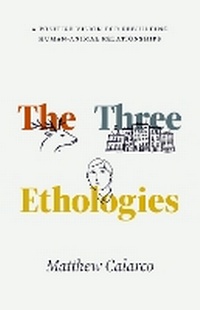
The Three Ethologies
A Positive Vision for Rebuilding Human-Animal Relationships
Will be published approx. on 20. May 2024
Book
Hardback
160 pages
978-0-226-83243-2 (ISBN)
Description
A transformative vision for human-animal relations on personal, social, and environmental levels.
The Three Ethologies offers a fresh, affirmative vision for rebuilding human-animal relations. Venturing beyond the usual scholarly and activist emphasis on restricting harm, Matthew Calarco develops a new philosophy for understanding animal behavior-a practice known as ethology-through three distinct but interrelated lenses: mental ethology, which rebuilds individual subjectivity; social ethology, which rethinks our communal relations; and environmental ethology, which reconfigures our relationship to the land we co-inhabit with our animal kin. Drawing on developments in philosophy, (eco)feminist theory, critical geography, Indigenous studies, and the environmental humanities, Calarco casts an inspiring vision of how ethological living can help us to reimagine our ideas about goodness, truth, and beauty.
The Three Ethologies offers a fresh, affirmative vision for rebuilding human-animal relations. Venturing beyond the usual scholarly and activist emphasis on restricting harm, Matthew Calarco develops a new philosophy for understanding animal behavior-a practice known as ethology-through three distinct but interrelated lenses: mental ethology, which rebuilds individual subjectivity; social ethology, which rethinks our communal relations; and environmental ethology, which reconfigures our relationship to the land we co-inhabit with our animal kin. Drawing on developments in philosophy, (eco)feminist theory, critical geography, Indigenous studies, and the environmental humanities, Calarco casts an inspiring vision of how ethological living can help us to reimagine our ideas about goodness, truth, and beauty.
Reviews / Votes
"[A] landmark book." * Psychology Today * "With impressive clarity . . . a challenging, enjoyable read, and a lesson in philosophy." * The European Legacy * "Calarco is a longstanding pioneer thinker in animal studies who weds philosophical acuity with activist passion. In this work, he explores intellectual and practical transformations necessary for the lively co-existence of humans and animals in a post-anthropocentric world. His onto-ethical vision is a lyrical call for a worthwhile and meaningful life rife with opportunities for co-flourishing." -- Eileen Crist, Virginia Tech "Calarco develops a very strong argument for rethinking our relation to other species along with the land that, as Indigenous peoples teach, holds us in connection. This highly readable book for those with a philosophical bent clears the ground for a reinvention of social bonds for an interspecies ethics. Along with the argument, vignettes anchored in the author's own experiences with a family of crows offer a glimpse of the beauty we might behold in learning to see-with other animals." -- Cynthia Willett, Emory University "Modeled on Guattari's The Three Ecologies, Calarco's new book offers more than just an argument for a deeper, more compassionate coexistence with our fellow non-human creatures. It offers a vision of the good life, a richer modus vivendi that can only be achieved with their help. The question is this: can we become worthy of their gifts? Read this book and find out how." -- Cary Wolfe, Rice UniversityMore details
Series
Language
English
Place of publication
Chicago
United States
Publishing group
The University of Chicago Press
Target group
Professional and scholarly
Dimensions
Height: 216 mm
Width: 140 mm
Thickness: 18 mm
Weight
313 gr
ISBN-13
978-0-226-83243-2 (9780226832432)
Copyright in bibliographic data and cover images is held by Nielsen Book Services Limited or by the publishers or by their respective licensors: all rights reserved.
Schweitzer Classification
Person
Matthew Calarco is professor of philosophy at California State University, Fullerton. He is the author of three books, including Altermobilities: Reflections on Roadkill between Mobility Studies and Animal Studies.
Content
Introduction
Chapter 1: Mental Ethology
Chapter 2: Social Ethology
Chapter 3: Environmental Ethology
Conclusion: A Worthwhile Life (and Death) with Animals
Acknowledgments
Notes
Index
Chapter 1: Mental Ethology
Chapter 2: Social Ethology
Chapter 3: Environmental Ethology
Conclusion: A Worthwhile Life (and Death) with Animals
Acknowledgments
Notes
Index