

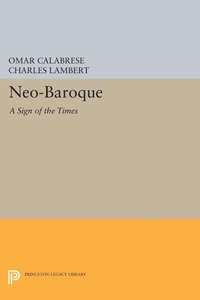
Neo-Baroque
A Sign of the Times
Published on 21. March 2017
Book
Paperback/Softback
252 pages
978-0-691-60713-9 (ISBN)
Description
A leading young Italian semiologist scrutinizes today's cultural phenomena and finds the prevailing taste to be "neo-baroque"--characterized by an appetite for virtuosity, frantic rhythms, instability, poly-dimensionality, and change. Omar Calabrese locates a "sign of the times" in an amazing variety of literary, philosophical, artistic, musical, and architectural forms, from the Venice Biennale through the "new science" to television series, video games, and "zapping" with the remote control device from channel to channel! Calabrese admits that he begins the book with a refusal to distinguish between "Donald Duck and Dante." Avoiding hierarchies or ghettos among works, he takes his readers on a fast-paced expedition through contemporary culture that closes with an elegant essay on evaluation and classical form. According to Calabrese, the enormous quantity of narrative now being produced has led to a new situation: everything has already been said, and everything has already been written. The only way of avoiding saturation has been to turn to a poetics of repetition.
The author shows that pleasure in texts is now produced by tiny variations, and a certain kind of citation from other works has taken on a central importance that would have been unthinkable only a few years ago. In describing this development, and others shared by both avant-garde and mass media, he makes us aware of the rapid shrinkage in the once ample space between "highbrow" and "lowbrow." Originally published in 1992. The Princeton Legacy Library uses the latest print-on-demand technology to again make available previously out-of-print books from the distinguished backlist of Princeton University Press. These editions preserve the original texts of these important books while presenting them in durable paperback and hardcover editions. The goal of the Princeton Legacy Library is to vastly increase access to the rich scholarly heritage found in the thousands of books published by Princeton University Press since its founding in 1905.
The author shows that pleasure in texts is now produced by tiny variations, and a certain kind of citation from other works has taken on a central importance that would have been unthinkable only a few years ago. In describing this development, and others shared by both avant-garde and mass media, he makes us aware of the rapid shrinkage in the once ample space between "highbrow" and "lowbrow." Originally published in 1992. The Princeton Legacy Library uses the latest print-on-demand technology to again make available previously out-of-print books from the distinguished backlist of Princeton University Press. These editions preserve the original texts of these important books while presenting them in durable paperback and hardcover editions. The goal of the Princeton Legacy Library is to vastly increase access to the rich scholarly heritage found in the thousands of books published by Princeton University Press since its founding in 1905.
More details
Series
Language
English
Place of publication
New Jersey
United States
Target group
College/higher education
Professional and scholarly
Product notice
Paperback (trade)
Dimensions
Height: 234 mm
Width: 156 mm
Thickness: 14 mm
Weight
374 gr
ISBN-13
978-0-691-60713-9 (9780691607139)
Copyright in bibliographic data and cover images is held by Nielsen Book Services Limited or by the publishers or by their respective licensors: all rights reserved.
Schweitzer Classification