

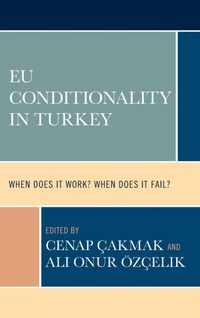
EU Conditionality in Turkey
When Does It Work? When Does It Fail?
Published on 1. August 2022
Book
Hardback
240 pages
978-1-6669-1069-8 (ISBN)
Description
EU Conditionality in Turkey: When Does it Work? When Does it Fail? seeks to address several interconnected questions on the terms, circumstances, and factors that make the dynamics of conditionality work or fail in the case of the European Union-Turkey relationship. Analyzing the areas of disputes and of agreements, the contributions of this edited volume are focused on exploring the strengths and weaknesses of what the conditionality offers or stipulates, and what Turkey, as a candidate state, is capable or incapable of performing in response. Through a detailed analysis of each separate case underlined by the parties involved in the process of Turkey's accession to the EU, the editors and the contributors of this collection expertly infer how, when, and under what conditions the concept of conditionality works or fails.
Reviews / Votes
This volume offers a lucid and insightful analysis of Europeanization and de-Europeanization processes in Turkey in a myriad of policy fields ranging from rule of law, foreign policy, democratization, women's rights to civil society, environmental policy, migration and development aid. It problematizes most of the established discourses on Europeanization and goes beyond the straightjacket of conditionality by fully engaging in both internal and international factors shaping the impact of EU-led processes in Turkey. It also presents a well-balanced analysis of the current stalemate in Turkey-EU relations as well as potential areas of cooperation between the two. This book stands out in the crowded literature of Europeanization and Turkey-EU relations. -- Alper Kaliber, Altinbas University An extremely insightful book aiming to understand the role and evolution of EU conditionality in the age of crises for the EU and Turkey. The book boldly touches upon all hot issues such as the rule of law, democratization, women's rights, migration, environment, and foreign policy in the contested period of de-Europeanization in Turkey-EU relations. It will undoubtedly be essential reading for those interested in Turkey-EU relations, EU enlargement, and Europeanization literature. -- Erhan Icener, Istanbul Sabahattin Zaim University The contributions to this volume explore the limits and obstacles to EU membership conditionality in the case of Turkey through the phases of democratization, proto-Europeanization and de-Europeanization. They analyze different levels from domestic to global across a variety of policy areas to produce a multi-faceted and empirically rich picture of EU-Turkey relations, drawing on a range of theoretical approaches from explanation to critique. An important contribution to the debate about the EU's impact on its neighborhood-and its failures and unintended consequences. -- Thomas Diez, University of TueebingenMore details
Language
English
Place of publication
United States
Publishing group
Bloomsbury Publishing Plc
Target group
Professional and scholarly
Illustrations
9 graphs;
Dimensions
Height: 235 mm
Width: 157 mm
Thickness: 19 mm
Weight
546 gr
ISBN-13
978-1-6669-1069-8 (9781666910698)
Copyright in bibliographic data and cover images is held by Nielsen Book Services Limited or by the publishers or by their respective licensors: all rights reserved.
Schweitzer Classification
Other editions
Additional editions
EU Conditionality in Turkey
When Does it Work? When Does it Fail?
E-Book
08/2022
1st Edition
Lexington Books
€90.99
Available for download
EU Conditionality in Turkey
When Does it Work? When Does it Fail?
E-Book
08/2022
1st Edition
Lexington Books
€90.99
Available for download
Persons
Cenap Cakmak is professor of international law and politics at Anadolu University's Department of International Relations.
Ali Onur OEzcelik is associate professor and a full-time lecturer in the International Relations Department at Eskisehir Osmangazi University.
Ali Onur OEzcelik is associate professor and a full-time lecturer in the International Relations Department at Eskisehir Osmangazi University.
Content
Introduction by Ali Onur OEzcelik and Cenap Cakmak
Chapter 1: Expectations, Benchmarks and Tensions: Exploring Turkey's Political U-Turn from Brussels by Anthony Costello
Chapter 2: The Rule of Law as "Arrested Development": The Turkish Experiment with the Political Condition by Mustafa Yaylali
Chapter 3: The Collapse of Turkey's Three-Pillar Engagement Policy as a Part of Reversed Third Wave by Devrim Sahin and Ahmet Soezen
Chapter 4: A Search for Effective Governance at the Cost of Turkey's EU Democratization Process by Devrim Sahin and Ahmet Soezen
Chapter 5: Turkey on the Frontline between the West and the Middle East: A Buffer State or More? by Devrim Sahin and Ahmet Soezen
Chapter 6: EU Accession Process and Women's Rights in Turkey: The Effects on Family Values and Culture by Cenap Cakmak and Ali Onur OEzcelik
Chapter 7: The EU's Civil Society Conditionality in Turkey: Applying a Gramscian Lens to Procedural Diffusion by Sinem Bal
Chapter 8: EU Conditionality in the Europeanization of Turkish Env
Chapter 1: Expectations, Benchmarks and Tensions: Exploring Turkey's Political U-Turn from Brussels by Anthony Costello
Chapter 2: The Rule of Law as "Arrested Development": The Turkish Experiment with the Political Condition by Mustafa Yaylali
Chapter 3: The Collapse of Turkey's Three-Pillar Engagement Policy as a Part of Reversed Third Wave by Devrim Sahin and Ahmet Soezen
Chapter 4: A Search for Effective Governance at the Cost of Turkey's EU Democratization Process by Devrim Sahin and Ahmet Soezen
Chapter 5: Turkey on the Frontline between the West and the Middle East: A Buffer State or More? by Devrim Sahin and Ahmet Soezen
Chapter 6: EU Accession Process and Women's Rights in Turkey: The Effects on Family Values and Culture by Cenap Cakmak and Ali Onur OEzcelik
Chapter 7: The EU's Civil Society Conditionality in Turkey: Applying a Gramscian Lens to Procedural Diffusion by Sinem Bal
Chapter 8: EU Conditionality in the Europeanization of Turkish Env