

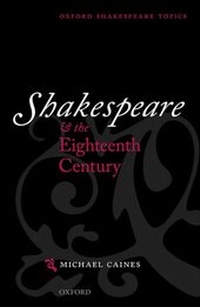
Shakespeare and the Eighteenth Century
Published on 31. October 2013
Book
Hardback
252 pages
978-0-19-964238-0 (ISBN)
Description
OXFORD SHAKESPEARE TOPICS
General Editors: Peter Holland and Stanley Wells
Oxford Shakespeare Topics provide students and teachers with short books on important aspects of Shakespeare criticism and scholarship. Each book is written by an authority in its field, and combines accessible style with original discussion of its subject.
This book considers the impact and influence of Shakespeare on writing of the eighteenth century, and also how eighteenth-century Shakespeare scholarship influenced how we read Shakespeare today.
The most influential English actor of the eighteenth century, David Garrick, could hail Shakespeare as 'the god of our idolatry', yet perform an adaptation of King Lear with a happy ending, add a dying speech to Macbeth, and remove the puns from Romeo and Juliet. Garrick's friend Samuel Johnson thought of Shakespeare as 'above all writers, at least above all modern writers, the poet of nature'. Voltaire thought he was a sublime genius without taste. The Bluestocking Elizabeth Montagu, meanwhile, could be found arguing with Johnson's biographer James Boswell over whether Shakespeare or Milton was the greater poet.
Shakespeare and the Eighteenth Century traces the course of a many-faceted metamorphosis. Drawing on fresh research as well as the most recent scholarship in the field, it argues that the story of Shakespeare in the eighteenth century has become a significant 'subplot' in later scholarship, made up of great debates about how to read Shakespeare and how to rank him among the great English writers, how to perform his plays and how to edit the texts of those plays. This book surveys the critical and creative responses of actors and audiences, literary critics and textual editors, painters and philosophes to Shakespeare's works, while also suggesting how the Shakespeare of the theatre influenced the Shakespeare of the study, and how other, less straightforward interactions combined to bring about this sea-change in English cultural life. It speaks of the crucial role of Shakespeare in eighteenth-century culture, and the importance of that culture's absorption of Shakespeare for subsequent generations. This is a book about what the eighteenth century did to Shakespeare - and vice versa.
General Editors: Peter Holland and Stanley Wells
Oxford Shakespeare Topics provide students and teachers with short books on important aspects of Shakespeare criticism and scholarship. Each book is written by an authority in its field, and combines accessible style with original discussion of its subject.
This book considers the impact and influence of Shakespeare on writing of the eighteenth century, and also how eighteenth-century Shakespeare scholarship influenced how we read Shakespeare today.
The most influential English actor of the eighteenth century, David Garrick, could hail Shakespeare as 'the god of our idolatry', yet perform an adaptation of King Lear with a happy ending, add a dying speech to Macbeth, and remove the puns from Romeo and Juliet. Garrick's friend Samuel Johnson thought of Shakespeare as 'above all writers, at least above all modern writers, the poet of nature'. Voltaire thought he was a sublime genius without taste. The Bluestocking Elizabeth Montagu, meanwhile, could be found arguing with Johnson's biographer James Boswell over whether Shakespeare or Milton was the greater poet.
Shakespeare and the Eighteenth Century traces the course of a many-faceted metamorphosis. Drawing on fresh research as well as the most recent scholarship in the field, it argues that the story of Shakespeare in the eighteenth century has become a significant 'subplot' in later scholarship, made up of great debates about how to read Shakespeare and how to rank him among the great English writers, how to perform his plays and how to edit the texts of those plays. This book surveys the critical and creative responses of actors and audiences, literary critics and textual editors, painters and philosophes to Shakespeare's works, while also suggesting how the Shakespeare of the theatre influenced the Shakespeare of the study, and how other, less straightforward interactions combined to bring about this sea-change in English cultural life. It speaks of the crucial role of Shakespeare in eighteenth-century culture, and the importance of that culture's absorption of Shakespeare for subsequent generations. This is a book about what the eighteenth century did to Shakespeare - and vice versa.
More details
Series
Language
English
Place of publication
Oxford
United Kingdom
Target group
College/higher education
Professional and scholarly
Dimensions
Height: 205 mm
Width: 141 mm
Thickness: 22 mm
Weight
406 gr
ISBN-13
978-0-19-964238-0 (9780199642380)
Copyright in bibliographic data and cover images is held by Nielsen Book Services Limited or by the publishers or by their respective licensors: all rights reserved.
Schweitzer Classification
Other editions
Additional editions
Michael Caines
Shakespeare and the Eighteenth Century
Book
10/2013
Oxford University Press
€31.60
Shipment within 15-20 days
Michael Caines
Shakespeare and the Eighteenth Century
E-Book
10/2013
1st Edition
OUP eBook
€19.49
Available for download
Person
Michael Caines is an editor on the Times Literary Supplement. He has edited an anthology of plays by eighteenth-century women and an anthology about the actor David Garrick, and is a general editor of 'The Works of Nicholas Rowe' (forthcoming).
Content
Introduction ; Cibber's Richard III, Rowe's Works ; Pope versus Theobald ; Macklin's Shylock, Shakespeare's Statue ; Garrick ; Johnson's Plays, Garrick's Jubilee ; As Shakespeare Says ; Shakespeare Abroad ; Unreal 'Shakspeare' ; Shakespeare for Some Time ; Appendix: Chronology of selected eighteenth-century editions of Shakespeare, critical studies, theatrical productions and related events ; Further Reading