

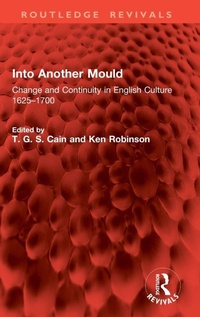
Into Another Mould
Change and Continuity in English Culture 1625-1700
1st Edition
Published on 30. September 2024
Book
Hardback
222 pages
978-1-032-84627-9 (ISBN)
Description
It is widely agreed that the period from 1625 to 1700 witnessed radical shifts in English life and thought. For historians of politics, science, religion, and philosophy, it is a time when the intellectual bases of modern thought and modern institutions were in the process of formation: divine monarchy gave way to contractual monarchy, the 'truths' of received authority gave way to those reached by inductive reasoning.
Although the year 1660 to some extent marks a turning point, this comprehensive and fascinating book, Into Another Mould (originally published in 1992), demonstrates an underlying continuity within the period of Stuart rule. It presents thinkers and writers before and after 1660 responding to similar dilemmas, albeit with different attitudes, methods, and conclusions.
Central to this volume are the related concepts of authority and reason. By looking at the changing attitudes to these two concepts in all spheres of life, it examines the crucial developments of the period and their bearing on the literature. Within this framework, the authors examine social and political history, religious belief and scientific knowledge, and painting, sculpture, and architecture as contexts for the literature of the time. This book will be a beneficial read for students and researchers of English literature, history, and cultural studies.
Although the year 1660 to some extent marks a turning point, this comprehensive and fascinating book, Into Another Mould (originally published in 1992), demonstrates an underlying continuity within the period of Stuart rule. It presents thinkers and writers before and after 1660 responding to similar dilemmas, albeit with different attitudes, methods, and conclusions.
Central to this volume are the related concepts of authority and reason. By looking at the changing attitudes to these two concepts in all spheres of life, it examines the crucial developments of the period and their bearing on the literature. Within this framework, the authors examine social and political history, religious belief and scientific knowledge, and painting, sculpture, and architecture as contexts for the literature of the time. This book will be a beneficial read for students and researchers of English literature, history, and cultural studies.
More details
Series
Language
English
Place of publication
London
United Kingdom
Publishing group
Taylor & Francis Ltd
Target group
College/higher education
Postgraduate
Dimensions
Height: 240 mm
Width: 161 mm
Thickness: 17 mm
Weight
511 gr
ISBN-13
978-1-032-84627-9 (9781032846279)
Copyright in bibliographic data and cover images is held by Nielsen Book Services Limited or by the publishers or by their respective licensors: all rights reserved.
Schweitzer Classification
Other editions
Additional editions
Book
01/2026
1st Edition
Routledge
€49.00
Shipment within 10-20 days
E-Book
09/2024
1st Edition
Routledge
€41.99
Available for download
E-Book
09/2024
1st Edition
Routledge
€41.99
Available for download
Persons
T. G. S. Cain is Emeritus Professor in the Department of English Literature, Language and Linguistics at Newcastle University, UK. His area of expertise is early modern English literature.
Ken Robinson, at the time of the first publication, was Senior Lecturer in English Literature at the University of Newcastle upon Tyne, UK. He is now a psychoanalyst, a member of the British Psychoanalytical Society, an Honorary Member of the Polish Psychoanalytic Psychotherapy Society, and Visiting Professor of Psychoanalysis in Northumbria University.
Ken Robinson, at the time of the first publication, was Senior Lecturer in English Literature at the University of Newcastle upon Tyne, UK. He is now a psychoanalyst, a member of the British Psychoanalytical Society, an Honorary Member of the Polish Psychoanalytic Psychotherapy Society, and Visiting Professor of Psychoanalysis in Northumbria University.
Content
1. Introduction 2. English politics 1625-1700 3. From faith to faith in reason? Religious thought in the seventeenth century 4. The book of nature 5. The visual arts and architecture in Britain 1625-1700 6. Conclusion: another pattern. Seventeenth-century Britain revisited.