

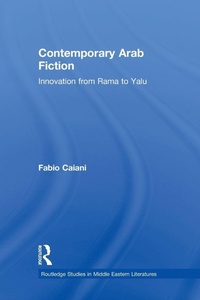
Contemporary Arab Fiction
Innovation from Rama to Yalu
1st Edition
Published on 29. July 2010
Book
Paperback/Softback
192 pages
978-0-415-59937-5 (ISBN)
Description
This book introduces Western readers to some of the most significant novels written in Arabic since 1979. Despite their contribution to the development of contemporary Arabic fiction, these authors remain largely unknown to non-Arab readers.
Fabio Caiani examines the work of the Moroccan Muhammad Barrada; the Egyptian Idwar al-Kharrat; the Lebanese Ilyas Khuri and the Iraqi Fu'ad al-Takarli. Their most significant novels were published between 1979 and 2002, a period during which their work reached literary maturity. They all represent pioneering literary trends compared to the novelistic form canonized in the influential early works of Naguib Mahfouz. Until now, some of their most innovative works have not been analyzed in detail - this book fills that gap.
Relying on literary theory and referring to comparative examples from other literatures, this study places its findings within a wider framework, defining what is meant by innovation in the Arabic novel, and the particular socio-political context in which it appears. This book will significantly enrich the existing critical literature in English on the contemporary Arabic novel.
Fabio Caiani examines the work of the Moroccan Muhammad Barrada; the Egyptian Idwar al-Kharrat; the Lebanese Ilyas Khuri and the Iraqi Fu'ad al-Takarli. Their most significant novels were published between 1979 and 2002, a period during which their work reached literary maturity. They all represent pioneering literary trends compared to the novelistic form canonized in the influential early works of Naguib Mahfouz. Until now, some of their most innovative works have not been analyzed in detail - this book fills that gap.
Relying on literary theory and referring to comparative examples from other literatures, this study places its findings within a wider framework, defining what is meant by innovation in the Arabic novel, and the particular socio-political context in which it appears. This book will significantly enrich the existing critical literature in English on the contemporary Arabic novel.
Reviews / Votes
"The author extensively uses the multi-faceted experience of both European and Arab scholars, avoiding eclecticism and 'simplistic and over-generalized conclusions' (p. 15)... Caiani's study is based on a close textual analysis of the novels that are indicative of the diversity of artistic searches in recent decades, and most of the works analysed by the author are known to a wide western audience through their translation. His monograph not only exposes the formal innovations of the novels by Barrada, al-Kharrat, Khuri and al-Takarli, but also reveals the mechanisms of their creativity. In the last analysis they are connected to problems that offer a perspective for further investigations in the fields of theory and history of Arabic literature." -Baian Rayhanova; Middle Eastern Literatures, 14:2, 213-215 (2011).More details
Series
Language
English
Place of publication
London
United Kingdom
Publishing group
Taylor & Francis Ltd
Target group
College/higher education
Dimensions
Height: 234 mm
Width: 156 mm
Thickness: 11 mm
Weight
304 gr
ISBN-13
978-0-415-59937-5 (9780415599375)
Copyright in bibliographic data and cover images is held by Nielsen Book Services Limited or by the publishers or by their respective licensors: all rights reserved.
Schweitzer Classification
Other editions
Additional editions
E-Book
09/2007
Routledge
€64.49
Available for download
E-Book
09/2007
Routledge
€64.49
Available for download
Book
08/2007
1st Edition
Routledge
€230.50
Shipment within 15-20 days
Person
Fabio Caiani teaches Arabic in the Department of Arabic and Middle East Studies at the University of St. Andrews, UK
Content
Introduction: On Literary Innovation (Part 1) 1. Fragmentation 2. Polyphony 3. Intertextuality 4. Metafiction. Conclusion: On Literary Innovation (Part 2)