

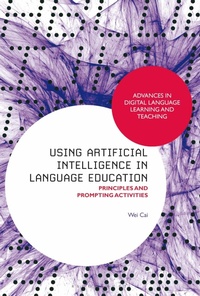
Using Artificial Intelligence in Language Education
Principles and Prompting Activities
Will be published approx. on 6. August 2026
Book
Hardback
296 pages
978-1-350-45716-4 (ISBN)
Description
The book explores principled methodologies for integrating artificial intelligence (AI) into language learning and teaching.
It investigates the features of learner-AI interactions, second language (L2) acquisition theories and teaching methodologies, ChatGPT's role in the development of the four language skills (listening, speaking, reading and writing), ChatGPT's integration with form-focused, meaning-focused and content-based language learning, and individual differences in AI-facilitated learning. The book distinguishes itself by integrating theoretical evidence and practical applications, fostering an in-depth understanding of the application of AI in language education. By blending L2 acquisition theories and traditional pedagogy with the transformative capabilities of AI, this book offers a fresh perspective on language instruction. While the examples drawn on are from the teaching of Chinese and English as L2, the underlying principles, methodologies, and AI applications are relevant and can be directly applied to learning and teaching other languages.
It investigates the features of learner-AI interactions, second language (L2) acquisition theories and teaching methodologies, ChatGPT's role in the development of the four language skills (listening, speaking, reading and writing), ChatGPT's integration with form-focused, meaning-focused and content-based language learning, and individual differences in AI-facilitated learning. The book distinguishes itself by integrating theoretical evidence and practical applications, fostering an in-depth understanding of the application of AI in language education. By blending L2 acquisition theories and traditional pedagogy with the transformative capabilities of AI, this book offers a fresh perspective on language instruction. While the examples drawn on are from the teaching of Chinese and English as L2, the underlying principles, methodologies, and AI applications are relevant and can be directly applied to learning and teaching other languages.
More details
Series
Language
English
Place of publication
London
United Kingdom
Publishing group
Bloomsbury Publishing PLC
Target group
Professional and scholarly
Product notice
Laminated cover
Illustrations
10 bw illus
Dimensions
Height: 234 mm
Width: 156 mm
Thickness: 14 mm
Weight
454 gr
ISBN-13
978-1-350-45716-4 (9781350457164)
Copyright in bibliographic data and cover images is held by Nielsen Book Services Limited or by the publishers or by their respective licensors: all rights reserved.
Schweitzer Classification
Person
Wei Cai is Professor in the School of Languages, Linguistics, Literatures and Cultures at the University of Calgary, Canada.
Content
Chapter 1: Rethinking language learning in the age of GenAI
Chapter 2: Overview of AI in language learning and teaching
Chapter 3: L2 acquisition theories and GenAI affordances
Chapter 4: Principles of purposeful language learning with GenAI
Chapter 5: Learning listening with GenAI
Chapter 6: Learning speaking with GenAI
Chapter 7: Learning reading with GenAI
Chapter 8: Learning writing with GenAI
Chapter 9: Task-based language teaching with GenAI
Chapter 10: Looking ahead: Rethinking language education in the age of GenAI
References
Index
Chapter 2: Overview of AI in language learning and teaching
Chapter 3: L2 acquisition theories and GenAI affordances
Chapter 4: Principles of purposeful language learning with GenAI
Chapter 5: Learning listening with GenAI
Chapter 6: Learning speaking with GenAI
Chapter 7: Learning reading with GenAI
Chapter 8: Learning writing with GenAI
Chapter 9: Task-based language teaching with GenAI
Chapter 10: Looking ahead: Rethinking language education in the age of GenAI
References
Index