

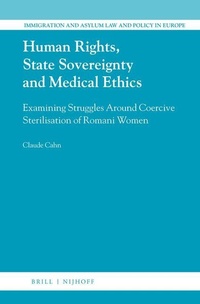
Human Rights, State Sovereignty and Medical Ethics
Examining Struggles Around Coercive Sterilisation of Romani Women
Published on 16. October 2014
Book
Hardback
318 pages
978-90-04-28033-5 (ISBN)
Description
Human Rights, State Sovereignty and Medical Ethics: Examining Struggles Around Coercive Sterilisation of Romani Women examines the mobilized use by people and groups of the international human rights law framework to move legal, policy and ultimately social change at national and local level. One particular case study is examined in detail: efforts by Romani women in the Czech Republic and Slovakia to secure legal remedy for coercive sterilization. International legal aspects of these cases are examined in detail. The book concludes by endeavouring to answer questions concerning the nature of international law and the evolution of the post-World War II international human rights framework, the structure of national sovereignty, and the potential impact of both on human autonomy.
More details
Series
Language
English
Place of publication
Netherlands
Publishing group
Brill
Target group
Professional and scholarly
Product notice
sewn/stitched
Cloth over boards
Dimensions
Height: 241 mm
Width: 161 mm
Thickness: 25 mm
Weight
594 gr
ISBN-13
978-90-04-28033-5 (9789004280335)
Copyright in bibliographic data and cover images is held by Nielsen Book Services Limited or by the publishers or by their respective licensors: all rights reserved.
Schweitzer Classification
Person
Claude Cahn, Ph.D. (2014), Radboud University, Nijmegen, is Human Rights Adviser, United Nations Office of the High Commissioner for Human Rights. He has over twenty years of human rights experience, and is widely published.
Content
Excerpt of table of contents:
Acknowledgements; Abbreviations; Introduction;
Chapter 1 Sovereignty, Autonomy and Right
1.1 Introduction
1.2 National Sovereignty
1.3 National Sovereignty and Personal Autonomy
1.4 National Sovereignty and International Law
1.5 National Sovereignty and International Human Rights Law
1.6 National Sovereignty between Personal Autonomy and the International Human Rights Law Order
1.7 Recovering Autonomy
1.8 Core Dilemmas
Chapter 2 Coercive Sterilization of Romani Women in the Czech and Slovak Republics
2.1 Czechoslovakia
2.2 Domestic Law
2.3 Sterilization as a Component of 'Roma Policy' in Czechoslovakia
2.4 The 1978 Charter 77 Action
2.5 The Pellar/Andrs Report
2.6 The Investigation by the Czechoslovak Prosecutors
2.7 Slovakia
2.8 The Czech Republic
2.9 Conclusion
Chapter 3 Triple Helix: The Jurisprudence of the European Court of Human Rights, Roma and Racial Discrimination
3.1 The Buckley/Chapman/Connors Jurisprudence
3.2 Expulsion
3.3 Discrimination
3.4 Pogrom
3.5 D.H. and Others v. Czech Republic
3.6 Munoz Diaz, and Sejdic and Finci
3.7 Subsequent Judgments on Other Thematic Issues
3.8 Absence
3.9 Some Implications
Chapter 4 Identifying the Harm: Coercive Sterilization on Contested Interpretive Terrain
4.1 Extreme Harms
4.2 Informed Consent as a Core Principle of Human Rights in the Field of Bio-Medicine
4.3 The Council of Europe, Bio-medicine and Human Rights
4.4 Ruling on the Coercive Sterilization of Romani Women
4.5 The Court and International Law: Absorption, Refraction and Transformation of Norms
4.6 Conclusion
Chapter 5 Social Forces and National, Regional and International Human Rights Processes
5.1 Theorizing Social Action in Human Rights
5.2 The Social Field
5.3 Civil Society
5.4 Attention by International and Regional Organisations
5.5 Implications for Social Action in Human Rights
5.6 Conclusions
Conclusions; Summary; Bibliography; Index.
Acknowledgements; Abbreviations; Introduction;
Chapter 1 Sovereignty, Autonomy and Right
1.1 Introduction
1.2 National Sovereignty
1.3 National Sovereignty and Personal Autonomy
1.4 National Sovereignty and International Law
1.5 National Sovereignty and International Human Rights Law
1.6 National Sovereignty between Personal Autonomy and the International Human Rights Law Order
1.7 Recovering Autonomy
1.8 Core Dilemmas
Chapter 2 Coercive Sterilization of Romani Women in the Czech and Slovak Republics
2.1 Czechoslovakia
2.2 Domestic Law
2.3 Sterilization as a Component of 'Roma Policy' in Czechoslovakia
2.4 The 1978 Charter 77 Action
2.5 The Pellar/Andrs Report
2.6 The Investigation by the Czechoslovak Prosecutors
2.7 Slovakia
2.8 The Czech Republic
2.9 Conclusion
Chapter 3 Triple Helix: The Jurisprudence of the European Court of Human Rights, Roma and Racial Discrimination
3.1 The Buckley/Chapman/Connors Jurisprudence
3.2 Expulsion
3.3 Discrimination
3.4 Pogrom
3.5 D.H. and Others v. Czech Republic
3.6 Munoz Diaz, and Sejdic and Finci
3.7 Subsequent Judgments on Other Thematic Issues
3.8 Absence
3.9 Some Implications
Chapter 4 Identifying the Harm: Coercive Sterilization on Contested Interpretive Terrain
4.1 Extreme Harms
4.2 Informed Consent as a Core Principle of Human Rights in the Field of Bio-Medicine
4.3 The Council of Europe, Bio-medicine and Human Rights
4.4 Ruling on the Coercive Sterilization of Romani Women
4.5 The Court and International Law: Absorption, Refraction and Transformation of Norms
4.6 Conclusion
Chapter 5 Social Forces and National, Regional and International Human Rights Processes
5.1 Theorizing Social Action in Human Rights
5.2 The Social Field
5.3 Civil Society
5.4 Attention by International and Regional Organisations
5.5 Implications for Social Action in Human Rights
5.6 Conclusions
Conclusions; Summary; Bibliography; Index.