

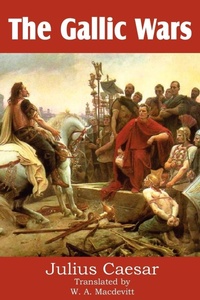
The Gallic Wars
Published on 1. February 2012
Book
Paperback/Softback
170 pages
978-1-61203-436-2 (ISBN)
Description
The Gallic Wars were a series of military campaigns waged by the Roman proconsul Julius Caesar against several Gallic tribes. They lasted from 58 BC to 50 BC and culminated in the decisive Battle of Alesia in 52 BC, in which a complete Roman victory resulted in the expansion of the Roman Republic over the whole of Gaul. The wars paved the way for Julius Caesar to become the sole ruler of the Roman Republic.
Caesar portrayed his invasion of Gaul as being a defensive pre-emptive action, most historians agree that the wars were fought primarily to boost Caesar's political career and to pay off his massive debts. Even so, Gaul was of significant military importance to the Romans, they had been attacked several times by native tribes indigenous to Gaul and further north. Conquering Gaul allowed Rome to secure the natural border of the river Rhine.
More details
Language
English
Product notice
Paperback (trade)
Unsewn / adhesive bound
Dimensions
Height: 229 mm
Width: 152 mm
Thickness: 9 mm
Weight
256 gr
ISBN-13
978-1-61203-436-2 (9781612034362)
Copyright in bibliographic data and cover images is held by Nielsen Book Services Limited or by the publishers or by their respective licensors: all rights reserved.
Schweitzer Classification
Persons
¿Born on July 12, 100 BC, into the patrician gens Julia, Julius Caesar was immersed in Rome's political life from an early age. His family claimed descent from Iulus, son of Aeneas, linking them to divine ancestry. Despite their noble lineage, the Julii Caesares were not particularly influential during the middle republic. ¿Caesar's early career was marked by military service and political maneuvers. He served in Asia and Cilicia, earning the civic crown for his bravery. His return to Rome saw him elected as military tribune and later as quaestor, aligning with popularist factions to challenge the Senate's authority. ¿His ascent continued with his election as pontifex maximus in 63 BC and praetor in 62 BC. As governor of Hispania Ulterior, he achieved military successes that alleviated his debts. Forming the First Triumvirate with Pompey and Crassus, Caesar's influence expanded, leading to his pivotal role in the transformation of the Roman Republic.