

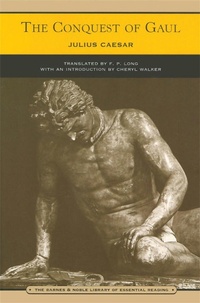
The Conquest of Gaul (Barnes & Noble Library of Essential Reading)
Published on 16. July 2005
Book
Paperback/Softback
288 pages
978-0-7607-6895-2 (ISBN)
Description
Among the most durable and engaging texts in world literature, Julius Caesar's "Conquest of Gaul" tells how he and his legions conquered much of modern France in less than a decade (58-51 BCE), despite determined resistance. Perhaps the most famous Roman ever, Gaius Julius Caesar created a legacy which has resonated, for good or ill, throughout Western culture. Architect of an imperial system, eponymous sponsor of a reformed calendar system, orator second only to Cicero, conqueror of Gaul: Surely those accomplishments in the diverse fields of politics, applied mathematics, rhetoric, and military science would justify his eminence. Nevertheless, the high literary quality and historical value of this seemingly modest account match its exciting story of diplomatic maneuverings, shifting alliances, and military actions; the final chapters culminate in the revolt of the united Gallic tribes under Vercingetorix, France's first national hero, and are as compelling as any contemporary spy thriller.
More details
Series
Edition
Customer-Specific
Language
English
Place of publication
United States
Publishing group
Union Square & Co.
Product notice
Paperback (trade)
Illustrations
maps
Dimensions
Height: 208 mm
Width: 139 mm
Thickness: 22 mm
Weight
289 gr
ISBN-13
978-0-7607-6895-2 (9780760768952)
Copyright in bibliographic data and cover images is held by Nielsen Book Services Limited or by the publishers or by their respective licensors: all rights reserved.
Schweitzer Classification
Persons
Julius Caesar was born in 100 BCE to a distinguished, although not politically prominent, patrician family. During his praetorship (62 BCE) and consulship (59 BCE) Caesar espoused positions and causes which excited great passion. He generated the military forces and political clout which made him, first, a conqueror of the territory from Northern Italy to the far side of the English Channel, then a contender for world dominion in 49 BCE.