

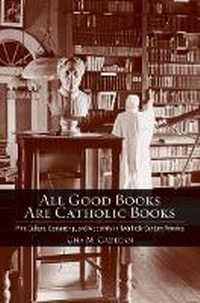
All Good Books Are Catholic Books
Print Culture, Censorship, and Modernity in Twentieth-Century America
Published on 15. September 2013
Book
Hardback
240 pages
978-0-8014-5112-6 (ISBN)
Description
Until the close of the Second Vatican Council in 1965, the stance of the Roman Catholic Church toward the social, cultural, economic, and political developments of the twentieth century was largely antagonistic. Naturally opposed to secularization, skeptical of capitalist markets indifferent to questions of justice, confused and appalled by new forms of high and low culture, and resistant to the social and economic freedom of women-in all of these ways the Catholic Church set itself up as a thoroughly anti-modern institution. Yet, in and through the period from World War I to Vatican II, the Church did engage with, react to, and even accommodate various aspects of modernity. In All Good Books Are Catholic Books, Una M. Cadegan shows how the Church's official position on literary culture developed over this crucial period.
The Catholic Church in the United States maintained an Index of Prohibited Books and the National Legion of Decency (founded in 1933) lobbied Hollywood to edit or ban movies, pulp magazines, and comic books that were morally suspect. These regulations posed an obstacle for the self-understanding of Catholic American readers, writers, and scholars. But as Cadegan finds, Catholics developed a rationale by which they could both respect the laws of the Church as it sought to protect the integrity of doctrine and also engage the culture of artistic and commercial freedom in which they operated as Americans. Catholic literary figures including Flannery O'Connor and Thomas Merton are important to Cadegan's argument, particularly as their careers and the reception of their work demonstrate shifts in the relationship between Catholicism and literary culture. Cadegan trains her attention on American critics, editors, and university professors and administrators who mediated the relationship among the Church, parishioners, and the culture at large.
The Catholic Church in the United States maintained an Index of Prohibited Books and the National Legion of Decency (founded in 1933) lobbied Hollywood to edit or ban movies, pulp magazines, and comic books that were morally suspect. These regulations posed an obstacle for the self-understanding of Catholic American readers, writers, and scholars. But as Cadegan finds, Catholics developed a rationale by which they could both respect the laws of the Church as it sought to protect the integrity of doctrine and also engage the culture of artistic and commercial freedom in which they operated as Americans. Catholic literary figures including Flannery O'Connor and Thomas Merton are important to Cadegan's argument, particularly as their careers and the reception of their work demonstrate shifts in the relationship between Catholicism and literary culture. Cadegan trains her attention on American critics, editors, and university professors and administrators who mediated the relationship among the Church, parishioners, and the culture at large.
Reviews / Votes
Cadegan adds to the body of recent scholarship that seeks to explain the complex relationship between American Catholicism and American intellectual culture in the years leading up to the Second Vatican Council.... This is a thought-provoking and inventive book.- Arnold Sparr (The Catholic Historical Review) The clash of religious faith with Enlightenment thought is the great drama of modern Western intellectual history. Una M. Cadegan's All Good Books Are Catholic Books recounts a particularly fractious and fascinating moment in that epic saga, the struggle of American Catholics-lay and religious, faithful and lapsed-with modernity. In particular, Cadegan aims to demonstrate that 'literature and literary culture played a key role' in this encounter, allowing Catholics neither to acquiesce to nor fully resist the moral, cultural, and intellectual developments of the age, but rather accommodate them, ultimately, 'on their own terms.' Cadegan refreshingly refuses to cast the Roman Catholic Church as villain in a larger tale of intellectual and spiritual liberation. Cadegan makes revealing connections throughout between theology and other intellectual work. For those seeking to understand Catholic literary culture in the twentieth century, and the Catholic encounter with American modernity more broadly, there is no better place to start.
- Matthew S. Hedstrom (American Historical Review) Trying to embrace the subject of American Catholic literary culture in the twentieth century can stretch a researcher to her fingertips. Una M. Cadegan shows her range in ably canvassing a broad swath of writers and critical commentators who left their mark between World War I and the immediate aftermath of the Second Vatican Council (1962-1965).
(Journal of American History)
More details
Series
Language
English
Place of publication
Ithaca
United States
Product notice
Paper over boards
Dimensions
Height: 235 mm
Width: 155 mm
Thickness: 21 mm
Weight
907 gr
ISBN-13
978-0-8014-5112-6 (9780801451126)
Copyright in bibliographic data and cover images is held by Nielsen Book Services Limited or by the publishers or by their respective licensors: all rights reserved.
Schweitzer Classification
Other editions
Additional editions
Una M. Cadegan
All Good Books Are Catholic Books
Print Culture, Censorship, and Modernity in Twentieth-Century America
E-Book
09/2013
Cornell University Press
€34.49
Available for download
Person
Una M. Cadegan is Associate Professor of History at the University of Dayton.
Content
Introduction: The Cultural Work of Catholic Literature1. U.S. Catholic Literary Aesthetics2. Modernisms Literary and Theological3. Declining Oppositions4. The History and Function of Catholic Censorship, as Told to the Twentieth Century5. Censorship in the Land of "Thinking on One's Own"6. Art and Freedom in the Era of "The Church of Your Choice"7. Reclaiming the Modernists, Reclaiming the Modern8. Peculiarly Possessed of the Modern ConsciousnessEpilogue: The Abrogation of the IndexNotes
Index
Index