

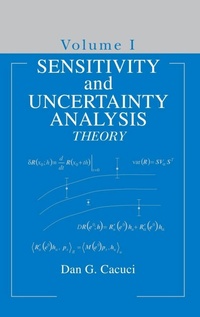
Sensitivity & Uncertainty Analysis, Volume 1
Theory
1st Edition
Published on 28. May 2003
Book
Hardback
304 pages
978-1-58488-115-5 (ISBN)
Description
As computer-assisted modeling and analysis of physical processes have continued to grow and diversify, sensitivity and uncertainty analyses have become indispensable investigative scientific tools in their own right. While most techniques used for these analyses are well documented, there has yet to appear a systematic treatment of the method based on adjoint operators, which is applicable to a much wider variety of problems than methods traditionally used in control theory. This book fills that gap, focusing on the mathematical underpinnings of the Adjoint Sensitivity Analysis Procedure (ASAP) and the use of deterministically obtained sensitivities for subsequent uncertainty analysis.
More details
Language
English
Place of publication
Oxford
United States
Publishing group
Taylor & Francis Inc
Target group
Professional and scholarly
Illustrations
5 s/w Abbildungen
5 Illustrations, black and white
Dimensions
Height: 240 mm
Width: 161 mm
Thickness: 21 mm
Weight
622 gr
ISBN-13
978-1-58488-115-5 (9781584881155)
Copyright in bibliographic data and cover images is held by Nielsen Book Services Limited or by the publishers or by their respective licensors: all rights reserved.
Schweitzer Classification
Other editions
Additional editions
E-Book
05/2003
1st Edition
Chapman and Hall
€225.99
Available for download
E-Book
05/2003
1st Edition
Chapman and Hall
€225.99
Available for download
Person
Content
As computer-assisted modeling and analysis of physical processes have continued to grow and diversify, sensitivity and uncertainty analyses have become indispensable investigative scientific tools in their own right. While most techniques used for these analyses are well documented, there has yet to appear a systematic treatment of the method based on adjoint operators, which is applicable to a much wider variety of problems than methods traditionally used in control theory. This book fills that gap, focusing on the mathematical underpinnings of the Adjoint Sensitivity Analysis Procedure (ASAP) and the use of deterministically obtained sensitivities for subsequent uncertainty analysis.